
Join Low Voltage Nation — Find project opportunities and showcase your company to thousands of industry professionals
Prime Data Centers has broken ground on SMF02 in Sacramento, with Clune named as general contractor, SMUD utility context, BKF engineering evidence, and a clear low-voltage watchlist.
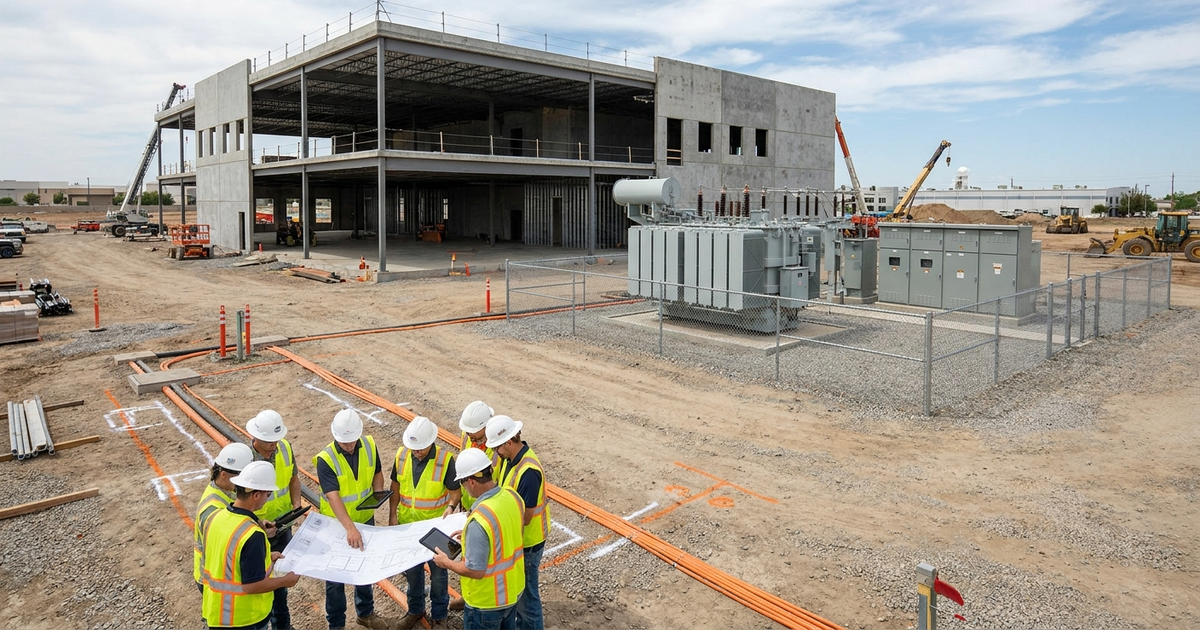
Prime Data Centers has moved its second Sacramento facility from planning into construction. The owner announced the groundbreaking for SMF02 on May 7, 2026, describing a 150,000-square-foot data center with 18 MW of critical IT load designed for AI and high-performance-computing demand. For low-voltage contractors, integrators, fiber teams, and mission-critical service providers, the important part is not just that another AI-ready campus is coming online. The important part is that several upstream roles are already public, while many specialty package names are not.
The public map starts with Prime as owner and developer, Clune Construction Company as general contractor, Sacramento Municipal Utility District as the utility provider, and BKF Engineers tied to civil engineering, surveying, SWPPP, utility design, entitlement support, construction documentation, public utility laterals, and construction administration. Sacramento County also has a public CEQA record for the data-center expansion at McClellan Park. That gives LVN a stronger project signal than a generic market rumor: a named owner, named GC, utility context, public approval trail, engineering support, job counts, and a facility profile built around AI/HPC loads.
| Fact | Public Detail |
|---|---|
| Project | Prime Data Centers SMF02, the second facility on Prime's Sacramento / McClellan Park campus. |
| Location | 2408 AK Street, McClellan Park / North Highlands, Sacramento County, California. |
| Scale | Prime describes SMF02 as 150,000 square feet and 18 MW of critical IT load. |
| Campus Context | Prime's Sacramento campus page lists two enterprise data centers totaling 26 MW and 215,000 square feet. |
| Status | Groundbreaking was announced May 7, 2026; Prime lists SMF01-02 as under construction. |
| Jobs | Prime says construction will support about 250 construction jobs and roughly 30 permanent operations jobs. |
Why This Is More Than A Real Estate Announcement
Data-center construction has a habit of looking simple from the outside: land, power, shells, cooling, and racks. The low-voltage reality is more layered. An AI/HPC facility needs redundant pathways, clean fiber documentation, carrier coordination, security coverage, life-safety interfaces, controls integration, network spaces, labeling, testing, commissioning support, and turnover records that survive serious operations review. Prime's own Sacramento campus page points to SMUD utility service, an onsite substation, closed-loop air and liquid cooling, comprehensive layered security, and 10 carriers nearby. Those phrases are not contractor awards by themselves, but they help define the systems LVN should be watching as the project moves through shell, MEP, utility, and commissioning work.
The public CEQA record adds useful construction context. The California CEQA notice of determination lists Sacramento County as lead agency, a February 5, 2026 approval date, and a February 25, 2026 posting date. The record describes a new two-story data center, an administration building, a generator building, parking, landscaping, and related entitlement work. That confirms this is not only a press-release concept. It is a locally approved construction package with site, building, utility, and support-infrastructure implications.
| Company | Public Role | Evidence |
|---|---|---|
| Prime Data Centers | Owner, operator, and developer | Official SMF02 groundbreaking and Sacramento campus pages. |
| Clune Construction Company | General contractor named by Prime | Prime names Clune; Clune also documents mission-critical construction capability. |
| SMUD | Utility provider named by Prime | Prime identifies SMUD service; SMUD documents its Sacramento-area utility role. |
| BKF Engineers | Civil, survey, SWPPP, utility, entitlement, and construction-support work | BKF project page for Prime Data Center SMF01-02. |
| Sacramento County / CEQA | Public approval and environmental record path | Notice of determination for the McClellan Park data-center expansion. |
| Connect CRE | Secondary construction coverage | Trade coverage confirming the second Sacramento facility, 150,000 square feet, and 18 MW. |
The Low-Voltage Watchlist
No reviewed public source names the electrical contractor, low-voltage contractor, fiber/OSP contractor, structured cabling contractor, security integrator, fire alarm contractor, BAS/BMS controls integrator, DAS or facility-network partner, grounding and bonding specialty team, or commissioning agent. That should keep the industry from making unsupported claims. It also creates a clean watchlist. Once Clune and Prime move deeper into subcontracting, the next useful evidence may show up through subcontractor prequalification, bid-list references, local permits, inspection records, project pages, job postings, utility coordination notes, vendor case studies, or commissioning roles.
| Scope | Why It Matters | Signals To Watch |
|---|---|---|
| Fiber and OSP | AI/HPC facilities depend on diverse carrier paths, clean entrances, campus backbone, and tested fiber documentation. | Carrier mentions, duct-bank work, utility laterals, MMR/IDF references, OSP contractors, and fiber test requirements. |
| Structured Cabling | Data halls, network rooms, security systems, controls, and support spaces all need disciplined pathways and labeling. | Cable tray, rack/row buildout, labeling standards, copper/fiber testing, and turnover documentation. |
| Access Control and CCTV | Prime markets layered security, and mission-critical sites need perimeter, building, loading, and restricted-area coverage. | Security integrator awards, access hardware, VMS, cameras, mantrap references, and commissioning scope. |
| Fire Alarm and Life Safety | Generator buildings, data halls, support spaces, and suppression interfaces create coordination-heavy FA work. | AHJ reviews, fire alarm permits, monitoring, suppression interfaces, inspection milestones, and special inspections. |
| BMS/BAS and Facility Networks | Closed-loop cooling, power monitoring, alarms, and operations networks require controls integration and documentation. | Controls integrator roles, trend logs, alarm integration, IT/OT boundaries, commissioning, and turnover packages. |
| DAS and Grounding/Bonding | Large hardened facilities often require in-building wireless/public-safety coverage and disciplined telecom bonding. | DAS design, carrier/public-safety radio coordination, bonding specs, test records, and QA signoff. |
Jobs, Skills, And Practical Positioning
Prime's construction-job count gives this project a workforce angle, but LVN readers should look past the headline number. Mission-critical sites reward crews that can work cleanly under documentation pressure. Fiber techs need termination, cleaning, testing, and labeling discipline. Cabling teams need pathway coordination, tray awareness, cable management, and as-built accuracy. Security and life-safety teams need clean coordination with general construction, electrical rooms, site access, AHJs, and commissioning schedules. Controls and network teams need to understand how facility systems touch operations without overstepping IT boundaries.
Useful training references for this kind of work include BICSI Installer 2, Optical Fiber, BICSI Installer 2, Copper, FOA fiber workforce resources, and OSHA outreach training. Certifications are not a substitute for site experience, but they help technicians speak the language of testing, documentation, safety, and standards. On data-center projects, that language matters.
Why Timing Matters For LV Contractors
The best low-voltage opportunities usually appear before a project has a neat public subcontractor list. By the time a data center is fully framed as an opening-day technology story, the important trade relationships may already be set. SMF02 is still useful because the evidence is early enough to act on but strong enough to avoid speculation. Prime has announced the build, Clune is named, public records show the approval path, and the campus page gives enough facility context to understand the likely systems without inventing package awards.
For vendors, that means the immediate work is account mapping. Identify the owner-side procurement path, the GC's mission-critical subcontracting process, local permit and inspection cadence, utility and public-works touchpoints, and the job titles that start appearing around the site. Look for project language that ties directly to SMF02, SMF01-02, McClellan Park, North Highlands, 2408 AK Street, SVO Building Two LLC, or PLNP2024-00238. A generic Sacramento data-center post is weaker than a source that connects one of those names to fiber, security, controls, fire alarm, commissioning, or structured cabling.
For technicians, the lesson is similar. AI data-center work puts pressure on fundamentals. A crew that can terminate and test fiber is useful. A crew that can document every link, clean every connector, label consistently, coordinate around energized work, follow site access rules, and hand over test results in the format the commissioning team expects is more useful. That is where training, repeatable QA, and field documentation become business development tools instead of back-office tasks.
What Contractors Should Do Now
The right move is to map the account before the obvious specialty awards are everywhere. Follow Prime's Sacramento campus updates, Clune's mission-critical procurement signals, Sacramento County permit activity, SMUD utility milestones, BKF project references, and local job postings tied to SMF02, SMF01-02, McClellan Park, North Highlands, 2408 AK Street, SVO Building Two LLC, or PLNP2024-00238. Keep the project distinct from Prime's PHX01 Avondale campus, the existing SMF01 facility, and unrelated Sacramento airport references that also use the SMF shorthand.
The low-voltage opportunity is not guaranteed to be visible all at once. It will probably appear in layers: civil and utility movement, then building systems, then security and life-safety coordination, then structured cabling, carrier routes, facility networks, and commissioning closeout. That is exactly why LVN Signal tracks the construction layer instead of waiting for a polished opening-day announcement. For contractors, vendors, and technicians, the useful information is the project map while the work is still forming.
LVN take: Prime SMF02 is a high-confidence AI data-center construction signal. The owner, GC, utility, engineer, public approval path, capacity, square footage, and job counts are source-backed. The low-voltage specialty firms are not public yet. That makes fiber, OSP, structured cabling, access control, CCTV, fire alarm, BMS/BAS, networking, DAS, grounding, testing, labeling, and commissioning the practical watchlist.
Join 35,000+ Low Voltage Pros
Get weekly permit updates, tool deals, job opportunities, and industry news. No spam, unsubscribe anytime.