
Join Low Voltage Nation — Find project opportunities and showcase your company to thousands of industry professionals
Prime Data Centers has started the first three buildings at its 240 MW PHX01 campus in Avondale. Here is what low-voltage contractors should track next.
Prime's PHX01 build is a real construction signal, not just another AI headline
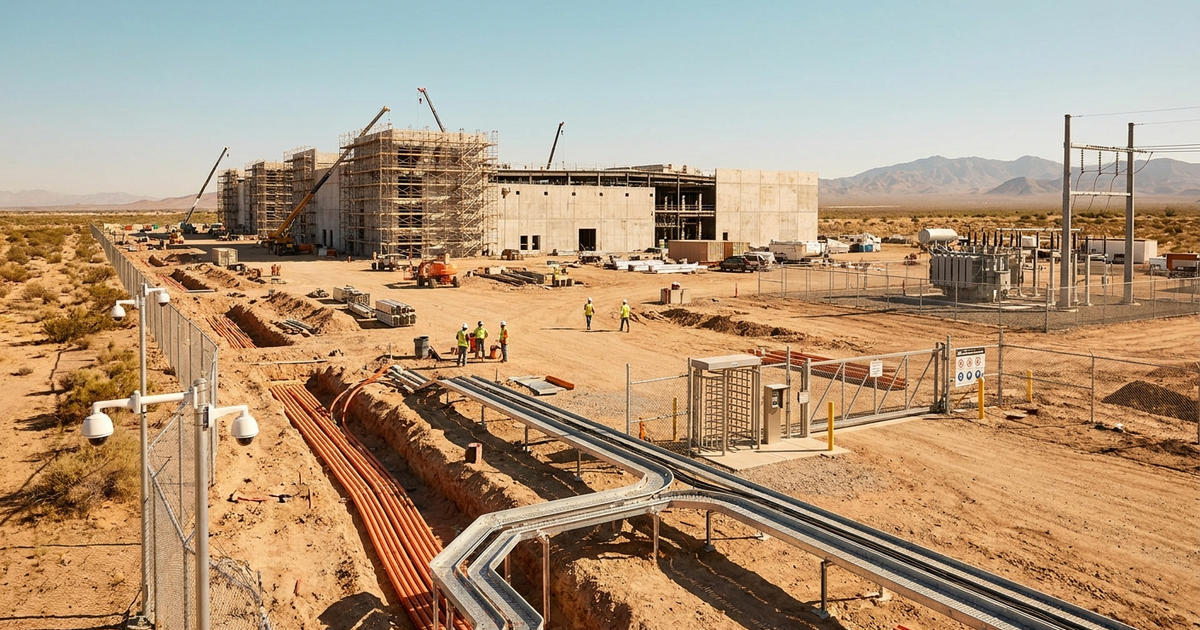
Prime Data Centers has moved the first phase of its PHX01 Phoenix campus from plan to construction in Avondale, Arizona. The company announced that it broke ground on the first three data centers at a five-building, 240 megawatt campus designed for AI-ready digital infrastructure and high-performance computing. Prime's announcement says each of the first three buildings is planned at 267,000 square feet and 48 megawatts of critical IT load, which puts the opening phase at 144 megawatts before the final two buildings are added. Prime's Business Wire release is the primary source for the construction start, the first-three-building phase, the $3 billion-plus investment, the ARCO/Murray construction quote, the dedicated substation, and the AI/HPC positioning.
The project matters for Low Voltage Nation because PHX01 is not a small edge site or a paper concept. Prime's own Phoenix campus page describes a 66.5-acre campus with five hyperscale data centers, 1.3 million square feet, 20 data halls, SRP as the utility provider, an on-site substation, multiple carriers in proximity, comprehensive layered security, closed-loop cooling, and projected SOC2 Type II and ISO 27001 compliance. Those details point directly at the field systems low-voltage contractors understand: outside plant, carrier entrances, fiber backbone, pathway coordination, access control, CCTV, fire alarm interfaces, BAS/BMS integration, DAS, network handoff rooms, labeling, testing, commissioning support, and documentation.
There is also named construction evidence. ARCO/Murray's Prime Data Centers project page lists a mission critical project in Arizona tied to 48 megawatts per building and site development, mass grading, and full underground coordination across civil, MEP, and structural disciplines on a 240 critical megawatt campus. Prime's release quotes Brent Jordan, Vice President at ARCO/Murray, on planning, collaboration, safety, and execution. That does not name every subcontractor yet, but it is enough to mark the campus as an active construction opportunity worth tracking.
| Project | Public detail | Why it matters |
|---|---|---|
| Campus | Five-building PHX01 campus in Avondale, Arizona | Multi-phase work creates recurring package and refresh signals. |
| Capacity | 240 MW total critical power; 144 MW in first three buildings | Large power and cooling scale usually means serious controls, security, and commissioning discipline. |
| Size | 1.3 million square feet across 66.5 acres | Big campus footprint increases OSP, pathway, entrance, and labeling complexity. |
| Status | Buildings 1-3 under construction; buildings 4-5 still available/development | Early phase is live while later phases can still create future vendor openings. |
| Customer signal | First three buildings secured by an unnamed hyperscaler | Hyperscale tenant requirements raise QA, documentation, security, and uptime expectations. |
What has been confirmed publicly
Prime says the full PHX01 campus will have infrastructure galleries for data hall privacy, concurrently maintainable mechanical and electrical systems, multiple carriers, comprehensive layered security, renewable energy commitments, and closed-loop cooling designed for zero process water use during operations. That is useful because low-voltage work is often hidden behind broad construction language. Here, the public project page gives enough detail to separate likely low-voltage packages from speculation.
Data Center Dynamics corroborated the May 2026 construction start, the three-of-five-building phase, the 267,000-square-foot building size, the 48 megawatts per building, the 250 megawatt substation, and the 3700 S. Avondale Boulevard site. Commercial Property Executive also covered the first-phase construction start, the $3 billion investment, the 1.3 million-square-foot plan, the 240 megawatt campus, the leading hyperscaler lease signal, and the on-site 250 megawatt substation. Those trade sources are secondary to Prime and ARCO/Murray, but they strengthen the construction context and confirm that the first phase is being treated as a major Phoenix-market development.
| Company or agency | Public role | Source-backed note |
|---|---|---|
| Prime Data Centers | Owner, developer, operator | Announced groundbreaking and lists PHX01 campus specs. |
| ARCO/Murray | Construction partner | Named in Prime's release and maintains a Prime project page. |
| SRP | Utility provider | Listed by Prime for the Phoenix campus. |
| City of Avondale | Local municipality | Mayor Mike Pineda is quoted in Prime's announcement. |
| Unnamed hyperscaler | Tenant/customer signal | Buildings 1-3 are publicly described as secured. |
Where low-voltage contractors should pay attention
The cleanest read is that PHX01 is a campus-scale opportunity for contractors and technicians who can work inside disciplined mission-critical construction. The public sources do not name a low-voltage subcontractor, fiber contractor, security integrator, fire alarm contractor, controls integrator, commissioning agent, or DAS provider. That gap is the point. Those names often surface later through subcontractor announcements, bid lists, permit records, job postings, vendor pages, or project photos. LVN Signal should treat PHX01 as an active watch target because the first phase is live and the later buildings are not fully absorbed yet.
Fiber and outside plant are the first obvious tracks. Prime lists multiple carriers in proximity and a large campus footprint. A five-building campus normally needs diverse entries, duct banks, vaults, carrier coordination, meet-me or network rooms, structured pathways, test documentation, and careful turnover records. The public sources do not name the carriers, but the phrase is enough to flag connectivity as a real watch item.
Security is another strong track. Prime describes comprehensive layered security. On a hyperscale campus, that can mean perimeter surveillance, access control, secure portals, badging, video management, visitor workflows, loading-area coverage, equipment-yard visibility, and operations security. No public source names the security integrator, so LVN should not fill that blank. The action item is to watch for integrator hiring, access control hardware, VMS references, and commissioning or service roles tied to Avondale.
Controls and life-safety interfaces are also likely to matter. Prime calls out closed-loop air and liquid cooling, concurrently maintainable mechanical and electrical systems, and high-density AI/HPC workloads. Data halls at this scale depend on monitoring, alarms, integration boundaries, controls documentation, sequence testing, fire alarm interfaces, and turnover packages. For a low-voltage contractor, that is a reminder that the work is not only pulling cable. It is pathway discipline, documentation, labeling, test results, commissioning coordination, and site safety.
| System | Why PHX01 points to it | What to watch |
|---|---|---|
| Fiber and OSP | Multiple carriers and a large multi-building campus | Carrier entrances, duct banks, vaults, test reports, and fiber contractor names |
| Structured cabling | 20 data halls and hyperscale tenant requirements | Pathways, labeling, rack/row support, QA, and turnover documentation |
| Access control and CCTV | Prime cites comprehensive layered security | Integrator awards, VMS references, camera packages, and secure-area controls |
| Fire alarm and life safety | Large data halls and AHJ-driven commissioning needs | FA contractor, inspections, monitoring, and interface scope |
| BAS/BMS controls | Closed-loop cooling and concurrently maintainable M&E systems | Controls integrator, trend logs, alarms, commissioning, and handoff documents |
| DAS and wireless | Large hardened buildings and emergency response needs | Public-safety coverage, carrier coordination, and in-building wireless design |
Jobs, skills, and what techs can do now
Prime and Avondale describe new jobs and long-term regional growth, but the public sources reviewed for this packet did not give a specific construction-job count. That means the responsible read is to keep the job count unknown while tracking the project for subcontractor hiring and package movement. For techs, the PHX01 story is still actionable: the market is rewarding people who can pass background and site access requirements, work safely around mission-critical construction, follow drawings, keep labels clean, produce usable test records, coordinate with electrical and mechanical teams, and survive commissioning without sloppy handoff work.
Training and credential paths matter here. Fiber technicians should understand inspection, cleaning, testing, documentation, and standards language. Copper and pathway techs should be comfortable with labeling, bend radius, grounding and bonding coordination, as-builts, and QA signoff. Security and controls technicians should be able to speak in commissioning terms, not just device installation terms. Useful public resources include BICSI optical fiber installer training, the FOA workforce training resources, and OSHA outreach training for the safety side of construction site work.
| Trade lane | Useful skill | Why it matters |
|---|---|---|
| Fiber | Cleaning, inspection, testing, and documentation | Hyperscale campuses punish bad handoffs and weak test records. |
| Security | Access control, CCTV, VMS, and secure-area workflows | Layered security is a named project feature. |
| Controls | BAS/BMS coordination and commissioning language | Cooling, alarms, and operations data need clean integration. |
| Life safety | Fire alarm interfaces and AHJ coordination | Large mission-critical facilities require clean inspection paths. |
| OSP | Duct banks, vaults, carrier entrances, and route diversity | Multiple carriers and campus scale create outside-plant work. |
Bottom line for LVN Signal
PHX01 is a high-confidence Signal project because it has a primary owner announcement, a live Prime campus page, a named construction partner, and multiple independent construction and real estate trade confirmations. The low-voltage contractor opportunity is not a single named bid package yet. It is a set of watch signals around a campus that is already under construction: carrier and OSP movement, security integrator names, controls and commissioning roles, fire alarm work, DAS or public-safety wireless requirements, and the subcontractor network around ARCO/Murray's mission-critical delivery.
LVN Signal is built for this exact window. By the time every subcontractor is obvious, the best early positioning may already be gone. Contractors, vendors, recruiters, and technicians can use LVN Signal to follow data-center projects, named companies, low-voltage systems, and the practical field signals that turn AI infrastructure headlines into work.
Join 35,000+ Low Voltage Pros
Get weekly permit updates, tool deals, job opportunities, and industry news. No spam, unsubscribe anytime.