
Join Low Voltage Nation — Find project opportunities and showcase your company to thousands of industry professionals
Prime ORD01-01 is a 72 MW, 384,000-square-foot CoreWeave facility with three of six halls operating, Clune leading construction, and ComEd's onsite substation still shaping final delivery.
Prime Data Centers' ORD01-01 in Elk Grove Village, Illinois is no longer just a proposed Chicago-area campus. Prime's current ORD01 facility page identifies 1650 E Higgins Road as a leased, operational 72 MW, 384,000-square-foot hyperscale data center with liquid cooling. The important construction story is that delivery remains phased: a June 2026 S&P Global Ratings analysis said three of six data halls were operating at May 31, a fourth hall was expected in August, and the last two halls were still moving through construction and long-term-power milestones.
That combination makes ORD01-01 a live low-voltage opportunity rather than a finished-building retrospective. Some systems are already supporting production loads, while remaining halls, the onsite substation, liquid-cooling interfaces, permanent power, documentation, testing, and final turnover still create work surfaces. Public sources name the owner, AI-cloud tenant, general contractor, utility, and a design partner. They do not yet name the specialty electrical, fiber, structured-cabling, security, fire-alarm, controls, wireless, grounding, or commissioning firms.
| Project fact | Source-backed detail | Reporting boundary |
|---|---|---|
| Facility | ORD01-01, 1650 E Higgins Rd | One building in a larger campus. |
| Current scale | 72 MW / 384,000 sq ft | Do not substitute campus totals. |
| Data halls | Six halls; phased operation | Final operation depends on power. |
| Tenant | CoreWeave, 15-year lease | Tenant is not project owner. |
| Construction | Clune GMP contract | Specialty package holders unknown. |
| Power | ComEd onsite substation | Bridge power supports early halls. |
The facility and campus numbers must remain separate. Prime currently markets the three-building Chicago campus at 270 MW and 958,000 square feet. ORD01-01 is the 72 MW, 384,000-square-foot facility leased to CoreWeave. Clune's project page uses an older campus frame of about 1.03 million square feet and describes its first building at roughly 380,141 square feet. Those figures reflect different dates and scope frames; they should not be blended into a false single value.
The same caution applies to money. S&P says Elk Grove Village Property LLC issued $900 million of senior secured notes. That is project financing used to refinance construction debt, fund remaining work and reserves, and support the capital structure. It is not a verified ORD01-01 construction-cost figure. Prime's 2022 groundbreaking announcement described a roughly $1 billion investment across the full three-building campus. The financing and campus-investment numbers answer different questions.
S&P's schedule detail is unusually useful for contractors. Construction spending was reported at roughly 75% complete at May 31, 2026. Three halls were operating, hall four was expected in August, and construction completion for halls five and six was expected in December. Full operation of those last halls was tied to long-term utility power expected in the second quarter of 2027, unless additional bridge power can be secured sooner. Dates are forecasts, not guarantees, but they define the current pursuit window.
| Organization | Source-backed role | Practical boundary |
|---|---|---|
| Prime Data Centers | Owner / developer / operator | Completion guarantor. |
| CoreWeave | AI-cloud tenant | 15-year triple-net lease. |
| Clune Construction | GMP general contractor | Specialty awards not disclosed. |
| ComEd | Utility / substation builder | Long-term power critical path. |
| Gensler | Groundbreaking project partner | Exact phase scope not stated. |
| Elk Grove Village | Land-use authority | Plat and zoning record source. |
Prime separately acquired material equipment on an owner-furnished, contractor-installed basis, according to the rating analysis. That matters because interface risk can sit between owner procurement, GC installation, equipment vendors, controls integrators, commissioning teams, and the tenant's operational requirements. A contractor should not assume every remaining equipment or integration scope is carried inside one conventional subcontract.
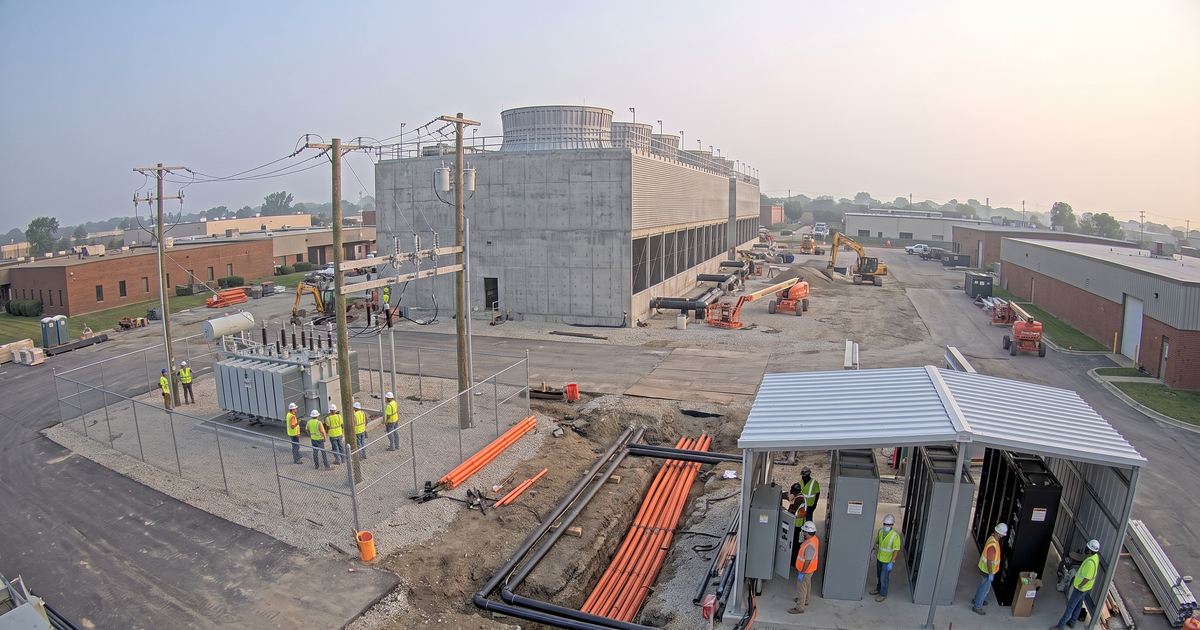
The onsite substation is the clearest critical path. ComEd began substation construction in March 2026, while bridge power supported the first four halls. Substation protection and control communications, relays, metering, alarms, time synchronization, SCADA, EPMS, OT networking, cybersecurity boundaries, grounding, and integrated testing all have to connect utility infrastructure with facility operations. Current sources prove the substation work and utility role but do not identify the specialty communications, controls, or commissioning vendors.
Liquid cooling creates another dense systems boundary. Prime markets ORD01-01 as liquid-cooled and AI-ready. That increases the importance of BAS/BMS points, leak detection, environmental sensors, pump and valve status, equipment telemetry, alarming, network segmentation, power-and-cooling correlation, sequence validation, and failure-mode testing. It does not prove which vendor architecture CoreWeave uses or which contractor owns those interfaces.
| Low-voltage lane | Why it matters now | Watch signal |
|---|---|---|
| Fiber / OSP | AI tenant and carrier-rich campus | Entrances, splicing, OTDR, diversity. |
| Structured cabling | Remaining hall and support fit-out | Pathways, copper, fiber, certification. |
| Access / CCTV | Layered operational security | Badging, VMS, gates, turnover. |
| Fire alarm | Phased occupancy and liquid systems | Interfaces, acceptance, monitoring. |
| BMS / EPMS / SCADA | Cooling and permanent-power integration | Point lists, OT networks, sequences. |
| DAS / wireless | Large hardened building coverage | Public-safety and carrier testing. |
| Grounding | Substation, racks and telecom | Responsibility matrix and test records. |
| Commissioning | Six-hall phased turnover | Scripts, witnesses, issue closure. |
The fiber opportunity extends beyond compute interconnects. Carrier entrances, meet-me spaces, backbone routes, diverse pathways, operations networks, security, controls, wireless systems, monitoring, and interbuilding connectivity require documented coordination. Prime says the campus has proximity to 17 carriers. That is market context, not proof that all 17 are contracted to ORD01-01, but it reinforces why pathway diversity, labeling, splicing, cleanliness, optical testing, and as-built discipline matter.
Physical security is also a turnover problem, not just an installation package. Temporary construction access has to become an operational credentialing environment without leaving gaps. Contractors should watch for gates, visitor management, badging, camera coverage, VMS, intercom, intrusion detection, equipment-yard coverage, security networking, and the handoff of identities and procedures to Prime and CoreWeave operations. Public sources describe comprehensive layered security but do not name the integrator.
Fire and life safety must follow phased occupancy. Remaining halls, liquid-cooling systems, support spaces, generator and electrical areas, and substation interfaces can create separate permitting and acceptance events. Useful signals include fire-alarm permits, suppression interfaces, emergency communications, cause-and-effect matrices, monitoring, public-safety radio testing, fire-marshal acceptance, and integrated systems testing. The current public record does not resolve those package awards.
Commissioning will determine whether completed construction becomes reliable tenant capacity. The final halls depend on both physical completion and power availability. That creates demand for structured prefunctional checks, sequence testing, failure scenarios, controls tuning, protection and metering verification, alarm routing, network validation, witness records, deficiency management, and clean closeout. Teams with evidence of mission-critical turnover discipline are more useful than teams that only advertise installation volume.
Workforce preparation should stay practical. Relevant resources include BICSI optical-fiber training, FOA workforce resources, and OSHA outreach training. Useful capabilities include fiber inspection and cleaning, OTDR and loss testing, copper certification, labeling standards, grounding and bonding, pathway coordination, BIM, lift and site safety, commissioning documentation, and data-center change control. These are preparation resources, not stated ORD01-01 contract requirements.
A credible pursuit package should identify the exact lane a contractor can own. Show regional labor depth, safety performance, project-management capacity, mission-critical references, manufacturer authorizations, calibrated test equipment, prefab capability, QA plans, digital turnover examples, and experience coordinating with electrical, mechanical, controls, security, and commissioning teams. Clune's named GC role makes its vendor and subcontractor ecosystem a logical channel, while Prime, CoreWeave, ComEd, permits, plan rooms, jobs, and supplier case studies can expose additional work.
The most valuable near-term verification is whether hall four entered operation in August 2026. After that, track construction completion for halls five and six, permanent substation energization, bridge-power changes, phased permits and inspections, tenant acceptance, and final revenue service. Each milestone can surface named integrators, equipment vendors, commissioning teams, or closeout needs that are not visible in the current public sources.
Track the aliases Prime ORD01, Prime ORD01-01, Prime Chicago Campus, EGVP, Elk Grove Village Property, CoreWeave Elk Grove, and 1650 E Higgins Road. Keep ORD01-01 separate from Prime's 1550 and 1600 E Higgins campus buildings unless a source explicitly assigns the same contract, schedule, or tenant across them.
Bottom line: ORD01-01 is a source-backed 72 MW, 384,000-square-foot AI-ready facility with Prime as owner, CoreWeave as tenant, Clune as GMP general contractor, and ComEd building the onsite substation. Production has started, but phased hall delivery and long-term power keep construction, systems integration, documentation, and commissioning active. The specialty-package map remains open enough to matter for LVN contractors, provided facility, campus, financing, and schedule figures stay in their correct lanes.
Join 35,000+ Low Voltage Pros
Get weekly permit updates, tool deals, job opportunities, and industry news. No spam, unsubscribe anytime.