
Join Low Voltage Nation — Find project opportunities and showcase your company to thousands of industry professionals
TDLR registered Prime Data Center AUS-01/AUS02 in Lockhart as a $400M two-building shell project tied to Prime's 384 MW Austin campus.
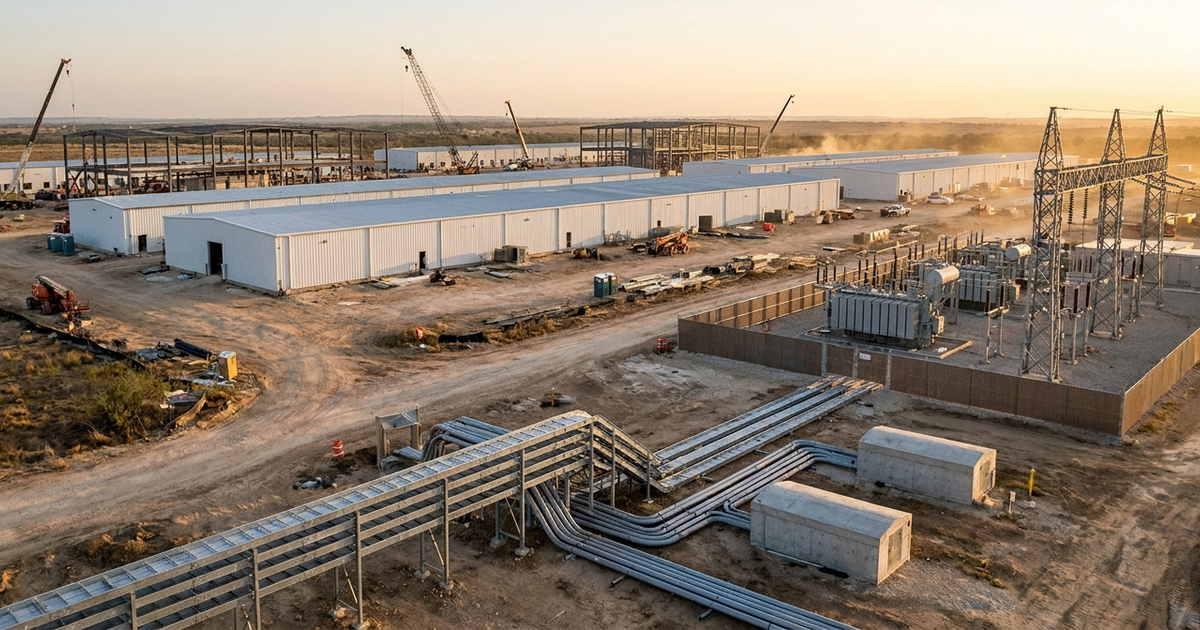
TDLR project TABS2026019473 is the clean public-record signal for Prime Data Centers' next Central Texas data-center work. The filing names Prime Data Center AUS-01, lists the facility as Prime Data Center AUS01 and AUS02, and places it at 1395 Bob White Road in Lockhart, Caldwell County. It is not a vague market rumor. It is a registered Texas accessibility project with a June 1, 2026 start date, a September 30, 2027 completion date, a $400 million estimated cost, and a stated scope of two new 380,000 sq ft shell buildings for future use as data centers.
The second source layer is Prime's own Austin campus page. Prime Data Centers lists Austin Campus AUS01 as a Lockhart campus with eight data centers, 384 MW of total critical power, 205 acres, 2,000,000 sq ft, on-site substation infrastructure, Bluebonnet Electric Cooperative utility service, closed-loop air and liquid cooling, 10 carriers in proximity, layered security, and AI-ready performance. That matters because the TDLR filing is building-level evidence, while Prime's page is campus-level evidence. Taken together, they show both the near-term shell package and the larger hyperscale campus context.
A Caldwell County development agreement ties Lockhart Property, LLC to the property known as Prime Data Centers AUS01 and covers roughly 205 acres. The agreement is useful because it anchors the project to the local development record, not just to a state filing or a marketing page. It also gives contractors a public-agency trail to follow as roads, utilities, inspections, and additional local approvals begin to move.
| Item | Source-backed detail | Why it matters |
|---|---|---|
| Project filing | TDLR TABS2026019473 | Current registered construction record |
| Location | 1395 Bob White Road, Lockhart | Caldwell County project target |
| Shell scope | Two 380,000 sq ft buildings | Large MEP and technology footprint |
| Schedule | June 2026 to September 2027 | Trade monitoring window is open now |
| Filing value | $400M estimated cost | Meaningful building-level spend |
The important distinction is that the TDLR record and the Prime campus page do not describe the same level of the project. The public filing covers two shell buildings, together totaling 760,000 sq ft. Prime's official page describes the broader Lockhart campus at eight buildings and 2,000,000 sq ft. Baxtel's coverage correctly treats the TDLR item as a filing for two buildings and notes the June 2026 to September 2027 schedule. For LVN, that makes the opportunity a public-record watch before the full specialty-contractor map has surfaced.
The named company map is strong but still incomplete. Prime Data Centers is the owner/operator/developer context. Lockhart Property, LLC is the legal owner named in the public filing and county documents. Gensler is named by TDLR as the design firm. Bluebonnet Electric Cooperative is named by Prime as the utility provider for the Austin/Lockhart campus. Caldwell County and TDLR provide the local and state public-record layers. Reviewed sources do not yet name the general contractor, EPCM, electrical contractor, low-voltage contractor, fiber/OSP contractor, security integrator, fire alarm contractor, BAS/BMS controls integrator, DAS/networking contractor, grounding/bonding contractor, or commissioning firm.
| Company | Role | Evidence |
|---|---|---|
| Prime Data Centers | Owner/operator | Official campus page |
| Lockhart Property, LLC | Legal owner affiliate | TDLR and county agreement |
| Gensler | Design firm | TDLR filing |
| Bluebonnet Electric Cooperative | Utility provider | Prime campus page |
| Caldwell County | Local public record | Development agreement |
Gensler's role should be handled precisely. The TDLR filing names Gensler as the design firm, and Gensler's critical-facilities practice provides useful company context for mission-critical design. That does not make Gensler the general contractor, the electrical contractor, or the low-voltage contractor. The same conservative stance applies to Bluebonnet Electric Cooperative. Prime names Bluebonnet as utility provider, which is highly relevant for substation, service, and energization signals, but it does not identify the contractors that will build the data-hall technology layer.
For low-voltage contractors, the practical story is timing. A June 2026 start date and September 2027 target completion put the project in the window where public filings, permit updates, bid lists, prequalification notices, site-work activity, and vendor pages can start exposing the package map. Large data-center shells usually move through civil, structural, utility, MEP, security, controls, telecom, commissioning, and turnover phases. The low-voltage scope often appears late to the public, but the work is shaped early by design, utility, pathway, data-hall layout, security, owner standards, and commissioning requirements.
| LV scope | Likely need | Public signal to watch |
|---|---|---|
| Fiber/OSP | Carrier entrances, diverse routes, vaults | Carrier, duct-bank, and utility records |
| Structured cabling | Data halls, support spaces, labeling | Cabling package or job postings |
| Security | Access control, CCTV, perimeter systems | Integrator awards and submittals |
| Fire alarm | Life-safety interfaces and monitoring | AHJ inspections and FA permits |
| BMS/BAS | Cooling, alarm, and controls integration | Controls partner and commissioning notes |
| Grounding | Telecom rooms, racks, pathways | Electrical coordination and QA records |
The skills angle is also clear. The project does not publish a construction headcount, so LVN should avoid inventing jobs. But the source-backed size, schedule, and campus power profile point to the kinds of technicians who will matter: fiber techs who can clean, terminate, test, and document; structured cabling crews that can work inside standards-heavy data halls; security and access-control installers who understand controlled areas and commissioning; fire alarm technicians who can coordinate with suppression and monitoring; BAS/BMS controls specialists who can work with mechanical systems; and foremen who can keep labeling, test records, redlines, closeout documentation, and safety paperwork clean.
That trade list is not a claim that Prime has awarded those scopes. It is a construction-readiness map. The public sources already show a campus that will need high-density electrical coordination, carrier access, utility service, secured perimeters, cooling support, and documentation discipline. Low-voltage companies should use that map to decide what to monitor and how to prepare, not to imply that they are already attached to the job.
Public-record timing also matters. TDLR lists the project as registered, not complete. The filing date, start date, completion date, owner, design firm, square footage, and scope are enough to establish a current opportunity signal, but they are not enough to fill in the full contractor roster. The next public breadcrumbs may come from inspections, local permits, utility work, civil packages, contractor portfolio updates, job postings, supplier announcements, or county meeting materials. A disciplined contractor should keep the evidence trail organized by source and date because these projects can change names, parcel references, and building labels as the campus moves from shell work into fit-out.
The campus geography is another reason to pay attention. Caldwell County sits in the expanding Central Texas data-center corridor, where Austin-area demand, power availability, land positions, and fiber routes are pulling hyperscale work beyond the most obvious metro addresses. Prime's page markets the campus as Austin, while the TDLR record places the work at Lockhart in Caldwell County. Both are useful: the market label helps explain tenant and connectivity positioning, and the Lockhart/Caldwell record helps contractors follow permits, inspections, utilities, and local development activity.
The most useful near-term questions are practical. Does a general contractor or construction manager appear in a permit, job listing, portfolio page, or subcontractor notice? Does Bluebonnet-related infrastructure activity point to substation or service milestones? Do local records show civil, road, drainage, or utility packages tied to the same address or developer affiliate? Do Gensler references surface additional design partners? Do carrier, fiber, or OSP companies mention Lockhart, AUS01, Project Snow, Bob White Road, or FM 2720? Those are the signals that can move this from a source-backed opportunity to a named-package map.
Useful training references for this category include BICSI Installer 2, Optical Fiber, BICSI Installer 2, Copper, FOA workforce training, and OSHA outreach training. Those links are not project-specific hiring pages. They are practical preparation paths for contractors that want to be credible on mission-critical sites where safety, documentation, testing, labeling, QA, and access rules matter as much as installation speed.
For contractors, the immediate play is not to claim a package that has not been publicly awarded. The better move is to monitor the right evidence trail. Watch TDLR/TABS updates, Caldwell County records, City of Lockhart records, Prime Data Centers announcements, Gensler references, Bluebonnet Electric Cooperative utility activity, local inspection movement, appraisal records, and contractor portfolio pages. Track aliases including Prime AUS01, Prime AUS02, Prime Austin Campus, Prime Lockhart Campus, Project Snow, 1395 Bob White Road, 3300 FM 2720, Maxwell, Lockhart, and Caldwell County data center. Keep it distinct from Prime PHX01 Avondale, Prime SMF02 Sacramento, EdgeConneX Bastrop, Tract Caldwell Valley, PowerHouse Uhland, and other Central Texas data-center projects.
There is also a sales-discipline lesson here. A contractor approaching a project like this should separate verified facts from outreach assumptions. Verified facts include the TDLR scope, the Lockhart address, the $400M estimated filing value, the two-building shell description, Gensler's design-firm listing, Prime's broader campus capacity, and Bluebonnet's utility-provider context. Outreach assumptions include which integrator, cabling firm, fire alarm company, controls contractor, or commissioning team will eventually win work. Keeping that boundary clean makes the intelligence more useful and keeps the public article credible.
LVN Signal is tracking this because the best data-center opportunities do not always arrive as tidy subcontractor announcements. Sometimes they show up first as a state filing, a county agreement, a utility clue, a design-firm name, or a campus specification page. Prime AUS01/AUS02 Lockhart is exactly that kind of signal: source-backed, large enough to matter, early enough for package names to still be open, and specific enough for low-voltage companies to start watching the right public trail.
Join 35,000+ Low Voltage Pros
Get weekly permit updates, tool deals, job opportunities, and industry news. No spam, unsubscribe anytime.