
Join Low Voltage Nation — Find project opportunities and showcase your company to thousands of industry professionals
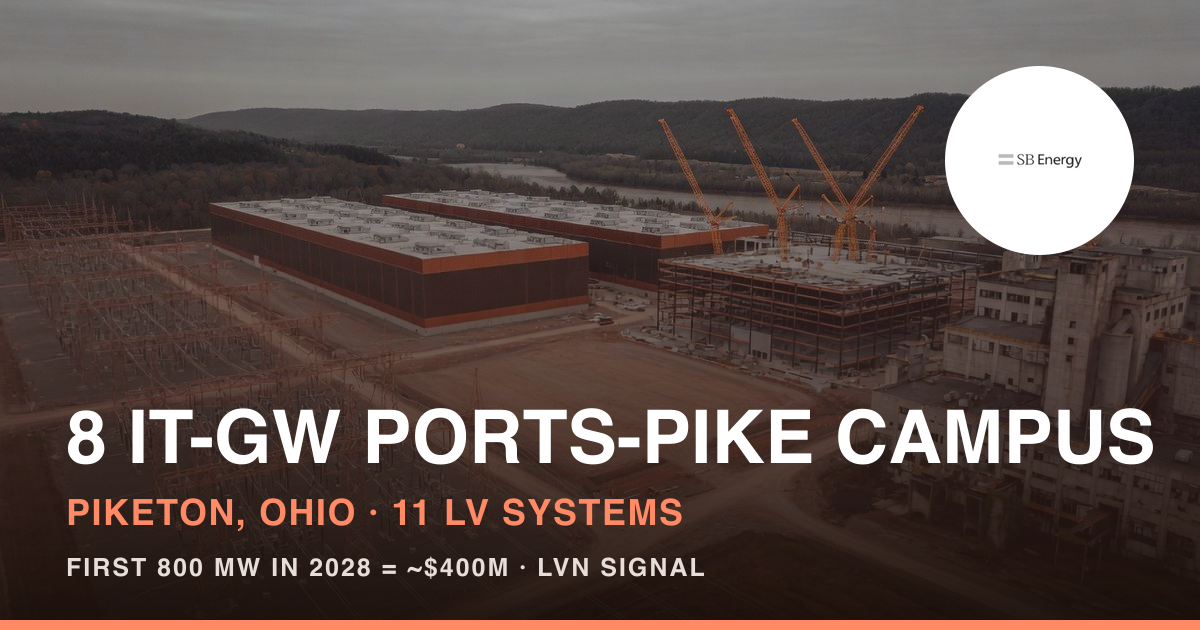
OpenAI confirmed on August 17 that it has taken roughly 8 IT-gigawatts at the PORTS-Pike Technology Campus on a former Cold War uranium enrichment site in Pike County, Ohio. SB Energy builds, owns and operates it. Eleven low voltage systems, a six-year buildout to 2032, and the largest low voltage opportunity we have ever scored.
On August 17, 2026, OpenAI confirmed an agreement for approximately 8 IT-gigawatts at the PORTS-Pike Technology Campus in Pike County, Ohio — a twenty-year lease on a site that spent the Cold War enriching uranium.
We have covered a lot of large campuses. This is a different order of magnitude. For scale: the entire Applied Digital campus we wrote about two days ago is 300 MW. This is roughly twenty-seven of those.
Seven Big Numbers. One Of Them Sizes Your Scope.
This announcement generated more large figures than any project we have covered, and almost none of them are construction budgets. Sort them before you do any math:
- $105 billion — the value of NVIDIA's guarantee per an SEC filing. A credit backstop. Not a construction cost, not even close.
- $1.5 billion — NVIDIA's direct equity investment into SB Energy, joining SoftBank Group and OpenAI as investors. Corporate finance.
- $4.2 billion — new regional grid infrastructure through a partnership with AEP Ohio. A utility asset.
- 10 GW — new electricity generation SB Energy and SoftBank plan to build. Not IT load.
- ~$80 million in community grant funds ($40M from OpenAI, $40M previously from SB Energy), inside a broader Ohio program commitment.
- $37.2 billion — an earlier project value still attached to the site. We will come back to this one, because it is instructive.
- 8 IT-GW — the usable AI factory capacity. This is the only number that sizes a low voltage package.
"IT-GW" is an unusually honest unit. Most campuses publish a utility draw and let you assume it is compute. Here the generation figure (10 GW) and the IT figure (8 IT-GW) are stated separately and explicitly. Use the second one.
The Low Voltage Number, By Phase
Our compute anchor is roughly $500,000 per MW of IT load. Applied against the published phasing:
- First 800 MW — available 2028, largely on existing AEP infrastructure: about $400 million. This is the near-term addressable number and the one to actually plan against.
- Initial 4.25 IT-GW — the tranche NVIDIA is providing defined credit support for, covering land, power and shell: about $2.1 billion.
- Full 8 IT-GW, six-year buildout through 2032: about $4.0 billion.
That is the largest low voltage figure LVN Signal has ever published, and it is spread across six years and an unknown number of contractors. Nobody wins $4 billion. But the first 800 MW is a real, dated, bounded target.
When Capacity Beats The Headline, The Headline Is Stale
Here is the analytical wrinkle, and it is the opposite of what we normally find.
Our other method — 4 percent of an announced capital investment — applied to the $37.2 billion figure gives $1.49 billion. The capacity method gives $4.0 billion. The capacity number is 2.7 times higher than the announced-investment number.
Every previous time these two methods disagreed, the announced figure came out too high, because it bundled land, program and IT hardware you would never build. When the capacity method comes out higher instead, it means something different: the announced figure is stale or partial. And that is exactly the case here — the 8 IT-GW tenant commitment is explicitly distinct from the earlier development and generation frameworks the $37.2 billion attaches to.
So the rule now has two directions. Announced far above capacity means the headline is bundling. Capacity far above announced means the headline is out of date. Either way, run both.
The Second Uranium Plant
The campus is being developed on and around the former Portsmouth Gaseous Diffusion Plant, which began enriching uranium in 1954 for the weapons program, later served commercial reactors, and stopped enriching in 2001.
If that sounds familiar, it should. We covered the Paducah gaseous diffusion site in Kentucky earlier this month for the same reason. Two of the three Cold War uranium enrichment complexes in the United States are now being redeveloped as AI compute campuses, and that is not a coincidence. These sites come with enormous existing electrical infrastructure, thousands of contiguous acres, industrial zoning nobody will contest, federal ownership that simplifies assembly, and transmission already in the ground.
For a contractor, the pattern is worth internalizing: when you are hunting for the next one, look at heavy federal industrial legacy sites with stranded power. That is the acquisition profile.
It also means Department of Energy land, which brings a different permitting and contracting posture than a county rezoning. Federal review here is running under FAST-41 with the U.S. Army Corps of Engineers as lead agency, covering a private-land two-building scope on roughly 1,300 acres, alongside an initial 189-acre federal-land phase described by DOE. FAST-41 is a coordinated federal permitting framework — it is designed to compress schedule, which for you means the design-to-construction window will be shorter than the acreage suggests.
Call SB Energy. Do Not Call OpenAI.
This is the single most practical thing in the article.
SB Energy will build, own and operate the data center under the twenty-year lease. OpenAI is the customer and capacity user — a tenant. The construction contracts, and therefore the low voltage buyout, flow through SB Energy and its builders. Chasing OpenAI for a cabling package is chasing the wrong party.
And a trap worth naming: Bechtel and Kiewit both appear in the record on this site, and both are there in a generation-delivery context — not as the data center general contractor. A power plant on the same campus is a different buyout with different subs. If you see those names and assume they hold the data hall work, you will spend your business development budget in the wrong place.
As of the current record, no project-specific general contractor, EPCM, design firm, electrical contractor, structured cabling or low voltage contractor, fiber carrier or OSP installer, security or fire alarm integrator, controls vendor, DAS contractor, grounding contractor, or independent commissioning authority has been named. On a project this size, that is the earliest possible moment to be in the conversation.
The Union MOU Is The Qualification Path
The announcement includes a labor MOU with North America's Building Trades Unions and a stated local contractor and trades preference.
Read that as a bid prerequisite, not a press release line. We learned the same lesson on the Micron campus in Boise: when a megaproject arrives with a project labor framework, the qualification path runs through the building trades, and a merit-shop contractor without a signatory route is not evaluated on price because it is not evaluated at all. If you want this work, the conversation to have this quarter is with the local halls and the trades council, well ahead of any bid list.
The flip side is the local preference, and it is real leverage. Pike County has fewer than 30,000 residents. The project projects 35,000 construction jobs across the buildout. There is no version of this where regional contractors are not needed. Columbus, Cincinnati, Portsmouth, Chillicothe, Huntington and Lexington are the realistic feeder markets, and travel cost, lodging, rotation and retention belong in the number from day one.
For Once, You Know The Compute
Most of the campuses we have covered this month have an anonymous tenant, which means the technology standard shows up under NDA after award. This project is the inverse.
The site will exclusively host NVIDIA AI compute, and NVIDIA and OpenAI will collaborate on design, testing and commissioning. That is unusual and it is good news:
- The rack power density, thermal envelope and network topology derive from a published reference architecture. You can design against it now instead of guessing.
- The compute vendor being inside the commissioning loop means the acceptance criteria will be driven by the hardware platform, not only by the building. Expect the integrated systems test to prove things a conventional building commissioning agent would not ask about, and expect the documentation format to be specified rather than negotiated.
- Cooling is closed-loop and air-cooled, recirculating water rather than relying on cooling towers. That is a heavier controls and instrumentation scope than an open-loop plant, and the BMS narrative has to hold up at load.
The Eleven Systems
Signal scores this campus a 10 out of 10 with the full mission-critical set: fiber, outside plant, structured cabling, access control, CCTV, fire alarm, BMS and controls, networking, DAS, grounding and bonding, and commissioning.
Grounding and commissioning appearing as their own line items is the correct read on a campus at this scale, and it is the same warning we keep repeating: both are routinely assumed to belong to somebody else, and both surface at integrated systems testing when there is no schedule left to absorb them.
What To Do This Quarter
- Get in front of SB Energy's construction organization. No builder is named yet. That will not last.
- Solve the labor question first. NABTU MOU plus local preference means the trades relationship precedes the bid list.
- Study the NVIDIA reference architecture now. You have a rare opportunity to be fluent in the platform before drawings exist.
- Plan against 800 MW in 2028, not against 8 GW in 2032. The first phase is the one with a date.
- Do not confuse the generation buyout with the data center buyout.
Track projects like this before the bid drops. LVN Signal monitors permits, bids, and construction news across the country and scores every project for low voltage opportunity. See what is in your market.
Join 35,000+ Low Voltage Pros
Get weekly permit updates, tool deals, job opportunities, and industry news. No spam, unsubscribe anytime.