
Join Low Voltage Nation — Find project opportunities and showcase your company to thousands of industry professionals
PointOne's Lee County Phase One is a 90 MW CyrusOne data-center watch item with utility, fiber, security, controls, and commissioning angles.
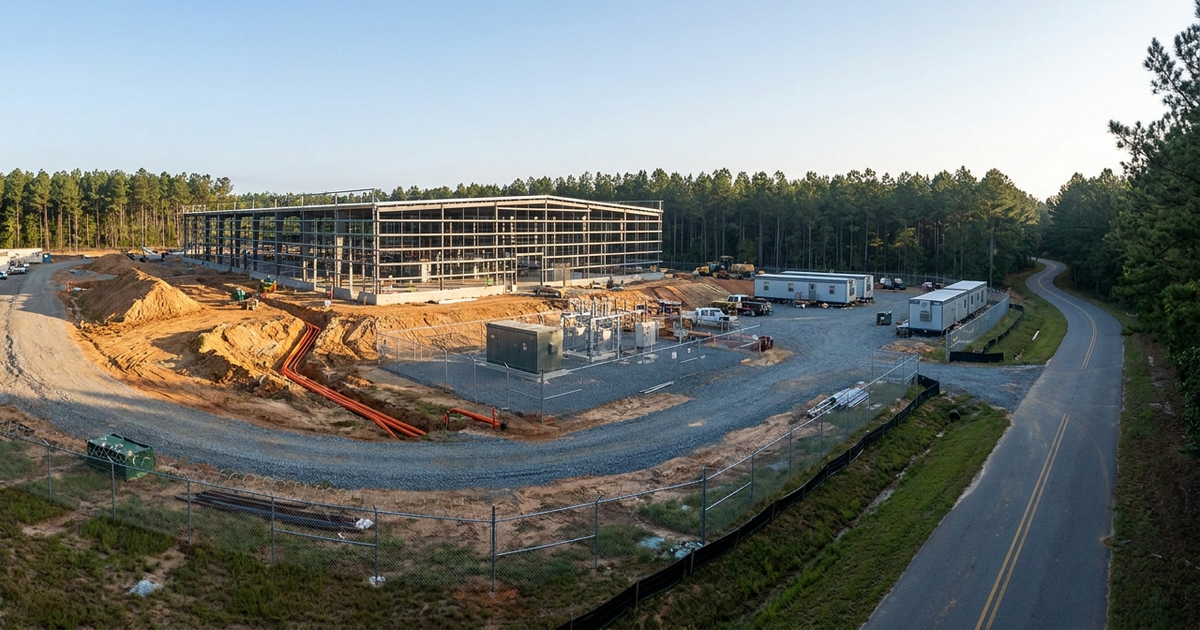
PointOne Data Centers and Helix Ventures have turned a Lee County, North Carolina site into one of the cleaner early AI data-center construction signals in the Raleigh orbit. The current public scope is not an 11-building megacampus ready for every trade package. The source-backed Phase One story is narrower and more useful: one 300,000 square foot data-center building at 4079 Lower Moncure Road, 90 MW of critical IT load, CyrusOne as the future owner/operator or end user, local-utility power, closed-loop cooling, and a later-2026 construction target if the county review and permitting path clear.
The strongest anchor is PointOne's own locations page. PointOne lists a 430-acre Lee County, North Carolina site and says Phase One is one data center building totaling 90 MW of critical IT load for CyrusOne. That matters because it separates the project from generic data-center speculation. This is a named developer, a named future operator, a named county, a specific first phase, and a public planning trail that low-voltage contractors can monitor before bid packages become visible.
The local economic-development record adds the investment and timing frame. Sanford Area Growth Alliance says Helix Ventures and PointOne announced a $900 million Phase One built-infrastructure investment in Lee County, with two to three times that or more expected in installed technology. SAGA also says the project is using no local financial incentives, will be served by local power utility infrastructure rather than onsite generation, and is expected to start construction later in 2026 if permitted, with first customers targeted in early 2028. Those are exactly the details that turn a project from a headline into a contractor watch item.
| Project Fact | Source-Backed Detail | LVN Read |
|---|---|---|
| Phase One scope | One data-center building for CyrusOne. | Track one real first-phase package before treating the larger site as awarded work. |
| Critical load | 90 MW for Phase One. | Large enough for serious fiber, security, controls, fire alarm, and commissioning coordination. |
| Building size | About 300,000 sq ft on 56 acres. | Local planning coverage points to a substantial first shell, not just land banking. |
| Investment | $900M built infrastructure for Phase One. | Installed technology may multiply the spend, but package holders are not public yet. |
| Timing | Later/fall 2026 construction target; early 2028 customer target if permitted. | Prequal, utility, site-plan, and permitting signals matter now. |
Local planning coverage fills in the address-level detail. The Rant cites planning paperwork for a 300,000 square foot PointOne/Helix facility on 56 acres off Lower Moncure Road. It reports that CyrusOne would become the owner and end user of the 90 MW facility, that Central Electric Membership Corporation is tied to substation and will-serve context, that the project uses closed-loop cooling, and that PointOne is targeting work in fall 2026 with 2028 operation if permitted. Sandhills News identifies the proposed address as 4079 Lower Moncure Road and names the local review path through the Sanford/Lee County/Broadway Technical Review Committee.
The bigger campus should be handled carefully. A later Sandhills News planning update says architectural drawings show a possible larger campus of 11 buildings totaling 2,708,535 square feet. That is useful context, but it is not the same thing as an approved Phase One construction scope. For a contractor, the disciplined read is simple: follow the approved or actively reviewed first building, keep the larger layout in the file, and do not sell or staff as if all 11 buildings are current awards.
Bisnow reports the same first-phase frame: a 90 MW data center at 4079 Lower Moncure Road, a 300,000 square foot initial phase, fall 2026 construction target, 2028 completion target, $900 million investment, and CyrusOne ownership or operation. Trade coverage is secondary here, but it is helpful because it aligns with the developer and local planning evidence. The article should not be used to invent a general contractor, engineer of record, electrical contractor, low-voltage contractor, or tenant beyond the source-backed CyrusOne role.
| Organization | Source-Backed Role | Evidence |
|---|---|---|
| PointOne Data Centers | Developer for the Lee County site and Phase One data-center plan. | PointOne locations page. |
| CyrusOne | Future owner/operator or end user for the Phase One facility. | PointOne page, local planning coverage, and CyrusOne company context. |
| Helix Ventures | Local property and development partner. | SAGA, local planning coverage, and Helix Ventures. |
| CEMC | Local power utility context tied to will-serve and substation reporting. | The Rant planning coverage and CEMC company site. |
| TriRiver Water | Water and wastewater utility context for the Lee County area. | SAGA and local planning context. |
| Lee County | Permitting and local review jurisdiction. | Sandhills News and TRC review context. |
The contractor table is intentionally missing one thing: a named GC or specialty package holder. Reviewed sources do not publicly name a general contractor, EPC, engineer of record, electrical contractor, low-voltage contractor, fiber/OSP contractor, structured-cabling contractor, security integrator, fire alarm contractor, BAS/BMS controls firm, DAS provider, grounding contractor, or commissioning agent. That does not make the project weak. It means the project is still in the window where contractors should prepare, monitor the review trail, and wait for real buying signals.
The low-voltage scope is still visible from the building type and site facts. A 90 MW data-center shell for CyrusOne will need utility entrance coordination, carrier entrance paths, fiber backbone, structured cabling, meet-me room and telecom-room planning, pathway and tray coordination, access control, CCTV, fire alarm interfaces, BMS/BAS controls, operational network support, DAS or public-safety wireless coverage, grounding and bonding discipline, test documentation, labeling, redlines, and turnover documentation. The exact buyer and package boundaries are unknown, but the system categories are not exotic for a facility of this type.
| LV System | Where It Shows Up | Public Signal To Watch |
|---|---|---|
| Fiber / OSP | Carrier entrances, campus pathways, utility coordination, and data-hall connectivity. | Conduit, easement, carrier, vault, boring, and fiber-contractor records. |
| Structured cabling | MMR/IDF spaces, data-hall support cabling, labels, tests, and closeout files. | Tenant fit-out, rack/row, tray, pathway, and cabling bid references. |
| Access control / CCTV | Perimeter, gates, secure rooms, loading zones, equipment yards, and operations areas. | Security integrator awards, device schedules, and commissioning jobs. |
| Fire alarm | Life-safety coordination with suppression, monitoring, and AHJ inspections. | Fire alarm permits, specialty names, inspection movement, and monitoring contracts. |
| BMS/BAS controls | Closed-loop cooling, alarms, mechanical/electrical monitoring, and facility dashboards. | Controls integrator, point lists, trend logs, OT network, and commissioning notes. |
| DAS / networking | Large-building wireless coverage and facility network segmentation. | Public-safety coverage, carrier coordination, IT/OT integration, and DAS design. |
| Grounding / commissioning | Telecom bonding, equipment-room QA, test evidence, and turnover readiness. | Electrical coordination, QA checklists, commissioning-agent records, and punch-list work. |
The jobs angle is also early but relevant. Local coverage says the completed facility could be staffed by about 30 to 40 people around the clock and would create significant construction work, but no exact construction job count was found in reviewed sources. For LVN technicians, the practical preparation list is familiar: OSHA site readiness, lift and secure-site habits, fiber cleaning and testing, copper certification, labeling standards, cable tray discipline, grounding and bonding, access-control commissioning, camera validation, fire alarm interface coordination, controls awareness, redline accuracy, and closeout documentation. These are the skills that separate data-center work from loose commercial cabling.
The local-utility power detail is important because it changes what to watch. This is not being framed like a behind-the-meter gas-generation campus. SAGA says the project will be served by local power utility infrastructure, and The Rant reports CEMC substation and will-serve context. That puts CEMC, substation timing, utility easements, service infrastructure, roadway work, site grading, water and fire-water infrastructure, and local approvals on the watch list. If those move, electrical and low-voltage coordination usually follows.
For outreach, small contractors should avoid pretending they have inside package knowledge. A better approach is to build a capability note around data-center experience, fiber test equipment, secure-site safety, lift access, certified installers, labeling and closeout discipline, commissioning support, and response capacity in central North Carolina. Then monitor the public trail for the first named prime contractor, engineer of record, plan-room listing, local permit, or job posting tied to PointOne, CyrusOne, Helix Ventures, Lower Moncure Road, or 4079 Lower Moncure Road.
LVN Signal should treat the Phase One project as active intelligence with a conservative scope. The source-backed facts are strong enough for a published contractor watch: PointOne is the developer, Helix is the local property/development partner, CyrusOne is the future owner/operator or end user, Phase One is 90 MW and about 300,000 square feet, the address is 4079 Lower Moncure Road, and construction is targeted for later 2026 if permitted. The unknowns are just as important: GC, EPC, engineer, electrical, fiber, low-voltage, security, fire alarm, BAS/BMS, DAS, grounding, and commissioning package holders are not public yet.
The bottom line: PointOne / CyrusOne Lee County is exactly the type of early data-center project LVN should track before the trade packages become obvious. It has a real site, real named companies, a public review path, a Phase One capacity number, and enough utility and cooling context to define the low-voltage watch zone. Keep the 11-building drawing separate from approved Phase One, keep the contractor claims conservative, and watch the county review, CEMC power path, permits, plan rooms, and job postings for the first named construction partners.
Join 35,000+ Low Voltage Pros
Get weekly permit updates, tool deals, job opportunities, and industry news. No spam, unsubscribe anytime.