
Join Low Voltage Nation — Find project opportunities and showcase your company to thousands of industry professionals
Oracle, BorderPlex, STACK, Bloom, and Dona Ana County sources show an active New Mexico AI data-center campus where power, workforce, and LV package signals are forming.
Oracle Project Jupiter in Dona Ana County, New Mexico is now a high-confidence AI data-center construction signal for Low Voltage Nation. The source trail is unusually strong: Oracle has its own Dona Ana County project page, Oracle has a separate power announcement with BorderPlex Digital Assets and Bloom Energy, the Project Jupiter Together site describes the campus and construction workforce, Dona Ana County maintains public project pages, and STACK Infrastructure has a project-related commitments release.
The useful contractor takeaway is not that every trade package is already named. It is the opposite. The public sources clearly identify Oracle, BorderPlex, STACK, Bloom Energy, Dona Ana County, and workforce/community partners. They also show active construction, an enormous power-infrastructure plan, dry-cooling design, reclaimed-water operations, and a large construction labor footprint. But the reviewed public sources do not yet name the GC/EPCM, electrical, low-voltage, fiber, OSP, access-control, CCTV, fire alarm, BMS/BAS, DAS, networking, grounding, or commissioning package winners. That makes this a watch-early project for LVN Signal.
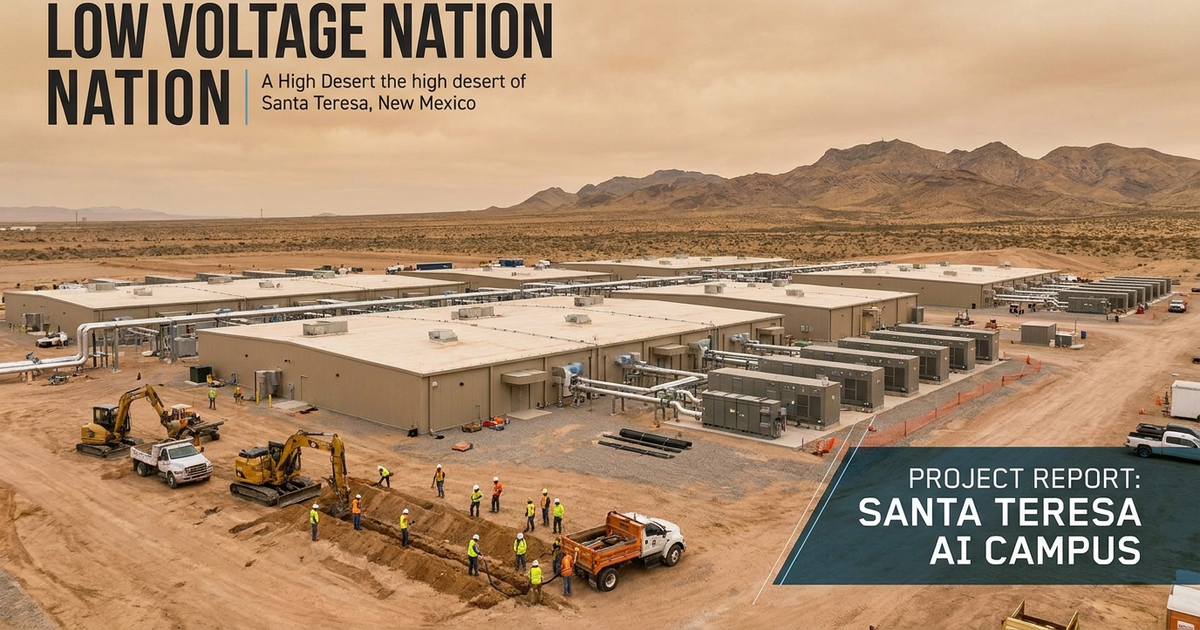
The campus sits in Santa Teresa / Dona Ana County near the Pete V. Domenici Highway and NM-136 corridor. Oracle says the project is on 818 acres and includes four data centers plus a warehouse. Project Jupiter Together also describes four data centers and points to initial operations in Q4 2026. Oracle's April 2026 power announcement says construction is continuing on schedule, with more than 1,200 team members onsite and more than 1 million construction hours already completed.
| Item | Source-backed fact | LVN read |
|---|---|---|
| Location | Santa Teresa / Dona Ana County, NM | Large border-region campus with utility, workforce, and logistics implications. |
| Campus | 818 acres, four data centers, and a warehouse per Oracle. | Multi-building work means repeated pathways, fiber, security, controls, and commissioning demand. |
| Stage | Under construction, with initial operations targeted for Q4 2026. | The trade window is active, but specialty package names are still mostly hidden. |
| Power | Oracle says up to 2.45 GW of installed Bloom fuel-cell capacity. | Treat this as power infrastructure, not confirmed IT load; controls and commissioning still matter. |
| Jobs | Oracle says 6,500+ onsite construction workers and 950+ permanent jobs. | Workforce scale makes safety, QA, labeling, testing, and documentation important. |
The power story is the part that separates Project Jupiter from a generic data-center announcement. Oracle says Project Jupiter will use up to 2.45 GW of installed Bloom fuel-cell capacity. The first 350 MW deployment is targeted for Q4 2026, with scaling through Q3 2028. Bloom Energy's company material frames fuel-cell power for data-center reliability, microgrid resilience, and grid-independent power paths. For LVN readers, the headline is not only power capacity. It is the interface work that follows power infrastructure: controls networks, monitoring, alarming, fiber, grounding, commissioning coordination, and disciplined turnover documentation.
There is also a public water and cooling angle that should be handled accurately. Oracle says the data centers use dry-cooling architecture and reclaimed wastewater for operations, with office and domestic water use expected to stay under 20,000 gallons per day at full operation. That does not remove the need to watch public water and utility records, but it does keep the article from turning into vague speculation. The low-voltage angle stays tied to what the sources support: data halls, site security, power monitoring, controls, fiber pathways, and commissioning interfaces around a large AI infrastructure campus.
The primary source set is strong enough for a published LVN brief. Start with Oracle's Dona Ana County data-center page for acreage, facility count, workforce, and cooling facts. Use Oracle's BorderPlex and Bloom power announcement for active-construction and fuel-cell power evidence. Use Project Jupiter Together for local project framing, jobs, cooling, and initial-operations timing. Use Dona Ana County's Project Jupiter page and Dona Ana County's latest updates page for the public-record trail. Use STACK's Project Jupiter commitments release for the developer/community partner signal.
| Company or agency | Public role | Evidence |
|---|---|---|
| Oracle | Owner/operator and cloud AI infrastructure signal. | Oracle project facts and power announcement. |
| BorderPlex Digital Assets | Developer/project partner signal. | Oracle power announcement and Project Jupiter public materials. |
| STACK Infrastructure | Developer/project partner and community-commitment signal. | STACK project commitments release. |
| Bloom Energy | Fuel-cell power vendor. | Oracle power announcement and Bloom data-center power context. |
| Dona Ana County | Public agency and project-record source. | County project and update pages. |
| Dona Ana Community College | Workforce partner. | STACK community commitments release. |
That table is deliberately conservative. It does not call STACK or BorderPlex the general contractor. It does not call Bloom a low-voltage contractor. It does not convert OpenAI trade-report context into a construction role. The public evidence supports Oracle as the owner/operator signal, BorderPlex and STACK as project/developer partners, Bloom as the fuel-cell power vendor, and county/workforce groups as public and workforce-context entities. The specialty contractor list remains open.
For low-voltage contractors, the practical opportunity is in the scope categories that almost always show up in hyperscale and AI data-center execution. Fiber and OSP work are the obvious first watch items because a four-data-center campus needs diverse entrances, carrier routes, duct banks, vaults, MMR connectivity, data-hall backbones, and test documentation. Structured cabling follows with pathways, tray, labeling, rack/row support, QA signoff, and documentation. Security and life safety are also material: perimeter systems, access control, CCTV, mantrap and secure-area integration, fire alarm interfaces, monitoring, and AHJ coordination.
The power architecture adds another layer. Fuel-cell infrastructure, power blocks, dry-cooling systems, and utility interfaces all need monitoring, controls, alarms, and commissioning support. That pushes BAS/BMS controls, networking, grounding and bonding, and commissioning documentation into the watchlist. It also creates a coordination layer between electrical contractors, controls integrators, power vendors, network teams, and the data-center operator.
| Scope | Likely demand | Public trigger to watch |
|---|---|---|
| Fiber / OSP | Diverse routes, carrier entrances, campus backbone fiber, and testing. | Carrier, civil, utility, duct-bank, or pathway filings. |
| Structured cabling | Data-hall pathways, tray, labeling, copper/fiber support, and QA records. | Rack/row buildout, prequal notices, and low-voltage hiring. |
| Security | Access control, CCTV, perimeter coverage, and secure-area integration. | Integrator awards, permit detail, and site security job postings. |
| Fire alarm | Life-safety interfaces, monitoring, suppression coordination, and inspections. | AHJ records, special inspections, and fire-alarm contractor movement. |
| BMS/BAS | Cooling, power, fuel-cell monitoring, alarms, trends, and turnover data. | Controls integrator awards, commissioning roles, and vendor postings. |
| DAS / networking | Facility wireless, public-safety coverage, OT networks, and system segmentation. | DAS design, carrier coordination, and network integrator signals. |
| Grounding | Bonding discipline around pathways, racks, telecom rooms, and power interfaces. | Electrical QA, test records, and commissioning punch lists. |
The jobs and skills angle is straightforward. A site with thousands of construction workers rewards contractors who can clear onboarding, work safely, follow documentation, and keep quality records clean. Fiber techs should expect testing, cleaning, labeling, and closeout discipline. Security and fire alarm teams should expect AHJ coordination and inspection-driven pacing. Controls and networking teams should expect OT/IT boundaries, commissioning scripts, trend logs, and formal turnover. Electricians and low-voltage teams will need to coordinate around grounding, bonding, tray, pathways, and energized infrastructure.
Useful training references for crews chasing this kind of work include BICSI Installer 2, Optical Fiber, BICSI Installer 2, Copper, BICSI face-to-face training, FOA workforce training, and OSHA outreach training. Those links are not project-award evidence. They are practical resource links for technicians who want to move into mission-critical data-center scopes.
There are two caveats LVN should keep visible. First, the 2.45 GW number is installed fuel-cell capacity from Oracle's power announcement, not a confirmed IT critical-load number for the data centers. Second, the broader public-investment framework is large, but the source-backed construction opportunity still needs package-level evidence before naming trade winners. The right posture is to monitor public records, plan rooms, job postings, and company updates until GC/EPCM and specialty package awards surface.
Next signals to watch include Dona Ana County updates, Santa Teresa public records, Oracle and STACK updates, BorderPlex Digital Assets announcements, Bloom Energy deployment milestones, Camino Real Regional Utility Authority context, utility and interconnection records, construction permits, inspections, plan-room or prequalification notices, and job postings tied to Project Jupiter, Oracle Project Jupiter, Santa Teresa data center, BorderPlex Project Jupiter, STACK Project Jupiter, and Dona Ana County data center.
For LVN, the timing matters because package signals often appear before broad public construction coverage catches up.
Bottom line: Project Jupiter is already real enough for LVN Signal because the owner/operator, developer partners, power vendor, site, workforce scale, cooling approach, and construction status are publicly sourced. It is still early enough that many of the low-voltage, fiber, security, fire alarm, controls, networking, grounding, and commissioning names have not surfaced. That is exactly where a contractor-focused construction intelligence workflow should pay attention.
Join 35,000+ Low Voltage Pros
Get weekly permit updates, tool deals, job opportunities, and industry news. No spam, unsubscribe anytime.