
Join Low Voltage Nation — Find project opportunities and showcase your company to thousands of industry professionals
Cedar Rapids permit BP-002597-2026 covers a 98,695-square-foot data center with a 10 MW full critical-load design, while live inspections confirm early site and foundation work and most delivery awards remain undisclosed.
A new data center is already moving through early construction at 1515 33rd Avenue SW in Cedar Rapids, Iowa. The issued City permit covers one 98,695-square-foot building, and its live inspection record shows passed temporary-power, footing, and groundwork-plumbing work through August 21, 2026. That puts the project beyond a concept announcement, while still leaving the tenant, delivery schedule, project team, specialty contractors, equipment vendors, and commissioning authority outside the public record.
The strongest source is Cedar Rapids building permit BP-002597-2026. It names CLOP Cedar Rapids, IA LLC as owner, identifies the work as a new data-center building, and describes a 10-megawatt full critical-load design. The permit also says the first three phases are a turnkey 6-megawatt critical-load facility with site work, core and shell, three data halls, an administrative area, and an electrical mezzanine.
Those figures need to stay distinct. Ten megawatts is the permitted full critical-load design. Six megawatts describes the turnkey scope for phases one through three. Neither figure establishes utility-service capacity, current energized load, a tenant commitment, or a final operating date. The public record does not disclose how or when the building would move from the first three phases to the full 10-megawatt design.
| Project fact | Current evidence | Important limit |
|---|---|---|
| Address | 1515 33rd Avenue SW, Cedar Rapids | One issued building permit |
| Building | 98,695 square feet | Later expansion is undisclosed |
| Full design | 10 MW critical load | Not utility or energized capacity |
| First scope | 6 MW across phases 1-3 | Turnover schedule undisclosed |
| Stage | Early site, foundation, and core-shell work | No verified data-hall fit-out |
| Tenant | Confidential or undisclosed | No public lease or customer name |
The permit establishes real construction activity
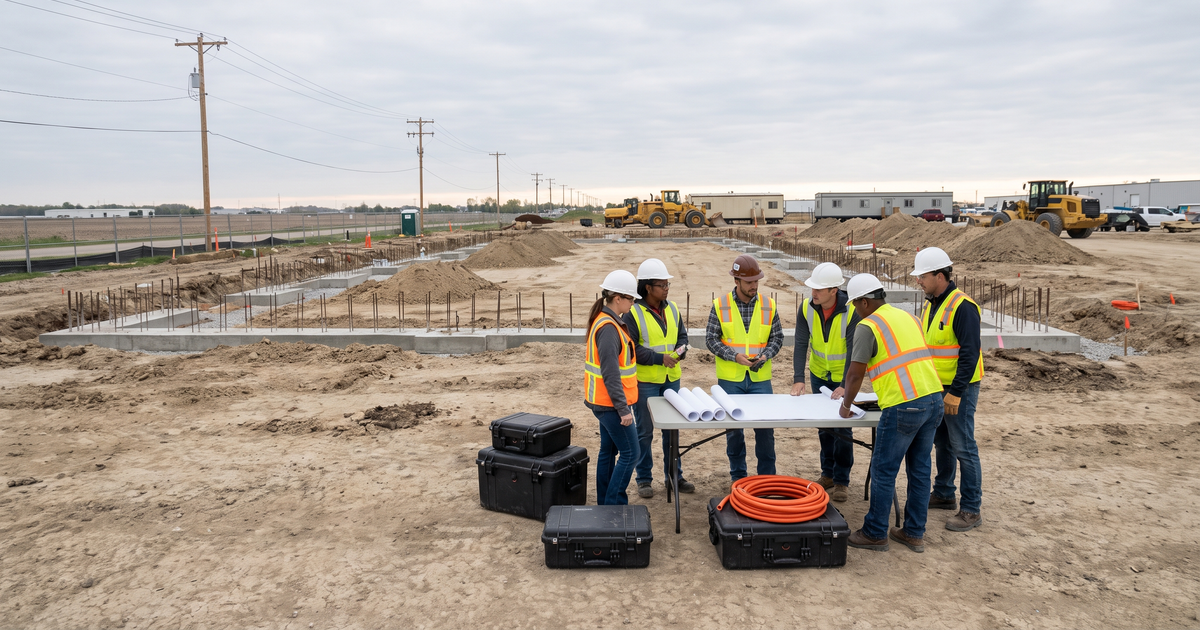
The permit was issued June 22, 2026. Its inspection history shows a passed temporary-pole electrical inspection on July 23, partial footing and groundwork-plumbing passes on August 17 and August 20, and a footing pass on August 21. Cedar Rapids Economic Development separately says site work has begun. Together, those records support an under-construction classification limited to early site, foundation, utility, and core-and-shell activity.
The evidence does not yet show framing completion, a dried-in building, permanent electrical service, data-hall fit-out, network installation, equipment startup, integrated systems testing, or certificate of occupancy. The permit viewer also leaves its contractor field blank. Contractors evaluating this opportunity should treat the current stage as active but early, with major delivery roles still undisclosed rather than automatically available.
The City's project page adds unusual clarity about the approval path. The privately funded development is allowed under existing Light Industrial I-1 zoning. Cedar Rapids says it provided no incentive or development agreement and that the project did not require rezoning, a public hearing, or a City Council vote. That explains why a nearly 100,000-square-foot data center could reach permit and site work without the public entitlement trail associated with the larger Google and QTS campuses in the market.
CLOP is the permit owner and Oppidan is the reported developer
The permit names CLOP Cedar Rapids, IA LLC. A current legal-entity record lists the company at 400 Water Street, Suite 200, Excelsior, Minnesota, the same headquarters address used by Oppidan Investment Company. Local business reporting attributes the development to Oppidan Connect. That combination supports describing Oppidan as the reported developer and data-center platform while keeping CLOP as the permit owner.
Oppidan's company profile describes a national real-estate developer with construction management, capital markets, and corporate build-to-suit capabilities. In a separate data-center development interview, the company says it has delivered more than 10 million square feet of data-center space and discusses utility coordination, substations, equipment lead times, single-tenant facilities, and construction delivery. Those pages establish company capability. They do not name the Cedar Rapids tenant, financing partner, general contractor, designers, or specialty subcontractors.
| Organization | Source-backed role | Evidence limit |
|---|---|---|
| CLOP Cedar Rapids, IA LLC | Permit owner | End tenant undisclosed |
| Oppidan | Reported developer and platform | No project contractor award shown |
| Cedar Rapids Building Services | Permit and inspection authority | Contractor field is blank |
| Cedar Rapids Economic Development | Project and zoning source | No incentive or development agreement |
| Alliant Energy | Industrial-park utility context | Project service agreement undisclosed |
No reviewed source identifies the general contractor, EPCM, construction manager, architect, civil engineer, MEP engineer, electrical contractor, carrier, outside-plant fiber contractor, structured-cabling firm, security integrator, fire-alarm integrator, controls vendor, DAS contractor, cooling or backup-power vendor, grounding package holder, or independent commissioning authority. The blank contractor field should remain an open fact, not be filled with a company borrowed from another Oppidan project.
The financial record is useful but incomplete
The Cedar Rapids Pulse, citing Corridor Business Journal, reports that the permit valuation exceeds $101 million. That is a reported permit valuation, not verified project financing, final construction spending, tenant investment, or stabilized asset value. The exact original City monthly permit row was not available in the automated source review, so the figure should remain approximate until the underlying record is retrieved.
The public sources do not identify a lender, equity partner, lease structure, tenant economics, equipment-financing program, tax-abatement package, or final project budget. Cedar Rapids explicitly says the project is privately funded and has no City incentive or development agreement. That makes the issued permit and inspection sequence more reliable indicators of current progress than an unsupported capex total.
Power has a number, but delivery details remain open
The permit's 10-megawatt and 6-megawatt critical-load figures give the market a real design anchor. They still leave the entire delivery chain unresolved: available utility megawatts, service voltage, feeder or substation work, interconnection terms, energization milestones, relay protection, grounding, generator and UPS topology, battery systems, EPMS, load-bank testing, and integrated commissioning.
Alliant Energy's official South 33rd Avenue Industrial Park profile identifies Alliant as the electric utility for the park area. That supports treating Alliant as the local utility to watch. It does not prove a project-specific service agreement, dedicated substation, feeder award, or confirmed energization date for 1515 33rd Avenue SW.
The first three phases could create a staged turnover path, but the permit does not publish dates for data halls one through three. Contractors and suppliers should watch inspection updates for permanent electrical service, framing, mechanical, fire, low-voltage, generator, final, and occupancy milestones. A plan index, electrical permit, utility filing, equipment delivery, or named commissioning team would materially improve the construction picture.
Where low voltage enters the build
A three-data-hall program with an administrative area and electrical mezzanine will require tightly coordinated pathways, communications, security, life safety, controls, power monitoring, testing, and turnover. The table below describes practical watch categories created by the permitted building scope. None is a confirmed subcontract award.
| Low-voltage lane | Likely project need | Evidence to watch |
|---|---|---|
| OSP and fiber | Diverse entrances and carrier paths | Civil plans, permits, carrier work |
| Structured cabling | Data halls, MMR/IDF, tray, labeling | Telecom plans and bid packages |
| Access and video | Perimeter, doors, cages, operations areas | Security design and integrator award |
| Fire and life safety | Alarm, suppression, shutdown interfaces | Fire review and acceptance tests |
| BMS and EPMS | Cooling, power, alarms, trending | MEP and controls specifications |
| DAS and radio | Indoor and public-safety coverage | Coverage study and authority review |
| Grounding | Racks, tray, rooms, equipment bonding | Electrical specs and QA records |
| Commissioning | Phased startup and integrated testing | Cx authority, scripts, turnover dates |
Early construction can create enabling scope before the permanent systems are released. Temporary jobsite connectivity, trailer networks, gate access, cameras, laydown-yard security, radio coverage, and fiber extensions may move alongside foundations and utilities. Permanent pathway and grounding coordination can also start well before cable installation. Public sources do not show that any of those packages are currently out for bid.
Fiber teams should be prepared for diverse-route documentation, fusion splicing, inspection and cleaning, OTDR and insertion-loss testing, polarity control, labeling, restoration, and complete as-builts. Cabling firms should expect pathway, rack, bonding, firestopping, testing, and digital closeout discipline. Security, fire, and controls integrators need strong electrical, mechanical, IT, and commissioning coordination because mission-critical acceptance depends on interfaces as much as individual devices.
Jobs, skills, and contractor readiness
Project-specific construction headcount, permanent jobs, apprenticeship partners, wage commitments, and trade-package counts remain undisclosed. The near-term value for local and regional firms is preparation. Keep safety records, insurance, licensing, bonding capacity, workforce depth, quality plans, test-equipment calibration, manufacturer certifications, mission-critical references, and turnover examples ready.
Useful training paths include BICSI education and certification for data-center ICT design, installation, project management, testing, and documentation; Fiber Optic Association programs for OSP and inside-plant fiber work; and NFPA professional training for electrical, fire-alarm, emergency-system, and life-safety coordination. These are readiness resources, not project prerequisites announced by the owner.
Oppidan maintains an official contact route, and Cedar Rapids Building Services is the primary public route for permit and inspection clarification. Neither is a published invitation to bid or subcontractor-registration portal. Firms should use them carefully, identify the exact project and permit number, and avoid representing an unverified package as available.
The next construction signals
The most important near-term record is the permit inspection history. Framing, permanent electrical, mechanical, fire, low-voltage, generator, and final inspections would show the project moving from foundations into building systems and turnover. A certificate of occupancy would establish a major milestone, but it would still need to be separated from tenant equipment installation and full operational readiness.
The team picture should improve through permits, plan indexes, contractor announcements, equipment deliveries, job postings, utility work, lien filings, or vendor case studies. The most valuable names will be the GC or construction manager, architect and MEP engineer, electrical contractor, fiber and structured-cabling firms, security and fire integrators, controls team, equipment vendors, carriers, and commissioning authority.
LVN Signal will keep following the Cedar Rapids project as those records surface. For contractors, manufacturers, distributors, and workforce partners, the current opportunity is to understand the verified 98,695-square-foot, three-data-hall scope, respect the limits around power and tenant disclosure, and be ready when a named package, procurement route, hiring need, or commissioning milestone becomes public.
Join 35,000+ Low Voltage Pros
Get weekly permit updates, tool deals, job opportunities, and industry news. No spam, unsubscribe anytime.