Join Low Voltage Nation — Find project opportunities and showcase your company to thousands of industry professionals
OpenAI's $20B Project Camellia in Effingham County brings 3.2 GW of planned utility service, thousands of construction jobs, and an open supplier-interest route.
OpenAI Project Camellia is today's LVN AI/data-center construction watch because it combines an owner-backed campus announcement, a 25-year utility agreement, a county-backed investment commitment, and an official supplier-interest path. OpenAI says it is designing and developing the Effingham County project, while Georgia Power confirms approximately 3,200 MW of phased service between 2028 and 2032.
The project is still early enough that the most important trade partners are not public. The official Project Camellia FAQ says OpenAI is competitively selecting the partner that will construct and operate the campus. That means LVN should not guess at a general contractor, EPCM firm, architect, engineer, electrical contractor, low-voltage integrator, fiber contractor, security firm, fire alarm contractor, controls vendor, DAS contractor, or commissioning agent.
The scale is source-backed but needs careful language. Georgia Power describes a 25-year agreement for about 3,200 MW and up to 1,000 MW of flexible demand response. That 3.2 GW figure is planned full-buildout utility service, not a disclosed building-level critical IT load. The flexible-demand figure is a grid-management commitment, not additional campus capacity.
| Project fact | Source-backed detail | LVN read |
|---|---|---|
| Project | OpenAI Project Camellia | Planned AI infrastructure campus in Effingham County, Georgia. |
| Investment | $20B announced by county agencies | Campus-scale capital commitment; phased delivery remains subject to approvals. |
| Power | About 3,200 MW phased from 2028-2032 | Utility-service figure, not building-level IT load. |
| Demand response | Up to 1,000 MW | Flexible-load commitment supporting Georgia's grid. |
| Stage | Planning, permitting, design, and partner selection | Track the project team before specialty packages appear. |
Effingham County, its industrial development authority, and the school district announced $20 billion of capital investment and at least 400 long-term jobs. OpenAI's project FAQ says permanent onsite employment could grow beyond 1,000 at full buildout, while construction will support thousands of skilled-trade jobs including electricians, equipment operators, mechanics, and technicians.
The county announcement places the campus inside Savannah Gateway Industrial Hub. Georgia Public Broadcasting reports roughly 1,400 acres and provides local tax, power, water, and environmental context. LVN should treat the acreage and reported four-building or 4.4-million-square-foot layout as secondary until a primary site plan, permit set, or owner document confirms them.
The named company map is useful even before the builder is known. OpenAI is the owner, designer, and developer context. Georgia Power is the utility partner. The Effingham County Industrial Development Authority and Effingham County are the local public partners. The Broe Group is tied to Savannah Gateway Industrial Hub, and the Georgia Public Service Commission is the utility regulator to watch.
| Company / agency | Role | Evidence |
|---|---|---|
| OpenAI | Owner / developer | Owner announcement |
| Georgia Power | Utility partner | Service agreement |
| Effingham County / ECIDA | Local project partners | Agency announcement |
| Effingham County Schools | Workforce partner | Agency announcement |
| The Broe Group | Industrial hub developer | Site context |
The clearest current business-development route is the official Project Camellia local-supplier registration page. It invites Southeast Georgia businesses to register interest across construction, materials, environmental services, safety, logistics, maintenance, and support. It is not yet a formal specialty bid list, but it is the source-backed way to enter the project's vendor awareness funnel.
For low-voltage contractors, the early opportunity is a watch lane rather than a named award. A multi-gigawatt AI campus will require campus fiber, diverse outside-plant routes, data-hall structured cabling, security entrances, access control, video surveillance, fire alarm interfaces, building and electrical controls networks, DAS and wireless coverage, grounding and bonding, test documentation, and commissioning support. None of those package holders is public yet.
| System | Likely project need | Public signal to watch |
|---|---|---|
| Fiber / OSP | Diverse campus entrances, duct banks, vaults, backbone routes, and carrier coordination. | Easements, carrier notices, conduit work, MMR language, and route permits. |
| Structured cabling | Repeatable data-hall pathways, copper/fiber testing, labeling, and turnover records. | Building permits, data-hall packages, rack standards, and closeout requirements. |
| Security | Perimeter gates, access control, CCTV, visitor workflows, and secure building zones. | Site plans, security permits, integrator job posts, and contractor case studies. |
| Fire alarm | Data halls, support spaces, utility yards, and suppression-system interfaces. | Fire-marshal reviews, alarm permits, acceptance testing, and monitoring scope. |
| BMS / EPMS | Cooling, electrical, generation, alarm, telemetry, and demand-response integration. | Controls specifications, SCADA references, point lists, and commissioning packages. |
| Grounding / commissioning | Mission-critical power and network turnover depend on verified installation and documentation. | Ground-grid work, QA/QC plans, commissioning-agent awards, and test requirements. |
The official project overview says OpenAI will pay project-specific power-infrastructure costs, use closed-loop cooling, prioritize local contractors, and undergo an annual independent audit. Those commitments create practical monitoring lanes around substations, transmission, water infrastructure, environmental approvals, local procurement, and construction reporting.
Closed-loop cooling is relevant to low-voltage coordination because it increases the importance of controls networks, instrumentation, alarming, leak detection, mechanical-system integration, and commissioning. The public record does not identify a cooling vendor or controls vendor. The right posture is to track design documents and partner announcements rather than assigning a speculative manufacturer.
The demand-response commitment also matters. A campus able to flex up to 1,000 MW will need sophisticated coordination among utility systems, campus power infrastructure, operational controls, telemetry, protection, and scheduling. Some of that work sits above traditional low voltage, but it creates interfaces for SCADA, EPMS, BMS, network security, redundant communications, alarm management, and commissioning.
Georgia Power and Georgia Public Service Commission records should reveal major upstream milestones before data-hall packages are public. Watch for substations, transmission upgrades, service territory filings, construction schedules, cost-recovery proceedings, protection-and-control work, fiber communications, and phased energization. Those records can identify engineers and contractors earlier than a conventional building permit search.
Effingham County, ECIDA, Georgia EPD, and the U.S. Army Corps of Engineers are the other public-record lanes. Site planning, wetlands, stormwater, grading, roads, utility extensions, water, wastewater, and environmental permits can expose parcel details, designers, civil firms, and early construction partners. Those names often become the first reliable project-team map.
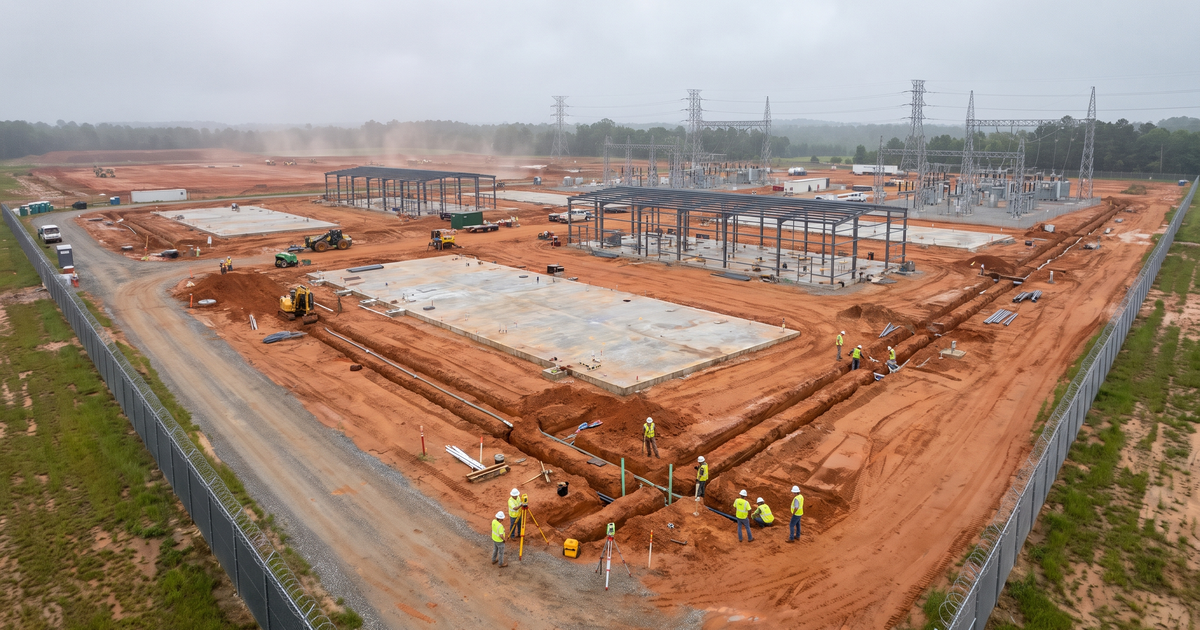
The construction sequence should begin with enabling work: site access, temporary construction communications, trailers, safety systems, security perimeters, civil infrastructure, utilities, substations, and backbone pathways. Low-voltage firms with outside-plant, industrial controls, perimeter security, and large-campus commissioning experience may see relevant work before interior data-hall packages are released.
The workforce angle is broader than permanent data-center operations. Thousands of construction positions imply a multi-year field program with safety onboarding, lift and equipment requirements, badging, documentation, quality control, and trade coordination. For LVN members, useful preparation includes fiber testing and cleaning, copper certification, grounding and bonding, pathway coordination, fire alarm acceptance testing, access-control and CCTV QA, controls integration, redlines, and closeout packages.
Local firms should use the supplier portal now but keep expectations precise. Registration expresses interest; it does not prove prequalification or award. A strong vendor profile should state geographic coverage, bonding and insurance capacity, safety record, data-center or industrial references, labor capacity, testing equipment, commissioning experience, and ability to deliver clean documentation at hyperscale.
Regional and national contractors should watch for the construction-and-operating partner selection because that party will likely shape prequalification, plan-room access, package timing, safety standards, and subcontractor onboarding. Once OpenAI names the winner, the next useful step is to map that firm's mission-critical vendor system and public trade-partner channels.
The public contractor stance must remain conservative. OpenAI explicitly says partner selection is underway. No reviewed primary source names a GC, EPCM, construction manager, architect, engineer of record, electrical contractor, low-voltage contractor, fiber/OSP contractor, structured-cabling firm, security integrator, fire alarm contractor, BAS/BMS/EPMS vendor, DAS/networking firm, grounding contractor, or commissioning agent.
The capacity stance needs equal discipline. The 3.2 GW figure is contracted or planned utility service for full buildout. Up to 1,000 MW is flexible demand response. Neither number is disclosed building-level critical IT load. Similarly, the $20 billion figure is a public-agency campus investment announcement, while individual phase costs and building-level construction values remain unknown.
Alias control will prevent duplicate records. Track Project Camellia, OpenAI Effingham County, OpenAI Savannah, Savannah Gateway Industrial Hub data center, SGIH data center, Rincon data center, and Effingham County AI campus. Keep this project distinct from OpenAI Stargate Freebird in Milam County, Vantage Lighthouse in Wisconsin, and other OpenAI-linked infrastructure campuses.
The near-term watch list is specific: OpenAI and Project Camellia updates, construction-partner selection, Effingham County and ECIDA records, Georgia Power and Georgia PSC filings, Savannah Gateway Industrial Hub activity, Georgia EPD and federal environmental permits, local plan rooms, supplier-registration updates, and project-specific job postings.
Contractors should also build a clean evidence file before outreach. Save the official supplier-registration confirmation, the company capability statement, safety metrics, relevant mission-critical or industrial references, service territory, workforce capacity, bonding limits, insurance limits, and current certifications. When the construction partner opens prequalification, that package can move quickly instead of starting from scratch. The same record helps firms avoid overstating their status: being registered as an interested supplier is useful, but it is not the same as being shortlisted, prequalified, invited to bid, or awarded.
LVN will update this project when source-backed names surface. The highest-value updates will be the construction and operating partner, design team, utility engineers, early civil and electrical firms, fiber and carrier route partners, perimeter-security integrator, fire alarm contractor, controls and monitoring vendors, commissioning authority, and any formal local workforce or apprenticeship programs. Each confirmed name turns a broad campus announcement into a practical contractor map without weakening the record with rumors.
Bottom line: Project Camellia is a high-confidence LVN Signal item because the owner, utility, county, power agreement, investment, jobs, and vendor-interest route are public before the specialty project team is known. The best move is to publish the source-backed watch record now and update it when permits and partner announcements reveal the actual construction and low-voltage package holders.
Join 35,000+ Low Voltage Pros
Get weekly permit updates, tool deals, job opportunities, and industry news. No spam, unsubscribe anytime.