
Join Low Voltage Nation — Find project opportunities and showcase your company to thousands of industry professionals
Nscale's Monarch Compute Campus pairs a 1.35 GW Phase 1 AI build with dedicated generation, active site work, a union-workforce agreement, and major low-voltage packages still to be identified.
Nscale is building the Monarch Compute Campus north of Point Pleasant in Mason County, West Virginia. The current Nscale project page describes a 2,250-plus-acre artificial-intelligence campus with 1.35 GW of Phase 1 computing capacity, more than $20 billion in planned capital investment, an early-2028 delivery target, and an expansion path above 8 GW.
The construction opportunity extends beyond the data-center buildings. A West Virginia Department of Environmental Protection application describes three H-shaped data-center buildings, approximately 1.8 GW of peak total site demand, and a proposed 2.16 GW natural-gas generation plant. The filing lists hundreds of generating units plus emergency and fire-pump engines. Those power figures are separate from Nscale's 1.35 GW computing figure.
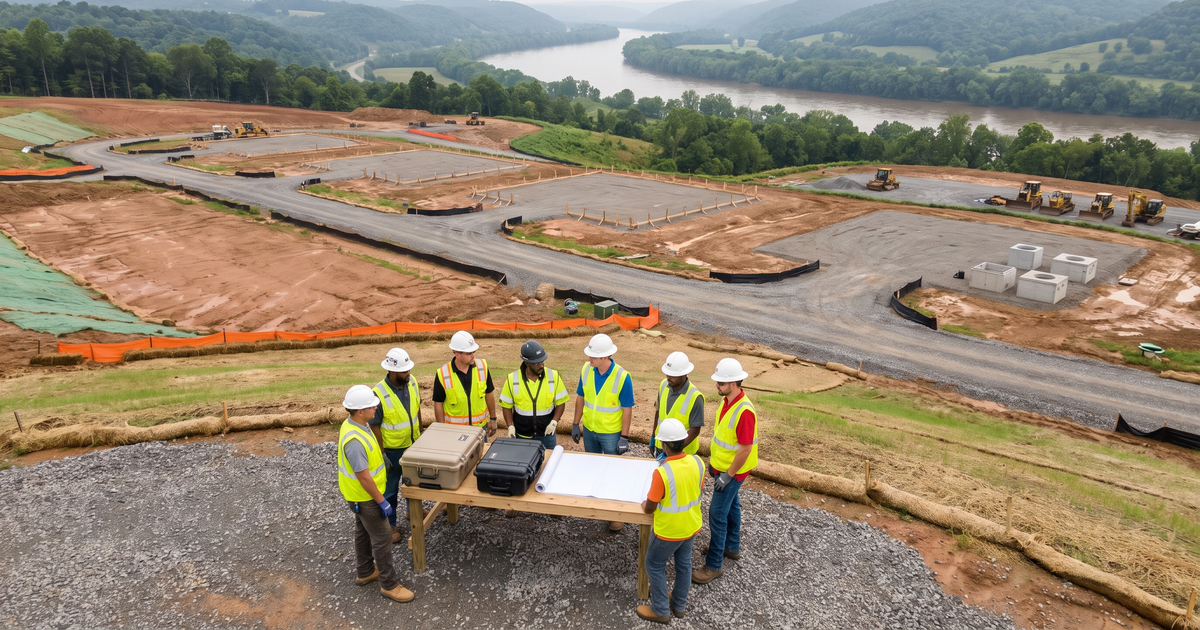
Current public evidence supports an under-construction classification because state regulators document active land-disturbing work and Nscale says it is building significant computing capacity. That classification needs an important qualifier. WVDEP's July enforcement action identified stormwater violations and stopped land disturbance in one separate drainage area until corrected controls were installed and verified. The reviewed order does not say that all campus construction stopped.
Monarch Compute Campus at a glance
| Item | Current public record |
|---|---|
| Location | WV Route 62 north of Point Pleasant |
| Developer | Nscale through Monarch Cloud Campus LLC |
| Phase 1 compute | 1.35 GW engineered capacity |
| Data-center buildings | Three H-shaped buildings in the air application |
| Planned capital | More than $20B stated by Nscale |
| Target | Early 2028 Phase 1 delivery |
| Current stage | Active site work; air application pending |
| Expansion path | More than 8 GW |
Nscale acquired the campus with American Intelligence & Power Corporation in March 2026. The company's acquisition announcement said initial power capacity was expected online in the first half of 2028 and named the site as the first state-certified AI microgrid in the United States. The current project page now frames Phase 1 around 1.35 GW of AI computing capacity with early-2028 delivery.
The project is also described as independent of the public electric grid. Nscale says on-site generation will supply the campus and that closed-loop cooling will avoid municipal drinking-water use during operations. Final cooling equipment, construction water demand, makeup-water requirements, network architecture, fuel supply, emissions controls, and commissioning procedures remain undisclosed in the reviewed public record.
Keep the capacity and investment figures separate
| Figure | What it describes | Reporting limit |
|---|---|---|
| 1.35 GW | Phase 1 AI computing capacity | Nscale engineering target |
| About 1.8 GW | Peak total site demand | WVDEP application estimate |
| 2 GW | Phase 1 power plant | EY economic model |
| 2.16 GW | Gas-generation nameplate | Pending WVDEP application |
| More than 8 GW | Multi-phase expansion path | Future campus potential |
| More than $20B | Nscale planned capital | Not an executed contract |
| $69.2B | EY development-expenditure model | Based on unaudited Nscale inputs |
The $20 billion and $69.2 billion figures should not be combined. Nscale publicly presents more than $20 billion as planned capital investment. The commissioned Ernst & Young economic-impact report separately models $69.2 billion of Phase 1 development expenditures using information supplied by Nscale management. EY says those inputs were not audited and actual results may differ.
Neither number is a disclosed general-construction contract, committed spend, financing close, purchase-order total, or spend-to-date figure. The wider model may include categories beyond buildings and site infrastructure, including compute equipment, on-site power, and other development costs. Contractors should use the figures as scale indicators while waiting for procurement records, named primes, equipment orders, bid packages, permits, and field milestones.
The same discipline applies to megawatts. Computing capacity, peak campus demand, power-plant framing, generator nameplate, and future expansion potential answer different questions. Collapsing them into one headline number would overstate what any single system or contractor is delivering.
Named organizations and current role boundaries
| Organization | Source-backed role | Current boundary |
|---|---|---|
| Nscale | Owner, operator, and developer | GC and specialty team undisclosed |
| Monarch Cloud Campus LLC | Project company and permit applicant | Prime-contractor role unconfirmed |
| NVIDIA | AI compute development partner | Installation scope undisclosed |
| Caterpillar | Power partner and proposed engine supplier | Delivery and installation unverified |
| Generac | Proposed emergency-generator supplier | Delivery and installation unverified |
| Clarke | Proposed fire-pump engine supplier | Delivery and installation unverified |
| Building-trades councils | Construction workforce partners | No package awards disclosed |
| WVDEP | Air and stormwater regulator | Air application still pending |
Nscale names NVIDIA and Caterpillar as development partners. The permit application lists 864 Caterpillar G3520K gas generating units, 48 Caterpillar C175-20 emergency generators, 12 Generac SD-1000 emergency generators, and six Clarke fire-pump engines. A proposed model in an application is valuable design evidence. It does not prove that equipment has been purchased, delivered, installed, accepted, or commissioned.
The WVDEP permit registry currently lists PSD construction application R14-0042 for Monarch Cloud Campus LLC's Point Pleasant Campus. The application was received April 20, 2026. The current listing does not show a final permit date. Power generation and building construction will have different permitting, procurement, installation, testing, and turnover tracks even when they share one campus.
No reviewed primary source names the data-center general contractor or construction manager, architect, civil engineer, structural engineer, building MEP engineer, electrical contractor, fiber carrier, outside-plant contractor, structured-cabling integrator, security integrator, fire-alarm contractor, controls firm, DAS provider, or independent commissioning authority. Named partners and equipment manufacturers should stay within their documented roles until a source expands them.
Where low voltage enters the build
| System | Likely project need | Evidence to watch |
|---|---|---|
| Fiber and OSP | Carrier entrances, campus backbone, and power links | Routes, vaults, splicing, and OTDR records |
| Structured cabling | Data halls, telecom rooms, and support spaces | Tray, labeling, testing, and turnover |
| Access and CCTV | Perimeter, vehicles, buildings, and secure rooms | Integrator, VMS, credentials, and acceptance |
| Fire alarm | Life safety across buildings and power nodes | Interfaces, AHJ review, and testing |
| BMS, EPMS, DCIM | Cooling, power, capacity, alarms, and operations | Platforms, points, networks, and trend data |
| SCADA and controls | Generation, protection, metering, and fuel systems | Network boundaries and functional tests |
| DAS and radio | Operations and emergency-response coverage | RF study, AHJ criteria, and commissioning |
| Commissioning | Integrated turnover across buildings and power | Scripts, witness tests, retests, and closeout |
A three-building AI campus with a dedicated generation plant creates a large outside-plant coordination problem. Fiber, medium-voltage distribution, gas infrastructure, roads, drainage, security, fire systems, water systems, and future phases will compete for corridors. Civil, electrical, mechanical, and communications teams will need coordinated duct banks, handholes, vaults, route diversity, building entrances, separation, grounding, spare capacity, and accurate as-built records.
The data-center interiors will demand repeatable QA. Fiber cleaning and inspection, loss testing, OTDR traces, copper certification, cable-tray coordination, device labeling, access-control acceptance, camera validation, fire-alarm interfaces, controls point checks, network segmentation, and digital closeout packages all affect turnover. Dense AI compute also raises the importance of cooling controls, leak detection, alarm routing, capacity telemetry, EPMS/DCIM integration, and disciplined change management.
The generation plant adds an operational-technology layer. Protection communications, relay networks, SCADA, metering, time synchronization, equipment networks, security, historian data, fuel-gas controls, and power-quality monitoring will need clear responsibility boundaries. Contracts will decide which scopes sit with the generation EPC, electrical contractor, controls integrator, building technology team, or owner.
Jobs, trades, and contractor readiness
The EY model forecasts 4,375 average annual onsite construction jobs over roughly two years and 645 onsite operating jobs. Wider Mason County and statewide totals include indirect and induced activity. Those projections are economic-model outputs rather than a current headcount, union dispatch list, released bid package, or verified job-opening count.
The West Virginia and Tri-State building-trades councils report a workforce memorandum of understanding with Nscale covering the data center and power-generating facility. That is the strongest current path for craft-workforce information. The agreement does not identify the GC, package holders, dispatch dates, manpower curves, or prequalification requirements.
Nscale also announced a $500,000 Mason County STEM and skilled-trades education initiative. Its careers page provides a company-wide hiring resource, but each position needs a West Virginia or Monarch connection before it is described as a campus opening.
Low-voltage contractors can prepare with a mission-critical capability sheet covering safety results, West Virginia staffing, insurance and bonding capacity, manufacturer certifications, BIM coordination, secure-site work, test equipment, QA procedures, material tracking, commissioning support, and digital closeout examples. Useful technical preparation includes fiber cleaning and testing, OSP splicing, grounding and bonding, cable tray and pathway coordination, labeling, controlled documentation, lift readiness, and lockout awareness.
BICSI education and certification covers ICT design, installation, pathways, and project management. The Fiber Optic Association publishes training resources for fiber installation, splicing, cleaning, loss testing, and OTDR documentation. OSHA outreach training supports baseline site-safety readiness. Actual project qualification will depend on the future prime contracts, owner standards, and package-specific requirements.
Stormwater status and the next field signals
WVDEP's July enforcement notice followed flooding and sediment impacts near the construction site. The order required repairs, stronger erosion controls, additional measures, and verification. Work in one separate drainage area was stopped until corrective controls were in place. Contractors should track the compliance record because drainage corrections can affect earthwork sequencing, access, underground routes, foundations, and future mobilization.
The next valuable construction signals are a final R14-0042 air-permit decision, verified stormwater corrective-action completion, building and civil permits, a named GC or construction manager, design-team appointments, foundation activity, structural packages, and equipment deliveries. Electrical awards, fiber-carrier announcements, outside-plant routes, security and fire packages, BAS/BMS and EPMS/DCIM platforms, SCADA integration, cooling vendors, and commissioning appointments would make the low-voltage opportunity more executable.
LVN Signal will track the Monarch Compute Campus across permits, construction status, named companies, workforce releases, power packages, connectivity, hiring, and field evidence. The project is already substantial enough for firms to organize qualifications and watch the buying chain. Actionable bid access begins when a verified buyer, package, prequalification route, or delivery partner becomes public.
Join 35,000+ Low Voltage Pros
Get weekly permit updates, tool deals, job opportunities, and industry news. No spam, unsubscribe anytime.