
Join Low Voltage Nation — Find project opportunities and showcase your company to thousands of industry professionals
New Era's TCDC campus outside Odessa has a land trail, Stream LOI, Energy Dome MOU, 1+ GW planned scale, and open low-voltage package names.
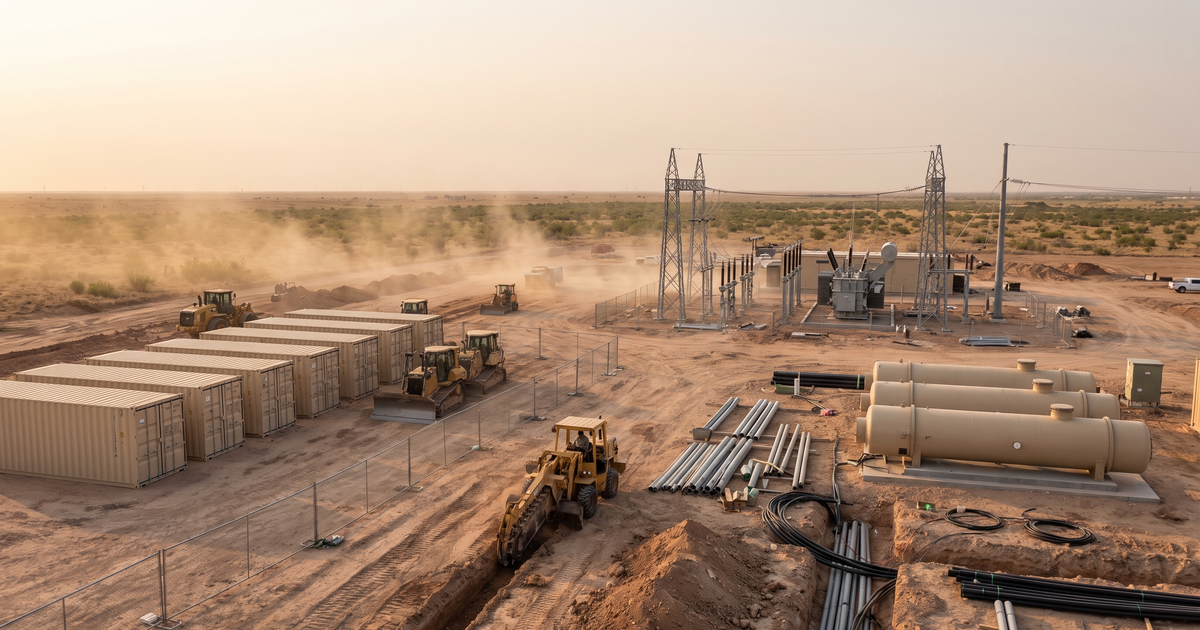
Texas Critical Data Centers in Ector County, Texas is now a high-value LVN Signal watch because the project has moved beyond a vague AI campus announcement. New Era Energy & Digital's TCDC project page describes a flagship AI and high-performance computing campus outside Odessa, about 438 acres, and planned scale above 1 GW over time. The same source points to high-capacity fiber, nearby combined-cycle generation, onsite natural-gas generation, advanced cooling, and potential carbon capture utilization and storage. That is enough to treat the campus as a serious low-voltage and mission-critical infrastructure watch item, while still keeping the unresolved trade-package names separate from confirmed facts.
The strongest near-term construction signal is New Era's partnership release with Stream Data Centers. New Era says it entered a non-binding letter of intent with Stream for development and financing of the TCDC campus. If that structure becomes definitive, Stream is expected to serve as development manager and operator. That does not make Stream the confirmed GC, EPCM, electrical contractor, or low-voltage package holder. It does put a serious data-center development/operator name into the project record and gives contractors a company to monitor for prequalification, procurement, and campus execution signals.
| Item | Source-backed detail | LVN read |
|---|---|---|
| Project | Texas Critical Data Centers / TCDC | AI/HPC campus outside Odessa in Ector County. |
| Developer | New Era Energy & Digital | Source-backed owner/developer context. |
| Campus scale | 438 acres and 1+ GW planned over time | Campus-scale opportunity, not one confirmed building package. |
| Original land scope | 235 acres for a 250 MW AI/HPC campus | SEC-backed early site/company trail. |
| Stream role | Expected development manager/operator under non-binding LOI | Strong watch signal; not a final construction award. |
The land trail is useful because it grounds the project in public-company filings. New Era's SEC Form 8-K says Texas Critical Data Centers LLC executed a purchase agreement with Grow Odessa for about 235 acres in Ector County for a 250 MW AI and HPC data-center campus, and that the transaction closed on July 25, 2025. That is narrower than the current 438-acre / 1+ GW campus framing, so LVN should preserve the distinction: 250 MW is the original SEC-backed land-purchase campus scope, about 200 MW is the stated utility-powered first phase in current project context, about 450 MW is the stated onsite gas-fired generation phase, and 1+ GW is the planned full-campus scale over time.
Energy and storage are part of the story from the beginning. Energy Dome says it signed an MOU with New Era to assess CO2 Battery Plus technology at the TCDC Odessa site. The stated goal is speed-to-power, operational flexibility, and lower-emissions power generation for the campus. For LVN readers, that means the first visible scopes may come from power, controls, EPMS, SCADA/BMS integration, grounding, commissioning, and monitoring rather than from data-hall structured cabling. Power infrastructure can create communications and security work before vertical building packages are public.
| Company | Role | Evidence |
|---|---|---|
| New Era Energy & Digital | Developer / owner | Project page |
| Texas Critical Data Centers LLC | Project company / land-purchase entity | SEC filing |
| Stream Data Centers | Expected development manager / operator if LOI becomes definitive | New Era release |
| Energy Dome | Energy-storage assessment partner | Energy Dome release |
| Grow Odessa / Odessa IDC | Land and economic-development context | SEC filing |
| Vistra / Calpine | Nearby generation context | New Era release |
Trade coverage is helpful, but it should stay in the right lane. Data Center Dynamics confirms the New Era / Stream LOI and the gigawatt-scale West Texas campus framing. Baxtel provides profile context for Texas Critical / Odessa. Those sources are useful for discovery and context, but the article should anchor claims in New Era, Energy Dome, and SEC records wherever possible.
The contractor map is still open. Reviewed public sources do not name a general contractor, EPCM, engineer of record, electrical contractor, low-voltage contractor, fiber/OSP contractor, structured cabling firm, security integrator, fire alarm contractor, BAS/BMS/EPMS controls firm, DAS or networking provider, grounding contractor, or commissioning provider. That is not a weakness in the intelligence; it is the most important business-development point. TCDC is visible early enough that contractors can prepare before obvious package announcements arrive.
| System | Why it matters | Watch signal |
|---|---|---|
| Fiber / OSP | Campus scale and high-capacity fiber language imply carrier routes, entrances, and diverse paths. | Carrier, conduit, duct-bank, MMR, splicing, and testing records. |
| Structured cabling | AI/HPC deployments require disciplined data hall pathways, labeling, and testing. | Fit-out filings, rack/row package language, and certification requirements. |
| Security | Large power-adjacent campuses need perimeter, access-control, CCTV, and visitor controls. | Integrator awards, gate/perimeter packages, VMS language, and construction access systems. |
| Fire alarm | Life-safety and monitoring coordination will matter once buildings and power blocks are filed. | AHJ review, fire alarm permits, acceptance testing, and suppression interfaces. |
| BAS/BMS/EPMS | Cooling, generation, storage, alarms, and facility monitoring create controls scope. | Controls integrator, SCADA/EPMS, commissioning, and turnover documentation signals. |
| Grounding / commissioning | Power-dense AI campuses need QA discipline from utility work through data hall turnover. | Bonding specs, test records, commissioning agent notices, and QA/QC job posts. |
The low-voltage opportunity starts before the first public cabling award. Site development, temporary construction networks, security fencing, camera coverage, access controls, utility communications, power-block monitoring, fiber route selection, carrier coordination, grounding, and controls integration can all appear before data hall fit-out. Contractors watching only TDLR building records may miss earlier utility, power, and site-package signals.
The West Texas context makes that especially important. Power-adjacent AI campuses are not always announced through a clean design-bid-build sequence. They often surface through land entities, generation plans, storage partners, fiber availability, operator LOIs, and economic-development documents before the public sees a conventional construction team. TCDC already has several of those pieces visible. That does not prove a final package sequence, but it gives low-voltage firms enough evidence to start account mapping, qualification work, and source monitoring without pretending the award list is known.
For field teams, the likely preparation path is concrete. Fiber contractors should expect long route coordination, handhole and duct-bank documentation, carrier entrance planning, MMR coordination, OTDR testing, power-meter results, and strict labeling. Security integrators should expect perimeter coverage, construction access, gate controls, camera placement around power and storage assets, visitor workflows, and future data-hall segmentation. Controls and EPMS teams should watch for generation, storage, cooling, switchgear, alarming, trend logs, and turnover requirements. Commissioning teams should expect a document-heavy environment where failed labeling, weak grounding records, or incomplete test packages can slow acceptance.
For estimators and BD teams, the immediate prep is practical. Build a watch list around New Era Energy & Digital, Texas Critical Data Centers LLC, Stream Data Centers, Energy Dome, Grow Odessa, Ector County, Odessa-area permitting, TDLR/TABS, TCEQ, ERCOT, PUCT, utility interconnection records, plan-room notices, and job postings. Track aliases such as Texas Critical Data Centers, TCDC, New Era TCDC, New Era Odessa, Ector County AI campus, Odessa AI data center, Grow Odessa data center, and West Texas TCDC. Alias discipline matters because West Texas already has multiple AI/data-center and power-adjacent projects in motion.
The jobs and skills angle is not a headcount claim yet. Reviewed sources do not disclose a full construction labor peak or permanent operations headcount for TCDC. But the systems implied by the public record point to the same data-center readiness stack LVN has been tracking: OSHA/site onboarding, lift access, fiber cleaning and testing, OTDR and power-meter documentation, copper/fiber labeling, pathway coordination, grounding and bonding, access-control and CCTV commissioning, fire alarm acceptance, controls point lists, EPMS/BMS trend logs, closeout documentation, and mission-critical QA discipline.
The sales motion should be careful. A contractor can say TCDC is worth tracking because the developer, project company, site, land trail, operator LOI, storage MOU, generation context, and fiber language are public. A contractor should not say a package is available, that Stream has awarded the work, or that any named specialty contractor is attached unless a source proves it. The useful posture is to prepare resumes, safety records, data-center references, bonding/insurance documentation, test-equipment capability, and commissioning experience now, then watch for the public records that turn the opportunity from intelligence into pursuit.
TCDC should stay distinct from other West Texas and Permian-region projects. It is not Chevron / Microsoft Project Kilby in Reeves County. It is not IREN Sweetwater, Galaxy Helios, Vantage Frontier, Circe West Texas, or Google / Intersect Meitner. The shared theme is power-adjacent AI infrastructure, but the source-backed company trail and site trail are different. LVN should not merge them when tracking contractors, packages, or utility milestones.
The best next evidence would be a definitive Stream/New Era agreement, a filed building package, an engineer-of-record, a GC/EPCM announcement, utility or interconnection records, TCEQ air or generation filings, TDLR/TABS records, site-work permits, or job postings tied to named project roles. Until then, the public article should frame TCDC as a high-confidence early construction-intelligence watch with major open package names, not as a completed procurement map.
Bottom line: New Era's TCDC campus belongs in LVN Signal because the owner, project company, site, land trail, Stream LOI, Energy Dome MOU, generation context, fiber language, and multi-phase capacity path are visible now. The low-voltage opportunity is real enough to monitor, but the package holders are not source-backed yet. That is exactly the window where LVN can be useful: organize the public record, separate confirmed facts from watch items, and give contractors a disciplined way to follow the opportunity before the market gets noisy.
Join 35,000+ Low Voltage Pros
Get weekly permit updates, tool deals, job opportunities, and industry news. No spam, unsubscribe anytime.