
Join Low Voltage Nation — Find project opportunities and showcase your company to thousands of industry professionals
Nebius has broken ground on its Independence, Missouri AI factory campus. LVN breaks down the named companies, power path, low-voltage scope, jobs, skills, and signals to watch.
Nebius has moved from approval to construction in Independence
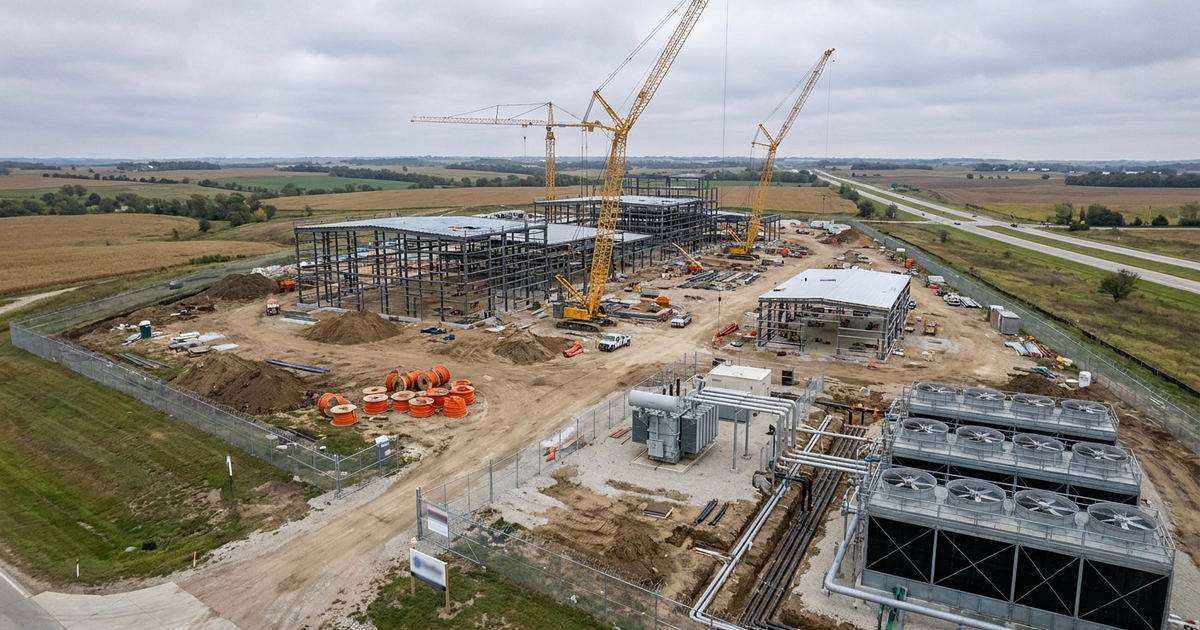
Nebius is no longer just proposing an AI factory in Independence, Missouri. The company says it broke ground on May 12, 2026, starting construction on a multi-building campus on roughly 400 acres in eastern Independence. For LVN, that moves the project from a policy and incentive story into a construction-market signal. The first phase is now the part to watch: land, utility service, building delivery, power rooms, pathways, secure perimeters, cooling interfaces, controls, and the low-voltage trades that support a hyperscale AI facility.
The strongest source is Nebius's May 12 groundbreaking release. It says the Independence AI factory is the company's first gigawatt-scale digital infrastructure project in the United States, that construction of the first phase is underway, and that the project is expected to create about 1,200 construction jobs and 130 permanent high-tech jobs at full operation. The public materials also point to local union building trades, education programs, a community benefits plan, and a long-term tax base for local jurisdictions.
That is exactly the type of project where low-voltage companies need to start mapping the account before every specialty contractor is public. A gigawatt-scale AI factory is not only a shell, a transformer yard, and GPU capacity. It is a dense coordination problem across fiber, OSP, structured cabling, access control, CCTV, fire alarm interfaces, BAS/BMS controls, operational networks, DAS, grounding, labeling, testing, closeout documentation, and commissioning.
| Item | Public detail | LVN read |
|---|---|---|
| Location | Eastern Independence, Missouri | Kansas City-area labor, utility, and public-record signals matter. |
| Site | About 400 acres | Large campus footprint points to OSP, entrances, perimeter security, and phased pathways. |
| Capacity | Up to 1.2 GW potential | Power delivery and commissioning timing will shape technology packages. |
| First building | 490,000 SF / 200 MW | The first phase gives vendors a concrete building and load to track. |
| Jobs | About 1,200 construction jobs | Workforce, apprenticeship, safety, and documentation discipline become part of the story. |
The first named construction-side company is ARCO
The clearest construction-side page is from ARCO National Construction. ARCO describes the Nebius project as a 490,000-square-foot, 200-megawatt AI factory in Independence. ARCO also says the project is the first phase of a planned 1.2-gigawatt campus on a 400-acre site and marks the project status as under construction. That matters because ARCO is not simply mentioned in a quote. It is publishing a project page with size, capacity, status, and design-build data-center positioning.
The ARCO page says the first building is engineered for high-density AI infrastructure and will address utility, environmental, and community requirements. It also points to closed-loop cooling, noise mitigation, electrical connection to the city's municipally owned utility, and planning intended to avoid residential rate increases. None of that makes ARCO a low-voltage contractor. It does make ARCO the primary named construction company for account mapping, prequalification watching, supplier signals, and package-level follow-up.
The owner/operator side is also unusually specific. Nebius's Independence project page places the site near Route 78 and Little Blue Parkway, describes a Q2 2026 through 2029-plus window for site construction and capacity coming online, and says utility and site power will be derived from Independence Power and Light and the Southwest Power Pool. The same page refers to initial power in the second half of 2026 and additional power planning by early 2029. Those are schedule signals for everyone downstream of power delivery.
| Company | Public role | Why to watch |
|---|---|---|
| Nebius | Owner/operator/developer | Primary source for capacity, jobs, schedule, community, and power updates. |
| ARCO National Construction | General contractor / design-build construction page | Best current construction-side path for phase-one project signals. |
| Independence Power & Light | Municipal power provider | Power delivery, studies, local generation, and rate structure affect the schedule. |
| City of Independence | Municipal approval authority | Chapter 100, public meetings, permits, and infrastructure items may surface here. |
| Missouri DED / KCADC / MCC | Economic and workforce partners | Useful for jobs, training, incentive, and regional development context. |
Power, approvals, and public funding signals are part of the construction story
The March approval release is important because it explains why the project could proceed. Nebius says the Independence City Council approved a Chapter 100 industrial development incentive plan for the AI factory campus, enabling construction of the company's largest U.S. AI factory to date. That release describes potential capacity up to 1.2 GW, the approximately 400-acre campus, roughly 1,200 skilled construction jobs, about 130 permanent positions, closed-loop cooling, connection to Independence Power and Light, and projected PILOT payments of more than $650 million over 20 years.
The Missouri Department of Economic Development separately corroborates the groundbreaking and says construction of the first phase is underway. That state source matters because it is not a vendor page. It validates the project as an active economic-development event in Missouri and reinforces the jobs, workforce, and infrastructure framing.
For contractors, the utility path is one of the highest-value things to monitor. AI data centers often look slow from the outside until power, substation, switching, generation, and service work aligns. Then the downstream schedule compresses. Nebius says the project connects to Independence Power and Light and IPL participation in the Southwest Power Pool. The project page also says IPL will deliver initial power in the second half of 2026 and study additional power by early 2029. That creates a practical timeline for watching package movement around building turnover, security, controls, carrier entrances, and commissioning.
Where low voltage shows up
No public source in this packet names the electrical contractor, low-voltage contractor, fiber carrier, security integrator, fire alarm contractor, BAS/BMS contractor, DAS provider, network integrator, or commissioning agent. That is not a weakness in the story. It is the reason this belongs on the watchlist now. The named project is active, the owner is public, the first building is public, the construction-side company is public, and the package-level names are still forming.
The low-voltage opportunity is not one single bid. It is a chain of scopes and coordination points that appear as the first phase moves from site work and utility readiness into facility buildout and commissioning. Data-center crews should watch for language around telecom rooms, MMRs, carrier entrance facilities, fiber duct banks, cable tray, secure lobby and mantrap packages, camera poles, access readers, VMS, fire alarm coordination, BAS points, EPMS/BMS integration, public-safety DAS, grounding and bonding, labeling standards, test results, as-builts, commissioning scripts, and turnover packages.
| Scope | Project surface | What to watch |
|---|---|---|
| Fiber and OSP | Campus backbone, carrier paths, entrances, duct banks, and vaults. | Route work, utility crossings, test records, and diverse entrances. |
| Structured cabling | Telecom rooms, data hall support cabling, pathways, labeling, and QA. | Cable tray, rack/row work, standards language, and closeout documentation. |
| Access control and CCTV | Perimeter, gates, buildings, secure areas, loading zones, and operations spaces. | Integrator awards, device schedules, VMS choices, and commissioning dates. |
| Fire alarm interfaces | Life-safety coordination with suppression, monitoring, and local inspections. | FA contractor names, special inspection milestones, and AHJ coordination. |
| BAS/BMS and networking | Cooling, monitoring, alarms, OT networks, and equipment integration. | Controls integrator roles, trend logs, network boundaries, and turnover scripts. |
| DAS and grounding | Public-safety coverage, in-building wireless, racks, pathways, and bonds. | Coverage testing, AHJ requirements, grounding QA, and final acceptance. |
Jobs and skills: this is a workforce story too
Nebius's public materials make workforce part of the project. The groundbreaking release says the build is expected to create about 1,200 construction jobs, overwhelmingly from local union building trades, and the community page says Nebius plans to support trades apprenticeship programs, updated tools, simulators, and labs. The practical takeaway for LVN readers is simple: the contractors who win on this kind of campus are not only low bidders. They are teams that can work safely on a high-control site, staff consistently, document every pathway and test result, and coordinate cleanly with electrical, mechanical, utility, security, and commissioning teams.
Technicians should sharpen the basics before the package names appear. Useful paths include BICSI optical fiber training, BICSI copper installer training, FOA workforce fiber resources, and OSHA outreach training. For mission-critical sites, the differentiator is often the discipline around testing, labeling, cleaning, grounding, as-built documentation, lift safety, access rules, QA, and commissioning support.
The next useful signals are specific: ARCO subcontractor or supplier paths, City of Independence permit language, Independence Power and Light power milestones, SPP-related power references, local generation and substation records, carrier/fiber route evidence, security and controls job postings, fire alarm or DAS permit language, and named commissioning roles. Until those names surface, LVN is treating Nebius Independence as a high-confidence AI data-center construction opportunity with a clear first-phase low-voltage watchlist.
For local contractors and suppliers, the action is practical. Build the account map now: Nebius, ARCO, Independence Power and Light, the City of Independence, Missouri economic-development contacts, workforce partners, and public permit channels. Then monitor the signals that usually precede low-voltage awards: subcontractor prequalification, design-build partner pages, union or apprenticeship announcements, security technician jobs, controls roles, data-center commissioning roles, telecom-room language, carrier entrance work, underground duct banks, camera and access-control device schedules, fire alarm coordination notes, and public-safety coverage requirements. The public sources do not yet answer every package question, but they do define the project family clearly enough to track it with discipline.
LVN Signal is tracking this project because AI data-center construction is moving faster than traditional market lists. The value is not just knowing that a data center exists. It is seeing the owner, site, first-phase building, construction lead, public approvals, power path, workforce context, and trade signals while contractors still have time to build a position.
Join 35,000+ Low Voltage Pros
Get weekly permit updates, tool deals, job opportunities, and industry news. No spam, unsubscribe anytime.