
Join Low Voltage Nation — Find project opportunities and showcase your company to thousands of industry professionals
MSB Global's Matrix campus is a 3 GW owner-stated AI data-center watch with reported land clearing, carrier context, and unknown package holders.
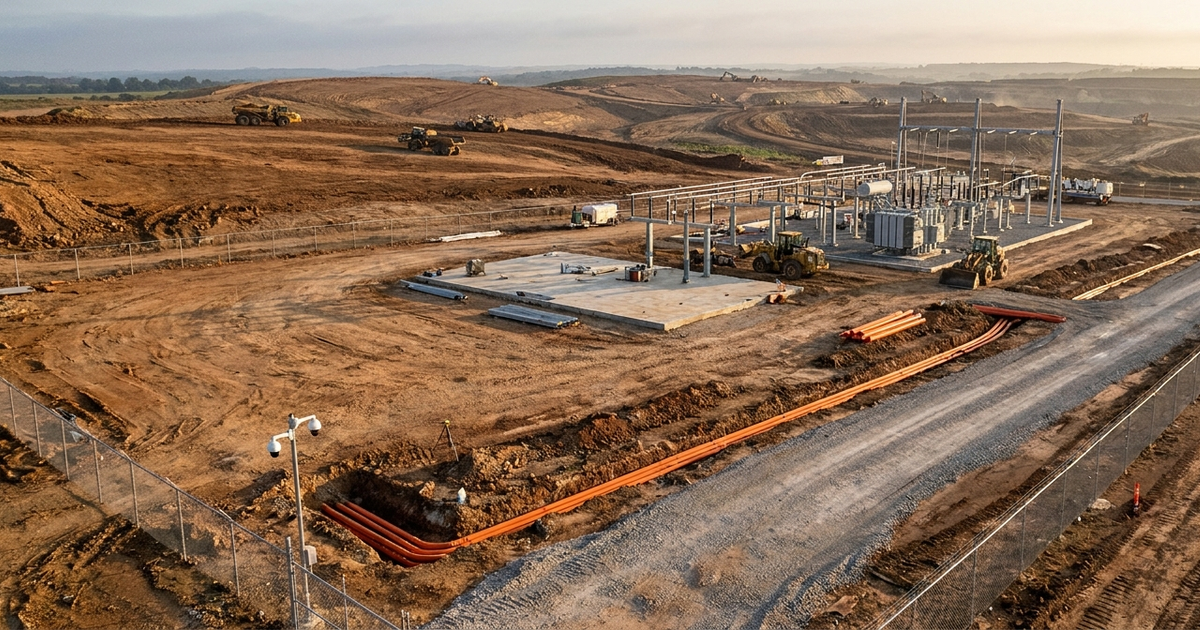
MSB Global Services has turned the former Thermo mine area in Sulphur Springs, Texas into one of the biggest and least settled AI data-center construction watches in the market. The public pitch is enormous: a Matrix Business Reserve campus on 1,677 acres, 30 planned 100 MW buildings, 3 GW of total campus capacity, direct-to-chip cooling, onsite substation work, carrier context from Zayo, Lumen, and AT&T, and thousands of construction and technology jobs. The source-backed construction read is more careful: land clearing and site/infrastructure work are reported underway, but reviewed public sources do not yet name a vertical building permit, general contractor, engineer of record, electrical contractor, low-voltage contractor, or commissioning firm.
The strongest owner-side source is MSB's official Sulphur Springs project page. MSB describes Matrix as a 1,677-acre campus in the Matrix Business Reserve with 30 planned 100 MW buildings, 3,000 MW of total power, direct-to-chip cooling, two redundant 30 MVA substations per building, an onsite substation under construction, bridge microgrid power, and Tier I carrier context from Zayo, Lumen, and AT&T. That is enough to make the project relevant to LVN Signal, especially because the advertised systems point directly at fiber, outside plant, structured cabling, security, fire alarm, controls, operational networking, and commissioning work.
The second owner-side source is MSB's Matrix press kit. It repeats the 3 GW hyperscale AI/HPC campus frame, says the plan is 30 identical 100 MW buildings, claims 400 MW in Q4 2026 and another 400 MW in Q1 2027, and describes monthly 100 MW delivery during 2027 and 2028. Those are useful schedule claims, but they should be treated as developer-stated milestones until public permits, utility records, power-generation filings, financing records, or contractor announcements confirm delivered phase capacity.
| Project Fact | Source-Backed Detail | LVN Read |
|---|---|---|
| Campus scale | MSB states 1,677 acres, 30 buildings, and 3 GW total campus target. | Track as owner-stated campus scale, not verified delivered IT load. |
| Current stage | Local reporting says land clearing and infrastructure work are underway. | Construction watch is valid, but vertical data-center packages are not public. |
| Power path | MSB cites onsite substation work and bridge microgrid power. | Watch TCEQ, ERCOT, PUCT, Oncor, TXU, and city records. |
| Connectivity | MSB names Zayo, Lumen, and AT&T as carrier context. | Fiber entrance, OSP, MMR, and carrier diversity are likely LV scopes. |
| Jobs | MSB/KLTV cite 7,000 temporary and permanent construction/IT jobs. | Useful workforce signal, but package holders remain unnamed. |
Local coverage supplies the construction signal and the risk context. KLTV reported that developers had begun clearing land for the Matrix Center in Hopkins County, led by MSB Global Services, and cited Sulphur Springs city manager Marc Maxwell on an $18 billion investment, 1,500 jobs, 7,000 construction-phase jobs, 30 AI-processing buildings, water and fire-station context, and onsite natural-gas power because ERCOT power would not be enough for the projected load. Construction Equipment Guide mirrors the same work-underway signal, which makes the project more than a purely speculative website announcement.
The caution comes from another KLTV public-process report and a KSST Radio review. KLTV describes resident questions, reviewed city minutes, Thermo Road infrastructure, and a deed-restriction dispute involving Luminant/Vistra and power generation or storage on former mine property. KSST adds questions around financing, onsite generation plans, insurance, timeline, and tax-abatement negotiations. For contractors, that does not mean ignore the project. It means keep the pitch and the verified work separate.
| Organization | Source-Backed Role | Evidence |
|---|---|---|
| MSB Global Services | Developer and public project promoter for Matrix. | MSB project page. |
| SSDC1 LLC | Project entity named in local public-process reporting. | KLTV public-process coverage. |
| City of Sulphur Springs | Local infrastructure and public-process context. | KLTV and Sulphur Springs Forward. |
| Oncor / TXU | Utility context reported by secondary research. | Aterio Matrix coverage. |
| Zayo / Lumen / AT&T | Carrier context listed by MSB. | MSB project page. |
| Bloom Energy | Reported power-vendor context only. | Aterio secondary coverage. |
The contractor stance should stay conservative. Reviewed sources do not publicly name the GC, EPCM, engineer of record, electrical contractor, low-voltage contractor, fiber or OSP contractor, security integrator, fire alarm contractor, BAS/BMS controls firm, DAS provider, grounding contractor, or commissioning agent. That matters because a 3 GW campus claim can tempt sloppy contractor attribution. In the public article, the correct sentence is simple: MSB is source-backed as developer, the city and county are local context, carrier and utility names are context, and specialty package holders are still unknown.
The low-voltage opportunity is still real if the campus moves. MSB's own technical claims imply campus-scale carrier entrances, dark-fiber backbone, diverse routes, meet-me rooms, IDF/MDF planning, pathway and tray coordination, structured cabling, access control, CCTV, perimeter security, fire alarm interfaces, BMS/BAS, SCADA or operational networking, DAS or public-safety wireless, grounding and bonding, labeling, testing, commissioning, and turnover documentation. None of those scopes should be assigned to a named contractor yet, but they are the right scopes for LVN members to watch.
| LV System | Where It Shows Up | Public Signal To Watch |
|---|---|---|
| Fiber / OSP | Carrier entrances, diverse routes, MMRs, duct banks, and campus backbone. | Zayo, Lumen, AT&T, boring, conduit, easement, and fiber-contractor records. |
| Structured cabling | Data halls, support spaces, telecom rooms, rack/row pathways, and labeling. | Tenant fit-out, tray, pathway, cabling, and closeout bid language. |
| Access control / CCTV | Perimeter, gates, yards, buildings, data halls, and operations spaces. | Security integrator awards, camera/VMS schedules, and commissioning jobs. |
| Fire alarm | Life-safety coordination with suppression, AHJ inspection, and monitoring. | Fire alarm permits, inspections, and specialty contractor names. |
| BMS/BAS / SCADA | Cooling, power monitoring, alarms, bridge microgrid context, and facility dashboards. | Controls integrator, point list, OT network, and commissioning records. |
| DAS / networking | Public-safety wireless, facility network segmentation, and operational systems. | DAS design, carrier coordination, IT/OT integration, and test records. |
| Grounding / commissioning | Telecom bonding, electrical coordination, test evidence, and turnover readiness. | Grounding specs, QA checklists, commissioning-agent records, and punch lists. |
The site also has a power story that low-voltage contractors should not ignore. Data centers at this scale pull electrical, controls, network, security, fire, and commissioning teams into the same schedule. MSB talks about bridge microgrid power and onsite substation construction. KLTV says onsite natural-gas generation is part of the local discussion because ERCOT power is not enough. Aterio describes Bloom fuel-cell microgrid claims and Oncor/TXU context. The safe read is that the power path is central but not fully verified in public records. TCEQ air filings, ERCOT or PUCT records, Oncor interconnection records, city development agreements, and any permit tied to the former Thermo mine should be watched before treating the campus schedule as firm.
For workforce preparation, the best move is not chasing a rumored package. It is getting data-center-ready. Crews that can document fiber tests, maintain clean labeling, manage secure-site access, coordinate with electrical pathways, use lift equipment safely, support access-control and CCTV commissioning, understand fire alarm interfaces, work around BAS/BMS controls, and produce clean closeout documentation will be easier to plug into a real package once a prime contractor or specialty contractor is named. BICSI copper and fiber training, FOA fiber training, OSHA outreach training, grounding and bonding discipline, and commissioning documentation habits all matter more than guessing who has the award.
Small and mid-size contractors should also separate three outreach lanes. The first lane is public-record monitoring: city council minutes, development agreements, fire-service planning, building permits, TCEQ applications, ERCOT or PUCT records, and Oncor/TXU references. The second lane is prime-contractor discovery: plan-room notices, prequalification pages, LinkedIn hiring, superintendent postings, procurement language, and vendor-registration pages tied to Matrix, Thermo Road, SSDC1, or MSB Global. The third lane is capability packaging: a short data-center qualifications sheet that proves fiber testing gear, certified installers, safety training, secure-site discipline, labeling standards, redline quality, and commissioning support. That is a better sales asset than a cold email claiming knowledge that is not public.
The risk language should remain visible in sales and content. KLTV and KSST both show that local process, legal restrictions, power generation, insurance, financing, and tax-abatement questions are part of the project context. Those questions do not erase the opportunity, but they change how LVN should frame it. This is a high-upside watch item with source-backed developer materials and local work-underway reporting, not a clean list of awarded scopes. Treat every future name as evidence-gated: when a GC, engineer, electrical contractor, fiber contractor, security integrator, fire alarm contractor, controls firm, DAS provider, or commissioning agent appears in a public source, then it can move from watch list to named project role.
Sulphur Springs Forward is useful as local project-advocacy context, and Baxtel's Matrix Bldg-4 profile is useful as data-center directory context. Neither should replace owner, public-record, utility, permit, or contractor evidence. They do help with aliases: Matrix Campus, Matrix Center, Matrix Business Reserve, Thermo Mine data center, Thermo Road data center, SSDC1, Sulphur Springs AI data center, and Hopkins County data center. Those names should be included in monitoring searches.
The bottom line for LVN members is this: Matrix is too large to ignore and too early to overstate. The source-backed story is a developer-promoted AI/HPC campus in Sulphur Springs with reported land clearing, major owner-stated capacity, carrier context, local infrastructure issues, and unresolved power, legal, financing, and package-award questions. Publish it as a contractor watch item, not as a fully awarded low-voltage job. The next meaningful signals are building permits, TCEQ and power-generation filings, Oncor or ERCOT movement, named GC/EPCM, engineer-of-record, specialty package awards, and job postings tied to Thermo Road or Matrix.
Join 35,000+ Low Voltage Pros
Get weekly permit updates, tool deals, job opportunities, and industry news. No spam, unsubscribe anytime.