
Join Low Voltage Nation — Find project opportunities and showcase your company to thousands of industry professionals
Microsoft confirms early site work at Silver Springs, Nevada. Explore Q&D’s documented role, separate substation approvals and prospective low-voltage scopes.
Microsoft's Silver Springs data center project has reached early site work, creating a useful construction signal for Nevada contractors. The confirmed activity is property preparation, earthmoving and utility relocation. Microsoft names Q&D Construction LLC as general contractor for that work. Low-voltage installation awards, building delivery dates and electrical capacity remain undisclosed.
The opportunity is in understanding how the site could progress from civil work into communications, security, controls and commissioning. Contractors can use the documented project team and public qualification routes to prepare their capabilities while waiting for specific procurement evidence. A verified construction milestone is useful even when an available subcontract has yet to be identified.
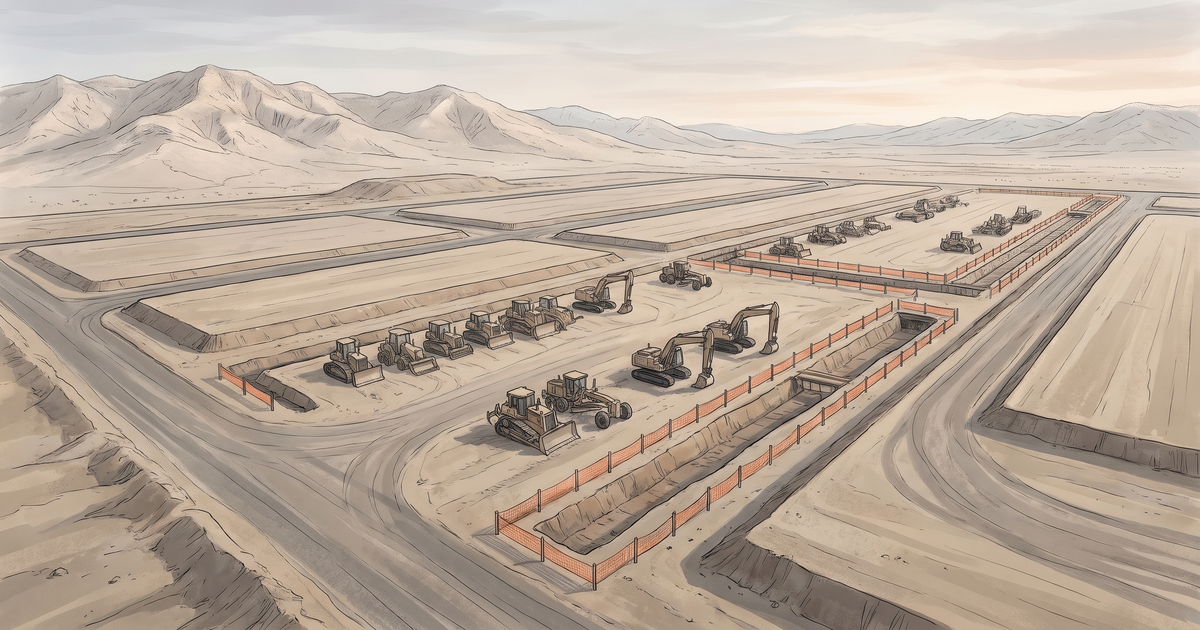
Reporting checked November 1, 2026. Generated artwork is an editorial concept of site preparation and fiber work; it does not document the actual site, layout or construction progress.
What is confirmed at Silver Springs
Microsoft's September 2026 construction update describes early activity at the Nevada site and expects construction to proceed in stages over several years. It establishes Q&D's current role without identifying later building or specialty packages. The update discusses cloud infrastructure broadly; it does not disclose a particular AI workload, customer or GPU deployment at Silver Springs.
An independent government record supports the construction status. Lyon County's October 15 commission packet, PDF page 60, places the campus north of US 50 and west of US 95A. Its development report records an administrative design review issued April 24 and approved grading plans for the campus and substation projects. It lists active construction. That supports an early-works description; completed data halls and occupancy are not established by the report.
| Project fact | Documented position | Qualification |
|---|---|---|
| Location | Silver Springs, Lyon County, Nevada | North of US 50, west of US 95A |
| Current stage | Earthwork and utility relocation | Vertical construction unverified |
| Current contractor | Q&D Construction LLC | Owner names early-work scope |
| Assessed parcel | 015-141-14; 223.18 acres | Tax parcel, not work footprint |
| Power and delivery | MW and opening date undisclosed | Substation voltage is a separate measure |
| Commercial scale | Cost, financing and jobs unknown | No numerical commitment verified |
The county assessor entry identifies Microsoft Corporation as owner of the 223.18-acre parcel at 1700 W Hwy 50. It records a May 19 merger/resubdivision. That acreage describes the assessed property. It does not establish the footprint currently being graded, the number of buildings or the final campus boundary.
Two substation approvals, with different boundaries
The county's signed RNO18 action letter, dated March 9, records a March 5 vote of 4–1 approving PLZ-2025-110. The approval covers a 120 kV substation on approximately 18.70 acres, with conditions and a masonry-wall requirement. A separate Nighthawk action letter records a 3–2 vote on PLZ-2025-109 for a 345/120 kV substation, two high-voltage lines and associated infrastructure across approximately 32.59 acres.
Those are conditional land-use actions. The letters do not demonstrate that all conditions were satisfied, that facilities were built or that power was energized. Their acreage descriptions also have different purposes from the assessor's parcel area; adding them together would create an unsupported campus-size claim.
Voltage indicates an electrical operating level. Estimating deliverable power would require additional equipment ratings and system constraints. Critical IT load would require another layer of facility information. Consequently, these filings do not support an advertised megawatt total for this campus. Financing, utility delivery commitments and operational capacity require their own evidence.
For communications contractors, the analytical relevance is coordination. Civil, electrical and communications teams can share corridors, crossings and interface points even when their contracts are separate. A useful future package would identify approved routes, access dates, trade boundaries and acceptance responsibilities. The existing records do not identify those buyers or issued specifications.
Named companies and their documented roles
Microsoft's owner update is the project-specific basis for Q&D's involvement. Q&D's corporate website supplies company background and navigation to its public subcontractor and employment resources. The county substation correspondence is addressed to Wood Rodgers, establishing a representative role. Wood Rodgers' website establishes the company's identity; a complete campus engineering award is not established by these documents.
| Organization | Documented role | Scope boundary |
|---|---|---|
| Microsoft Corporation | Owner and intended operator | Workload and capacity undisclosed |
| Q&D Construction LLC | GC for current early work | Later building/LV awards unverified |
| Wood Rodgers, Inc. | Substation land-use representative | Full design contract unverified |
| Lyon County | Land-use and development authority | Approvals retain conditions |
Arup appears in a county correspondence copy list. That alone does not establish an engineering contract. No electrical, fiber, structured-cabling, security, fire-alarm or controls installer was verified for the campus. These distinctions matter when building a prospective customer list: the relevant decision-maker depends on the eventual contract package and phase.
Where low-voltage work could emerge
The scopes below are practical analysis for a developing data center site. They are prospective categories, with quantities, designs, purchasing responsibility and subcontract awards still unknown. They give contractors a way to organize questions and evidence without presenting the campus as an open bid.
| Potential scope | Preparation focus | Evidence to seek |
|---|---|---|
| OSP and campus fiber | Routes, crossings, splicing | Issued plans and package buyer |
| Structured cabling | Pathways, labels, test records | Building fit-out specifications |
| Access control and CCTV | Power/network interfaces | Security design and integrator |
| Fire alarm interfaces | Monitoring and acceptance | Approved life-safety sequence |
| BMS and controls networks | OT boundaries and point lists | Controls architecture and award |
| Commissioning support | Test evidence and turnover | Acceptance plan and responsible lead |
Outside-plant firms can prepare examples of coordinated underground work, including crossings, conduit verification and traceable cable records. Those examples should show how the team resolved interfaces with civil and electrical contractors. A capability statement becomes more useful when it demonstrates a comparable constraint and the documentation delivered with the installation.
Fiber teams can assemble representative inspection, cleaning, splicing and testing records. The future specification will determine fiber types, test methods, acceptance limits and reporting formats. Preparing disciplined examples now is sensible; purchasing project-specific materials before those requirements exist would depend on assumptions that these sources cannot support.
Security and controls firms should be ready to explain device connectivity, power boundaries and handoff responsibilities. Proposed work can fail commercially when multiple subcontractors assume somebody else owns the same interface. A prospective scope review should explicitly identify responsibility for pathways, cable, network configuration, integration and final acceptance.
Life-safety coordination requires equally precise boundaries. A communications installer cannot assume ownership of fire-alarm programming, inspections or acceptance simply because a data center needs monitoring. Those responsibilities follow the actual approved design, applicable requirements and awarded contracts. The present public record does not identify the responsible campus installer.
Jobs, skills and credible entry points
No campus-specific construction headcount, permanent-job total or currently available vacancy was verified. Q&D's employment page describes company career, apprenticeship and internship routes. Those are useful employer resources, but a reader should check a particular listing's location, role and current availability before treating it as a Silver Springs opportunity.
For a technician, practical preparation includes fiber cleanliness and testing, pathway coordination, bonding, labeling, drawing literacy and turnover documentation. Employers determine the credentials and experience needed for each role. The Fiber Optic Association's workforce resources provide a starting point for exploring fiber training. BICSI is another resource for ICT education and credentials. These links are general preparation resources; no campus-mandated certification list was obtained.
Contractors can review Q&D's subcontractor page and its qualification route. A focused submission would describe relevant experience, geography, workforce capacity and the systems the firm actually installs. A qualification route does not establish an available package, invitation to bid or acceptance onto a project team.
A useful internal readiness review can be concrete: identify the crew that could support a Nevada project, list comparable completed work, and assemble a sample turnover package. Separate self-performed work from work that would require a partner. Record the assumptions behind travel, supervision and equipment availability. This gives an estimator a realistic starting point if an issued package arrives, while keeping the present decision limited to preparation. A future bid can then be evaluated against actual drawings, schedule, commercial terms and capacity.
Microsoft also publishes a construction-question contact in its update. Its stated purpose is communicating about construction activity. Readers seeking employment or procurement information should use the appropriate company resources and confirm the right channel before submitting material.
The next milestones that would change the opportunity
The most useful next evidence would make scope and timing more specific: building permits, a disclosed vertical-construction phase, named specialty contractors, issued bid packages or a dated commissioning program. Utility construction and energization records could clarify electrical readiness. A published job listing tied to the campus could establish a real hiring lead.
Each milestone answers a different question. A grading approval supports earthwork planning. A subcontract award identifies a responsible company and defined package. A commissioning record can establish completion of particular tests. A funding announcement can clarify a financing event. Treating those documents separately helps readers judge when preparation becomes a live commercial opportunity.
Location also deserves care. The project map uses the county parcel centroid as a property locator. It is not a surveyed building position or a site entrance. Anyone planning a visit, delivery or site walk should obtain the current access instructions from the responsible project team.
Silver Springs offers a documented early-construction lead with a named contractor and separate infrastructure approvals. Follow LVN Signal for project intelligence, company relationships and construction updates, and use the linked primary records to assess scope before committing estimating time or field resources.
Join 35,000+ Low Voltage Pros
Get weekly permit updates, tool deals, job opportunities, and industry news. No spam, unsubscribe anytime.