
Join Low Voltage Nation — Find project opportunities and showcase your company to thousands of industry professionals
Microsoft's MNZ07 Wellington project now has a two-building environmental permit scope, an onsite substation, direct fiber-conduit evidence, and a county final-site-plan case while contractor packages remain undisclosed.
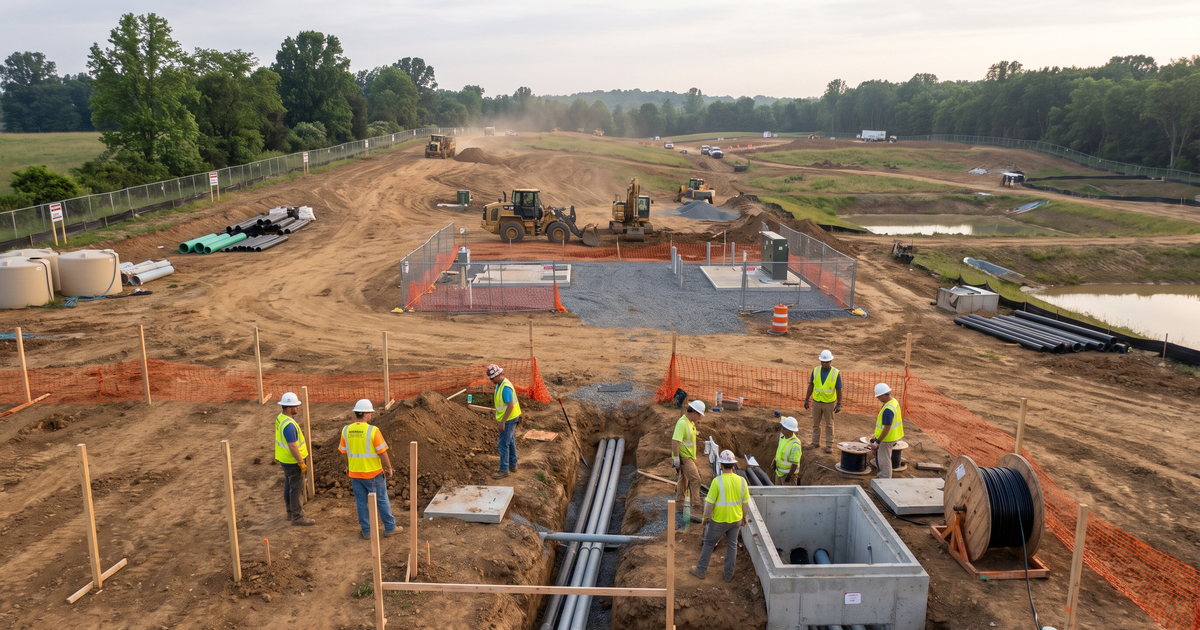
Microsoft's MNZ07 Wellington project has crossed into a stronger public-record stage in Gainesville, Virginia. A Virginia Department of Environmental Quality notice identifies Microsoft Corporation as the applicant for U.S. Army Corps of Engineers project 26-088F at 13490 University Boulevard. The proposed work covers two one-story data-center buildings on a 123-acre permit site, plus an onsite electrical substation, water storage, detention ponds, domestic and fire-hydrant water, sanitary sewer, industrial wastewater, fiber and electrical conduit, and stormwater systems.
The Clean Water Act public-comment period ran through August 7, 2026. That does not mean the federal permit has been issued, construction has started, or every site and building permit is complete. It does mean the project now has a named owner/applicant, a site-specific federal permit identifier, a defined two-building scope, and direct public-record evidence for fiber conduit, electrical conduit, fire-water infrastructure, wastewater systems, and an onsite substation.
Prince William County provides a separate land-use frame. Its June 30 DCOZOD property list identifies the address as ARC Wellington, GPIN 7497-43-7416, with 117.21 acres and final site-plan case SPR2023-00349. The county attachment explicitly warns that the list is not itself a final zoning determination. LVN is therefore treating it as strong case-and-alias evidence, not as proof of every approval or a notice to proceed.
| Project fact | Source-backed detail | Current limit |
|---|---|---|
| Location | 13490 University Blvd, Gainesville | Track GPIN 7497-43-7416. |
| Stage | Environmental permitting / final site plan | No sourced construction start. |
| Building scope | Two one-story data-center buildings | Square footage not disclosed. |
| Site frame | 123 permit acres / 117.21 county acres | Different public-record frames. |
| Power | Onsite electrical substation | MW and utility team unknown. |
| Direct LV clue | Fiber and electrical conduit | Package holders unknown. |
The acreage figures should remain separate. Virginia DEQ describes the permit action across 123 acres. Prince William County lists the specific ARC Wellington GPIN at 117.21 acres. Those values may reflect different boundaries, rounding, parcels, or regulatory scopes, but the current public records do not provide enough evidence to reconcile them. Publishing one blended acreage number would create false precision.
The same discipline applies to cost and building area. Data Center Dynamics reported that Microsoft bought about 124 acres across 13490 University Boulevard and 5941 Wellington Road for $465.5 million in 2024. That is a land-acquisition price, not construction capex. The report also referenced an earlier density request for up to 3.8 million square feet of data-center uses and a new substation. That was a maximum development request, not the current two-building permit scope and not verified built area.
Current reviewed sources do not disclose MNZ07 building square footage, MW capacity, critical IT load, generator count, cooling design, construction budget, construction headcount, permanent jobs, start date, or completion date. They also do not name a general contractor, EPCM, architect, engineer, utility, civil contractor, electrical contractor, fiber/OSP provider, low-voltage contractor, controls integrator, security integrator, fire-alarm contractor, DAS provider, or commissioning authority. Those fields should stay unknown until a source names them.
| Organization | Source-backed role | Scope boundary |
|---|---|---|
| Microsoft | Owner / permit applicant | No GC role implied. |
| Virginia DEQ | State review notice | Not project designer. |
| U.S. Army Corps | Federal permit authority | Project 26-088F. |
| Prince William County | Site-plan / land-use record | Case SPR2023-00349. |
Microsoft's Northern Virginia community page confirms its regional datacenter presence and provides a channel for construction and community updates. Its Virginia datacenter fact sheet says the company operates or is building facilities in Mecklenburg, Loudoun, and Prince William counties. That regional context supports Microsoft as the operator family around MNZ07, but it should not be used to fill missing MNZ07-specific project fields.
The fact sheet estimates roughly 5,190 construction jobs and 21.2 million construction hours for Microsoft's new Virginia datacenters, and it describes about 1,180 people employed across operating Virginia facilities as of 2025. Those are statewide portfolio figures. They are useful for market context, workforce planning, and the scale of Microsoft's Virginia program, but none can be represented as the job count or labor hours for MNZ07 Wellington.
For low-voltage contractors, the strongest current clue is unusually direct: the environmental notice expressly includes fiber and electrical conduit. That puts outside-plant pathways, duct banks, vaults, handholes, building entrances, route diversity, carrier coordination, backbone fiber, splicing, cleaning, inspection, optical-loss testing, OTDR records, labeling, and as-built documentation inside the project conversation. It does not identify who holds the work or whether it is combined with civil, electrical, or telecom packages.
| Low-voltage lane | Why it matters | Watch signal |
|---|---|---|
| Fiber / OSP | Conduit is directly named | Duct bank, vaults, carriers, splicing. |
| Structured cabling | Two buildings need support networks | Pathways, labeling, certification. |
| Access / CCTV | Secure campus and equipment yards | Gates, badging, VMS, perimeter. |
| Fire alarm | Buildings plus fire-water systems | Permits, interfaces, acceptance. |
| BMS / EPMS / SCADA | Substation, water and facilities | Point lists, OT networks, alarms. |
| DAS / wireless | Hardened multi-building coverage | Public-safety and carrier design. |
| Grounding | Substation, pathways and telecom | Specs, testing, responsibility. |
| Commissioning | Integrated mission-critical turnover | CxA, scripts, witnessed testing. |
Structured cabling will extend beyond white-space compute fabric. Administration, operations, security, controls, mechanical support, electrical rooms, telecom spaces, monitoring systems, wireless coverage, and interbuilding links all require coordinated pathways and documented testing. The package may be delivered by the owner, GC, electrical contractor, a dedicated low-voltage firm, or several integrators; no current source resolves that split.
The onsite substation is another high-value interface. Protection and control communications, relays, metering, equipment alarms, time synchronization, SCADA, EPMS, OT networking, cybersecurity boundaries, grounding, and commissioning must connect power infrastructure to facility operations. The permit record proves the substation is proposed. It does not name the serving utility, substation engineer, electrical contractor, controls vendor, or commissioning team.
Water storage, domestic and fire-hydrant water, sanitary sewer, industrial wastewater, detention ponds, and stormwater systems create additional monitoring and life-safety boundaries. Fire alarm and suppression interfaces, pump and tank controls, leak detection, environmental alarms, security, remote monitoring, sequence testing, and acceptance documentation may cross several trade contracts. Contractors should follow the interfaces without claiming packages that have not been awarded publicly.
Physical security will likely span temporary construction controls and permanent operations. Useful signals include gate and visitor-management packages, credentialing, perimeter cameras, intrusion detection, VMS, intercom, equipment-yard coverage, security-network requirements, and transition planning from construction access to operational badging. Current project-specific records do not name the integrator or define the final architecture.
Fire and life safety should be watched through building permits, fire-marshal reviews, water-storage and pump information, suppression interfaces, alarm monitoring, emergency communications, cause-and-effect documents, and integrated systems testing. DAS and public-safety radio requirements should stay open until the authority having jurisdiction or project documents identify coverage standards.
Mission-critical readiness depends on documentation as much as installation. Contractors should be prepared for safety and onboarding controls, BIM and pathway coordination, manufacturer qualifications, material tracking, prefab planning, clean labels, calibrated testers, fiber inspection records, copper and optical certification, redlines, asset data, punch resolution, operator training, and structured closeout. Useful training references include BICSI optical-fiber training, FOA workforce resources, and OSHA outreach training. These are preparation resources, not stated MNZ07 requirements.
A credible pursuit package should also be specific about capacity and interfaces. Useful prequalification material includes regional labor coverage, superintendent and project-management depth, safety performance, insurance and bonding, mission-critical references, manufacturer authorizations, quality-control plans, prefab capability, testing inventories, commissioning experience, and examples of accurate electronic turnover. Fiber firms should show inspection and test discipline. Security and controls firms should show network, software, sequence, and acceptance experience. Broad claims to handle every low-voltage system are less useful than a clear explanation of the package a contractor can execute and the adjacent trades it can coordinate with.
Timing matters because the project is still in the permitting lane. Site and civil work may surface before building fit-out, while fiber entrances, security, fire alarm, controls, and commissioning can appear through different bid packages and at different phases. Subcontractors should watch both the owner/operator channel and the eventually named builder, but they should not wait only for a public press release. Permit amendments, inspection records, job postings, plan-room listings, supplier announcements, utility filings, and local subcontractor portfolio updates often expose the real work map first.
The next evidence should come from USACE project 26-088F, Virginia DEQ permit decisions or mitigation terms, Prince William County case SPR2023-00349, GPIN 7497-43-7416, land-disturbance and building permits, inspection movement, Microsoft Local updates, plan rooms, utility records, and project-specific hiring. The most valuable new facts will be a verified construction start, current plan sheets, building area, power and utility details, GC/design awards, and named electrical, fiber, security, fire, controls, wireless, grounding, and commissioning firms.
Track the aliases MNZ07, MNZ07 Wellington, ARC Wellington, Microsoft Gainesville 2, 13490 University Boulevard, USACE 26-088F, SPR2023-00349, and GPIN 7497-43-7416. Keep this project distinct from Gainesville West, Project Gainesville on Wellington Road, Project Astrid, and other Prince William County data-center applications until source records explicitly connect them.
Bottom line: MNZ07 Wellington is a high-confidence planned data-center project with Microsoft named as owner/applicant, a two-building environmental permit scope, an onsite substation, direct fiber-conduit evidence, and a county final-site-plan case. It is early enough that the contractor and specialty-package map is still largely blank. That makes the project useful for LVN Signal now, provided the reporting stays disciplined about what is permitted, what is regional context, and what remains unknown.
Join 35,000+ Low Voltage Pros
Get weekly permit updates, tool deals, job opportunities, and industry news. No spam, unsubscribe anytime.