
Join Low Voltage Nation — Find project opportunities and showcase your company to thousands of industry professionals
Microsoft’s Alviso campus adds a source-backed San Jose AI/cloud data-center construction signal with HITT, 48 MW current coverage, and a 99 MW public-record power envelope.
Microsoft Alviso is a compact but high-signal Silicon Valley data-center build. It is not the biggest AI campus in LVN Signal this month, but it has the traits that matter for low-voltage contractors: a named general contractor, public power records, an approved campus footprint, current construction-start coverage, and a dense Bay Area labor and utility environment where specialty packages can surface quickly.
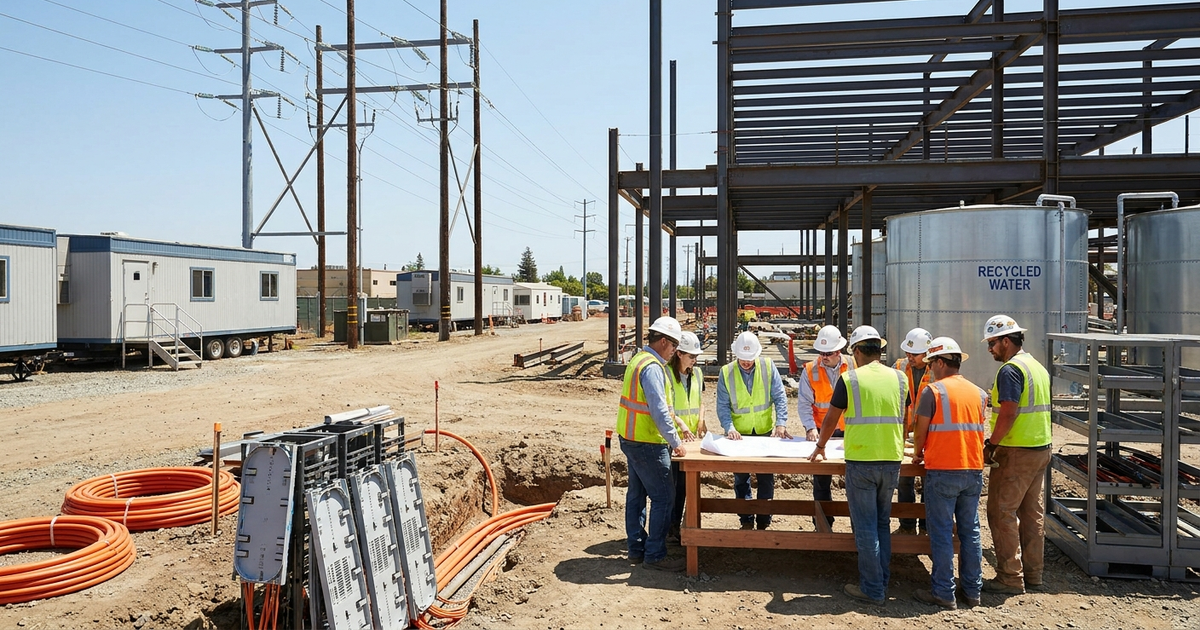
The strongest owner/operator source is Microsoft Local's Alviso construction update. Microsoft says construction began in fall 2025 at its new Alviso datacenter site, with earthmoving and soil-remediation work underway and site preparation expected to finish by summer 2026. The same Microsoft update names HITT Contracting Inc. as the general contractor. That is the core reason this project moved from a generic San Jose permit signal into a cleaner AI/cloud data-center construction record.
The public-record power envelope is larger than the simple construction-start headline. The California Energy Commission San Jose Data Center record identifies Microsoft Corporation as project owner, places the project at 1657 Alviso-Milpitas Road, references CEC docket 19-SPPE-04, and describes a data-center project with two buildings, roughly 396,914 gross square feet, 224 backup generators, PG&E service context, and onsite 115 kV substation infrastructure. The same record lists 99 MW capacity. City environmental-review material separately describes a 99 MW maximum electrical load and 77 MW estimated load for the approved project, but the City page returned a 403 to local command-line checking, so LVN is treating it as public-record context rather than the main article link.
Current construction-start coverage gives the field-facing snapshot. Baxtel's construction-start report describes Microsoft beginning construction on the Alviso campus, cites a 48 MW facility, a 2028 completion target, roughly 600 construction jobs, 100 permanent positions, and HITT as the construction contractor. NBC Bay Area / Bay City News coverage also frames the project around cloud computing and AI demand, 600-plus peak construction workers, 100-plus ongoing jobs, recycled-water cooling, renewable energy, and about 18 months to completion from the June 2026 report.
| Item | Source-backed detail | Why it matters |
|---|---|---|
| Project | Microsoft Alviso / San Jose data-center campus | New construction signal in a tight Silicon Valley data-center market. |
| Address | 1657 Alviso-Milpitas Road, San Jose, California | Allows permit, inspection, utility, and local hiring follow-up by site. |
| Power envelope | 48 MW in current construction coverage; 99 MW public-record capacity/load envelope | Large enough for material electrical, fiber, controls, security, life-safety, and commissioning work. |
| Building area | About 396,914 gross square feet across two data-center buildings | Two-building campus creates multiple phases and turnover points to watch. |
| Jobs | About 600 construction jobs and 100 permanent jobs in June 2026 coverage | Labor ramp should show up through contractor hiring, prequalification, and specialty roles. |
For LVN, the important contractor stance is simple: HITT is source-backed. Separate electrical, low-voltage, fiber/OSP, structured cabling, access-control, CCTV, fire alarm, BMS/BAS, DAS/networking, grounding, and commissioning firms are not yet source-backed in the reviewed public evidence. That does not make the opportunity weak. It makes the project a useful watchlist item while the construction work is moving from site prep toward building, power, and systems packages.
| Company or agency | Source-backed role | LVN stance |
|---|---|---|
| Microsoft Corporation | Owner/operator for the Alviso datacenter site | Primary owner source for construction timing and community updates. |
| Microsoft Azure | Cloud infrastructure operator context | Supports the AI/cloud demand framing; not a separate contractor award. |
| HITT Contracting Inc. | General contractor / construction contractor | Source-backed project role from Microsoft and construction-start coverage. |
| California Energy Commission | State energy public record | Best accessible record for power, generators, owner, address, and substation context. |
| PG&E | Utility service context | Watch service, substation, interconnection, and energization signals. |
| Santa Clara Valley Water District | Water/reuse site context | Useful context for recycled-water and public-works coordination. |
Power and site infrastructure are the clearest scope drivers. The CEC record points to 224 generators and onsite 115 kV substation infrastructure. The site also sits near existing Silicon Valley utility, water, and transportation constraints. For low-voltage contractors, that means work will not be isolated to pulling cable inside data halls. It will touch pathway coordination, grounding and bonding discipline, construction phasing, utility interfaces, secure access, fire/life-safety coordination, controls integration, and turnover documentation.
The water story is also worth watching. Local coverage says the facility will use recycled water for cooling, and the public-record context ties the site to Santa Clara Valley Water District / Valley Water material. That does not name a low-voltage package by itself, but it does point toward monitoring, alarms, controls interfaces, and commissioning dependencies around cooling and support systems. In data-center work, those interfaces often become practical friction points even when they are not the headline contract.
| System | Where it shows up | What to watch |
|---|---|---|
| Fiber / OSP | Carrier entrances, diverse routes, vaults, MMR links, and campus backbone | OSP permits, carrier work, fiber test packages, and pathway coordination. |
| Structured cabling | Data hall, support, security, controls, and telecom spaces | Cable tray, labeling, rack/row turnover, test reports, and QA standards. |
| Access control / CCTV | Perimeter, building entries, loading areas, secure rooms, and operations spaces | Security integrator awards, device schedules, VMS, and commissioning milestones. |
| Fire alarm | Life-safety systems, monitoring, suppression interfaces, and AHJ inspections | FA contractor names, special inspections, sequence testing, and acceptance dates. |
| BMS/BAS controls | Cooling, alarms, power-support monitoring, and facility operations | Controls integrator, trend logs, graphics, point-to-point testing, and closeout documents. |
| DAS / networking | Public-safety radio, in-building wireless, facility networks, and IT/OT handoffs | DAS design, carrier coordination, network integrator roles, and coverage testing. |
The jobs angle is practical. A 600-worker construction peak does not automatically mean hundreds of low-voltage roles, but it does mean site access, safety onboarding, documentation discipline, and schedule coordination will matter. Techs moving into this work should be sharp on fiber cleaning and testing, copper and fiber labeling, pathway standards, lift safety, grounding/bonding basics, firestop coordination, redlines, test documentation, and the difference between a clean turnover package and a field mess that slows commissioning.
The project also has a useful timing signal. Microsoft says site preparation is expected to complete by summer 2026, while current construction-start coverage points toward a 2028 target. That puts the project in the period where civil, remediation, power, and shell work can start turning into more visible trade sequencing. Low-voltage firms rarely get the earliest public spotlight on a campus like this. They show up through bid lists, project manager hiring, superintendent hiring, access-control and fire-alarm scopes, telecom pathway notes, controls packages, local permits, and commissioning roles.
That is why HITT's role matters even before every specialty partner is named. A source-backed general contractor gives contractors a practical place to monitor for subcontractor outreach, plan-room movement, supplier demand, and project-specific hiring language. LVN should not imply that HITT has awarded any particular low-voltage scope. The better read is that the project now has a clear construction manager/general-contractor signal and enough public infrastructure detail to make follow-up specific.
For owners and operators, Microsoft Alviso also shows how AI data-center work is moving into constrained urban and near-urban locations, not only greenfield mega-campus counties. Alviso sits inside the broader North San Jose and Silicon Valley infrastructure environment, where power availability, recycled water, public review, traffic, environmental records, utility coordination, and community communications all shape construction. That environment raises the bar for documentation, scheduling, safety, and clean turnover. It also creates more places for specialty contractors to leave public traces.
For vendors, the near-term sales angle should be disciplined. The public record supports Microsoft, HITT, PG&E, the CEC, San Jose public-review context, and Valley Water context. It does not yet support naming a fiber contractor, security integrator, controls contractor, fire-alarm contractor, DAS provider, or commissioning firm. A useful outreach list should therefore focus on verified construction stakeholders, project aliases, site address, public-record identifiers, and adjacent hiring signals instead of invented award claims.
The best early indicators will be boring but valuable: permit updates tied to 1657 Alviso-Milpitas Road, inspection movement, utility service work, substation activity, HITT job language, local subcontractor references, and any public mention of data-hall fit-out or controls commissioning. Those are the signals that turn a construction headline into an actual contractor map.
Training paths worth keeping close include BICSI Installer 2, Optical Fiber, BICSI Installer 2, Copper, BICSI face-to-face training, FOA workforce training, and OSHA outreach training. Those links are not project requirements. They are practical skill references for technicians and contractors trying to move from commodity cabling into mission-critical construction.
The next public signals to watch are HITT procurement or subcontractor movement, San Jose permits and inspections, CEC docket updates, PG&E service or substation activity, Valley Water/public-works movement, job postings tied to Alviso, and any named trade partners for electrical, fiber, security, fire alarm, controls, DAS, or commissioning. The project should also stay distinct from other Silicon Valley data-center rows, including Microsoft Orchard Parkway / Component Drive, Vantage Nortech Parkway, STACK Silicon Valley, Prologis San Jose, and Amazon Mission College.
LVN Signal is tracking Microsoft Alviso because it is an active construction project with named source-backed players and open specialty scope. If you are a contractor, supplier, estimator, recruiter, or tech watching AI/cloud infrastructure work, the useful move is not to wait for a generic grand-opening story. Watch the site, the public records, the GC, the utility milestones, and the package names while the work is still forming.
Join 35,000+ Low Voltage Pros
Get weekly permit updates, tool deals, job opportunities, and industry news. No spam, unsubscribe anytime.