
Join Low Voltage Nation — Find project opportunities and showcase your company to thousands of industry professionals
Meta Temple is now operational while a $197M, 145,177-square-foot TTX03 Building 3 filing remains on a September 2026 construction clock.
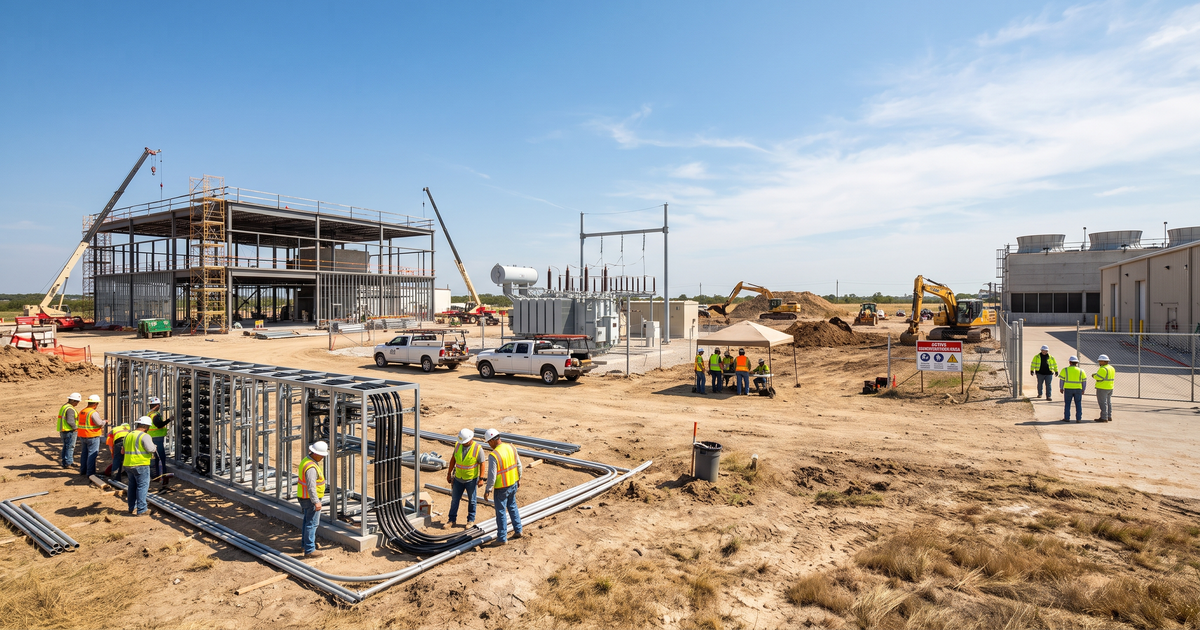
Meta's Temple, Texas campus has reached an unusual crossover point: the original three-building program is serving traffic while a fresh public filing still shows a major Building 3 construction scope in motion. Texas Department of Licensing and Regulation record TABS2026008019 identifies TTX03 Building 3 at 2230 Eberhardt Road as a $197 million, 145,177-square-foot single-story data-center project. The filing lists Polmer LLC as owner and gives a December 15, 2025 start with a September 30, 2026 completion target.
That building record matters because the wider campus story changed in July. Data Center Dynamics reported on July 23, 2026 that Meta's Temple facility had started serving traffic and that Meta now frames total campus investment at about $1.2 billion. The operating milestone does not cancel the Building 3 filing. It means low-voltage firms should distinguish completed base-campus work, operational support, and the still-active TTX03 Building 3 scope instead of treating Temple as either fully finished or entirely speculative.
Meta's own current Temple data-center one-pager confirms the broader facility is operational, cites $1.2 billion invested, about 1,200 skilled-trade workers at peak construction, and roughly 100 operational jobs. It also identifies Oncor Electric and the City of Temple as energy and water partners. Those are campus-wide facts. The $197 million cost, 145,177 square feet, address, and 2026 schedule belong specifically to the filed Building 3 scope.
| Project fact | Source-backed detail | LVN read |
|---|---|---|
| Filed scope | $197M / 145,177 sq ft | TTX03 Building 3 only. |
| Schedule | Dec. 2025-Sept. 2026 | TDLR target dates. |
| Campus status | Serving traffic | Base campus is operational. |
| Campus scale | $1.2B invested | Do not assign to Building 3. |
| Power | 152 MW campus profile | Building-level IT load unknown. |
| Address | 2230 Eberhardt Road | Temple, Bell County, Texas. |
The top of the construction map is unusually well sourced. In its official Temple construction update, Meta names JE Dunn Construction as general contractor and lists Rosendin, Brandt Companies, Peabody General Contractors, Alamo Structural Steel, Perry and Perry Builders, CentiMark Corporation, and BakerTriangle as local contractors. The same update says the campus design supports Meta's next generation of AI systems. That is direct owner evidence for who participated in the campus program, but it does not prove that every named firm holds a current Building 3 package.
JE Dunn provides the most detailed contractor record. Its Meta Temple project profile describes a 386-acre, three-building campus with more than 750,000 square feet, 152 MW, about 25 miles of underground conduit, and 750 prefabricated multi-trade racks. JE Dunn names itself as general contractor and says it self-performed survey, concrete, precast, carpentry, doors and hardware, multi-trade-rack fabrication and installation, hot-aisle containment, crane and rigging work, and temporary low-voltage services including access control, Wi-Fi, temporary controls, and equipment-storage monitoring.
JE Dunn's project page also identifies Burns & McDonnell as architect. That is stronger construction-party evidence than a generic capability page, but the public record still does not define whether Burns & McDonnell is architect of record for the filed 145,177-square-foot Building 3 scope or for the completed three-building campus program as a whole. LVN keeps that distinction explicit.
Rosendin and Brandt are source-backed campus contractors because Meta names them. Rosendin's data-center practice documents relevant electrical and mission-critical capability, while Brandt's exact Temple work remains defined only by Meta's named-contractor acknowledgment. Neither source authorizes LVN to assign a specific current Building 3 package. Their exact Temple scopes, dates, and Building 3 responsibilities remain follow-up items.
| Company | Source-backed role | Current limit |
|---|---|---|
| Meta / Polmer LLC | Operator / filed owner | Building 3 filing |
| JE Dunn | General contractor | Campus project profile |
| Burns & McDonnell | Architect | Campus-wide profile. |
| Rosendin | Named local contractor | Exact package not public. |
| Brandt Companies | Named local contractor | Exact package not public. |
| Other named trades | Campus contractors | Building 3 assignment unknown. |
The low-voltage story starts underground. JE Dunn's 25-mile conduit figure signals a campus where OSP pathways, duct banks, vaults, building entrances, diverse routes, grounding, drainage, pull planning, route labeling, as-builts, and carrier coordination are foundational. The City of Temple financial record also documents an $8 million infrastructure payment tied to the Polmer water and wastewater agreement. That is municipal infrastructure context, not a telecom award, but it shows how much site utility coordination sits around the campus.
A live campus plus an active building expansion raises the coordination bar. Contractors cannot treat TTX03 Building 3 as an isolated greenfield shell. New pathways, access zones, fire interfaces, controls networks, alarm points, monitoring, commissioning activity, material deliveries, and temporary systems may have to coexist with production operations and Meta's security rules. Tie-in planning, outage control, method-of-procedure discipline, access windows, temporary protection, and clean rollback plans become as important as raw installation speed.
JE Dunn's temporary low-voltage disclosure is especially useful. Its project page confirms temporary access control, Wi-Fi, temporary controls, and monitoring for equipment storage were part of the GC's self-perform work. JE Dunn's Aptitude intelligent-building operation is relevant account context because Aptitude delivers technology and low-voltage systems. Public sources reviewed for this article do not confirm an Aptitude permanent Building 3 award, so LVN treats it as a high-value account to monitor rather than a named package holder.
| Low-voltage lane | Likely requirement | Watch signal |
|---|---|---|
| Fiber / OSP | Campus and building links | Conduit, entrances, splicing, OTDR. |
| Structured cabling | Operations and support spaces | Pathways, labeling, certification. |
| Access / CCTV | Secure active-campus expansion | Badging, cameras, VMS, turnover. |
| Fire alarm / DAS | Life-safety and radio coverage | Permits, testing, AHJ signoff. |
| BMS / EPMS | Cooling, power, alarms, trends | Point lists, networks, sequences. |
| Commissioning | Live-site integrated turnover | MOPs, IST, training, closeout. |
Permanent fiber and structured cabling packages should be watched separately from the temporary systems JE Dunn confirms. A 152 MW campus with three buildings and a new AI-optimized design needs carrier and campus backbone connectivity, controls and security networks, operations-space cabling, equipment-room pathways, patching, labeling, optical-loss testing, OTDR traces, copper certification, rack and cabinet coordination, port records, redlines, digital as-builts, and maintainable turnover documentation.
Physical security work can span the active perimeter, construction gates, visitor processing, laydown yards, equipment storage, loading areas, utility yards, operations spaces, telecom rooms, electrical rooms, mechanical areas, data halls, and owner-furnished equipment. The public record supports temporary access control and monitoring; permanent access control, CCTV, intercom, perimeter detection, VMS, badging, credential migration, and security-operations integration remain package-level questions.
Fire and life safety coordination will cross the new building, central utility infrastructure, electrical rooms, battery and generator areas, cooling systems, offices, and the operating campus. Watch for early-warning detection, alarm and suppression interfaces, supervisory points, smoke-control or equipment-shutdown sequences, emergency-power behavior, releasing panels, monitoring, acceptance testing, public-safety radio coverage, and integrated tests involving controls and security.
BMS, EPMS, SCADA, and operational networks deserve separate attention. Meta's AI-optimized design and JE Dunn's description of prefabricated multi-trade racks increase the importance of factory coordination, connector and point standardization, prefab QA, field installation records, network addressing, panel and controller readiness, sensor validation, alarm priorities, trend logs, dashboards, failure-mode sequences, and the handoff between construction teams and operators already serving traffic.
Commissioning is where the operating-campus distinction becomes concrete. Building 3 turnover may require staged energization, factory and site acceptance, point-to-point checks, network and fiber readiness, security and fire interfaces, cooling and power sequences, alarm verification, failure testing, integrated systems tests, witnessed owner procedures, training, spare-parts documentation, punch-list control, and careful change management around live infrastructure. A September 2026 filed completion target leaves little room for incomplete test records or late coordination.
The workforce path is also source backed. Meta's one-pager names electricians, HVAC specialists, server and network technicians, engineers, steel workers, pipefitters, carpenters, and fiber technicians as jobs that build and operate its data centers. Meta also identifies Texas and Temple as part of America's Workforce Academy, a cost-free skilled-trades program designed around NCCER credentials and employment pathways. Project-specific openings still need to be checked against Meta, JE Dunn, named trade partners, and local workforce postings.
Low-voltage crews preparing for this work should be ready with mission-critical references, Texas licensing where required, safety and EMR records, site-access and lift training, clean-room and equipment-protection practices, fiber inspection and cleaning, fusion splicing, OTDR and optical-loss testing, copper certification, pathway and grounding coordination, access-control and VMS commissioning, fire-alarm acceptance support, controls point-to-point testing, redline discipline, digital as-builts, and progressive turnover experience.
Prequalification packages should show labor capacity, regional supervision, QA/QC procedures, calibrated test equipment, manufacturer certifications, prefabrication coordination, equipment tracking, schedule control, change management, commissioning experience, and examples of complete electronic closeout. Teams should also be able to explain how they work inside an operating campus: access windows, escorts, material screening, device custody, cybersecurity boundaries, temporary services, outage procedures, clean rollback, and protection of live systems.
Regulatory and ownership records add useful aliases. TCEQ's Polmer LLC record identifies the Temple Data Center under registration 168139 and regulated entity RN111448668. The Building 3 facility profile connects TTX03 and the Eberhardt Road address to Meta Temple Building 3. Those sources help dedupe the project from Rowan's separate south-Temple campus and from other Central Texas data-center filings.
Meta's AI infrastructure overview explains why the campus matters strategically: the company's data centers support its compute platform and next-generation AI systems. The public record does not disclose Building 3 rack density, GPU population, cooling topology, tenant allocation, or critical IT load. JE Dunn's 152 MW figure is a campus project-profile value, not permission to assign 152 MW to the 145,177-square-foot filing.
Temple's original economic-development announcement remains useful context. Temple EDC described an $800 million, roughly 900,000-square-foot plan on 393 acres with 1,250 workers at peak and about 100 operating jobs. Current Meta material raises campus investment to $1.2 billion, while JE Dunn describes 750,000-plus square feet across three buildings. Those figures come from different dates and scope definitions. LVN preserves them as campus history instead of forcing a false single-number reconciliation.
The next contractor signals should come from Meta, Polmer, JE Dunn, Burns & McDonnell, Rosendin, Brandt, Oncor, Temple, Bell County, TDLR inspections, TCEQ records, permits, job postings, subcontractor prequalification, supplier releases, commissioning hiring, and project-specific trade announcements. Watch TTX03, Temple Building 3, 2230 Eberhardt Road, Polmer Temple Data Center, registration 168139, RN111448668, and Meta Temple expansion.
Bottom line: Meta Temple is operational, but the public record still supports a live $197 million Building 3 expansion with a September 2026 target. JE Dunn is source-backed as campus general contractor, Burns & McDonnell as architect, and Meta names Rosendin, Brandt, and multiple local contractors. The campus scale and temporary low-voltage work are public; permanent Building 3 fiber, structured cabling, security, fire alarm, controls, DAS, networking, grounding, and commissioning assignments are not. That is the contractor-watch window.
Join 35,000+ Low Voltage Pros
Get weekly permit updates, tool deals, job opportunities, and industry news. No spam, unsubscribe anytime.