
Join Low Voltage Nation — Find project opportunities and showcase your company to thousands of industry professionals
Meta, Turner, Mortenson, and FTI have a source-backed 1GW AI data-center campus underway in Lebanon, Indiana, with low-voltage package signals still developing.
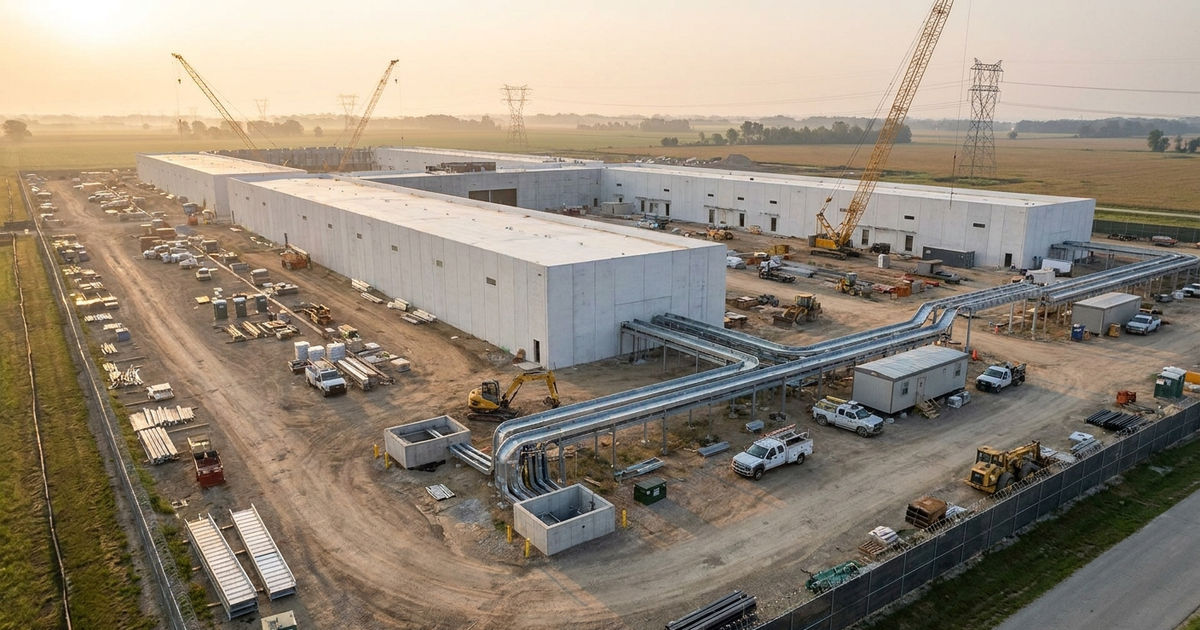
Meta's Lebanon, Indiana data-center campus is now one of the clearest AI infrastructure construction signals in the Midwest. The useful part for low-voltage contractors is not just the headline investment. It is the combination of owner confirmation, state economic-development records, visible construction partners, a named electrical/low-voltage delivery partner, and a workforce path that is already showing up in public sources.
Meta Data Centers says Lebanon will be home to its second Indiana data-center campus, roughly 4 million square feet, and part of a data-center fleet built to support Meta products and infrastructure. Meta Newsroom describes the project as a 1 GW campus built for AI workloads and core products. That makes this a practical construction-market signal: power, cooling, security, controls, fiber, structured cabling, documentation, and commissioning all have to move in sequence for a campus of this size to turn into an operating facility.
The public-agency record strengthens the read. Indiana Economic Development Corporation confirms the February 11, 2026 groundbreaking at the LEAP Innovation and Research District, more than $10 billion in investment, a 1,500-acre campus, 13 total buildings, and 10 data-center buildings. IEDC also ties the project to more than 4,000 peak construction jobs and 300 operational jobs. For LVN readers, that scale means the opportunity will not be one trade package or one mobilization. It should be watched as a long, phased buildout where early electrical, civil, and utility work eventually gives way to security, cabling, controls, life safety, DAS/networking, turnover, and ongoing facility support.
| Fact | Source-backed detail |
|---|---|
| Location | LEAP Innovation and Research District, Lebanon, Indiana |
| Owner/operator | Meta |
| Scale | About 4 million square feet on a 1,500-acre campus |
| Capacity | Designed for 1 GW of capacity |
| Investment | More than $10 billion |
| Buildings | IEDC says 13 total buildings, including 10 data centers |
| Jobs | About 4,000 construction jobs at peak and 300+ operating roles |
| Stage | Under construction after February 2026 groundbreaking |
The contractor picture is also better than most early data-center announcements. Turner Construction says Meta selected it as one of the contractors for the $10 billion campus. Turner also repeats the 4 million square foot, 1 GW, 4,000 peak construction job, and 300 operational job framing. Mortenson says it is supporting development of the campus and working with Turner and Faith Technologies. Mortenson's page matters because it points to local and regional trade partner opportunities without naming every downstream package yet.
The low-voltage signal is strongest around Faith Technologies Incorporated. FTI's Lebanon project page says it is partnering with Turner and Mortenson to help deliver the campus and references electrical and low-voltage roles tied to the work. That does not mean every specialty scope is public. It does mean the project is far enough along that the LVN audience should treat the campus as an account-mapping and hiring-watch target rather than a vague economic-development announcement.
| Role | Company | Evidence |
|---|---|---|
| Owner/operator | Meta | Official data-center announcement and newsroom release |
| Construction partner | Turner Construction | Project-specific contractor announcement |
| Construction partner | Mortenson | Project-specific construction announcement |
| Electrical/LV delivery signal | Faith Technologies Incorporated | Lebanon project and jobs page |
| State economic development | IEDC | Groundbreaking and LEAP District release |
| Power planning context | Boone Power / Wabash Valley Power Alliance | Meta Data Centers announcement |
| Workforce/community context | Boone County Career Collaborative / The Caring Center | Meta announcement and newsroom release |
The project should also be separated from older planning coverage. Inside INdiana Business previously covered the Project Domino planning process, the southern LEAP District site, and road context. That is useful background for location and entitlement history, but the official 2026 owner and state sources now support the cleaner current scale: roughly 4 million square feet, 1,500 acres, 13 total buildings, 10 data-center buildings, and 1 GW.
For contractors, the first read is not to overclaim named scopes. Public sources name Turner, Mortenson, and FTI. They do not yet name a separate fiber contractor, OSP contractor, security integrator, fire alarm contractor, controls integrator, DAS/networking integrator, grounding/bonding specialist, or commissioning firm. That gap is the opportunity window. The companies that want to be around this campus need to watch contractor pages, job postings, permit activity, utility milestones, vendor outreach, and local workforce channels before the work is fully visible in public bid lists.
| System | Why it matters | What to watch |
|---|---|---|
| Fiber / OSP | A 1 GW campus needs diverse entrances, duct banks, backbone paths, and clean test records. | Carrier route work, splicing, vaults, handholes, OTDR results, and closeout packages. |
| Structured cabling | Large data halls require repeatable pathways, labeling discipline, and QA at scale. | Apprentice, foreman, PM, QA, and documentation roles tied to Turner, Mortenson, and FTI paths. |
| Access control / CCTV | Phased campuses need perimeter, building, mantrap, and secure-area coverage. | Security integrator awards, VMS packages, badging systems, camera schedules, and commissioning. |
| Fire alarm / life safety | Mission-critical buildings require AHJ coordination and interfaces with suppression and monitoring. | FA contractor movement, inspections, special systems coordination, and turnover documents. |
| BMS/BAS controls | Cooling, monitoring, alarms, and facility systems must be integrated and tested before handoff. | Controls integrator roles, trend logs, point-to-point checks, and commissioning milestones. |
| DAS / networking | Large hardened buildings need in-building wireless and operational network coordination. | DAS design, public-safety coverage, carrier coordination, and IT/OT boundaries. |
| Grounding / bonding | Telecom rooms, pathways, racks, and equipment areas require disciplined bonding and test records. | Grounding packages, QA checklists, labeling, and electrical coordination. |
The power and infrastructure language is another reason this belongs in the AI data-center watchlist. Meta says it worked with Boone Power and Wabash Valley Power Alliance from the beginning to plan around the energy needs of the campus and to pay the full costs for the energy used by the data center. The same Meta sources describe water, wastewater, road, transmission-line, and utility improvements around the project. Those details matter because low-voltage work does not happen in isolation. Fiber entrances, carrier coordination, security perimeters, site access, temporary facilities, controls rooms, and commissioning all depend on the broader civil, electrical, and utility sequence.
That sequence is where smaller contractors can miss the timing. Early headlines usually focus on land, investment, jobs, power, and general contractors. The specialty systems come into focus later through prequalification portals, hiring posts, local permits, site photos, vendor pages, and project-specific subcontractor announcements. On a phased campus, the first building package can create lessons, preferred vendors, QA expectations, site rules, and documentation standards that carry into later buildings. Watching the first public electrical and low-voltage hiring signals around FTI is useful because it can show what skill mix the campus needs before every named package is public.
The workforce angle should be read the same way. A project that supports about 4,000 construction jobs at peak will pull from union labor, non-union specialty firms, regional contractors, national mission-critical builders, material suppliers, prefabrication shops, testing firms, commissioning teams, and local workforce programs. Meta and its partners are already pointing at education, community, and construction opportunity channels. For technicians, the play is to become easier to place on a controlled site: show clean safety habits, understand pathway coordination, document work without being chased, test fiber and copper correctly, label like the next person has to troubleshoot it at 2 a.m., and know how to work around electrical and mechanical teams without creating rework.
For vendors and integrators, the conservative account map is Meta as owner/operator, Turner and Mortenson as construction partners, FTI as the visible electrical and low-voltage delivery signal, Boone Power and Wabash Valley Power Alliance as power-planning context, and IEDC/City of Lebanon/Boone partners as the public-agency layer. Everything beyond that should stay evidence-led. If a security integrator, fiber contractor, controls firm, fire alarm contractor, DAS provider, or commissioning company becomes public, that is a fresh sales and recruiting signal. Until then, the right posture is to track, prepare, and qualify rather than pretend the whole subcontractor map is already known.
The jobs angle is practical. Meta and IEDC point to thousands of construction jobs at peak. FTI's project page turns that into a direct low-voltage workforce signal, including electrical and low-voltage roles. For technicians, this is where training and documentation discipline matter. Fiber cleaning and testing, copper and fiber labeling, pathway coordination, lift and site-safety readiness, grounding awareness, QA documentation, and commissioning support are not side skills on a campus like this. They are the difference between being useful on a mission-critical site and being treated as a commodity installer.
Useful preparation paths include BICSI Installer 2, Optical Fiber, BICSI Installer 2, Copper, FOA workforce training, and OSHA outreach training. Those links are not a guarantee of work. They are the kind of baseline preparation that makes a technician easier to place when a mission-critical project starts asking for clean documentation, repeatable testing, and site-ready behavior.
The current LVN read is straightforward: Meta Lebanon is source-backed, under construction, and large enough to create a multi-year low-voltage watchlist. Turner and Mortenson are source-backed construction partners. FTI is the visible electrical and low-voltage delivery signal. The next public signals to watch are specialty package names, local job postings, utility and transmission milestones, permit movement, inspections, and commissioning language. LVN Signal is tracking this type of project so contractors can see the company map before the opportunity becomes old news.
Join 35,000+ Low Voltage Pros
Get weekly permit updates, tool deals, job opportunities, and industry news. No spam, unsubscribe anytime.