
Join Low Voltage Nation — Find project opportunities and showcase your company to thousands of industry professionals
Meta's Hyperion data center has already pushed contracts, infrastructure money, jobs, and school grants into Richland Parish. The early impact looks positive, but incentives and power questions still matter.
Richland Parish, Louisiana is the kind of place that usually gets talked about in economic development decks, not in national AI infrastructure coverage. It is rural, agricultural, small, and far from the coastal tech corridors. The U.S. Census Bureau estimates the parish at fewer than 20,000 people in 2025, with a 26.4% poverty rate and median household income of $53,544 in 2020-2024 dollars. USDA's 2022 Census of Agriculture still counted more than 500 farms in the parish, but the number of farms fell 11% from 2017 to 2022.
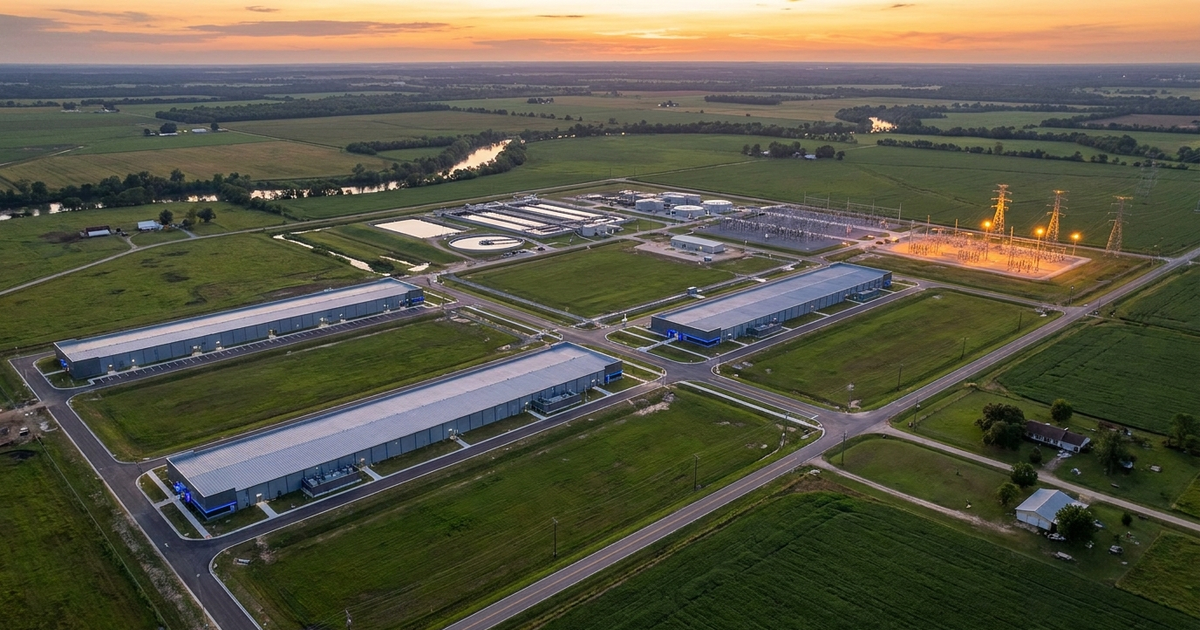
That is the backdrop for Meta's Hyperion project. This is not a normal warehouse, office campus, or speculative tech announcement. Meta describes the Richland Parish Data Center as its largest data center to date: a 4 million-square-foot campus on the former Franklin Farm megasite, with more than $10 billion in reported investment and more than two gigawatts of compute capacity. Louisiana Economic Development says the project is expected to create 500 or more direct jobs, more than 1,000 indirect jobs, and 5,000 construction workers at peak.
The question is whether this has actually helped the local economy, not whether the press release sounds impressive. Based on the evidence available right now, the construction-stage answer is yes. The impact is already visible in contracts, infrastructure commitments, workforce demand, school grants, and trade-partner channels. The longer-term answer is still open because the deal also carries serious asterisks around tax incentives, power generation, local hiring depth, and who captures the upside after construction ends.
The Local Baseline
The starting point matters because a dollar of construction demand does not land the same way in every place. Richland Parish is not Dallas, Phoenix, or Northern Virginia. It is a small northeast Louisiana parish with low density, limited broadband adoption compared with national tech hubs, modest educational attainment, and a long agricultural identity. Census QuickFacts lists 414 employer establishments in 2023 and total annual payroll of about $245 million. A single year of project-related Louisiana contracts from Meta is several times larger than that annual parish payroll figure, although those contracts are statewide rather than all inside Richland Parish.
| Baseline | Current Data | Why It Matters |
|---|---|---|
| Population | 19,582 estimated in 2025 | A 5,000-worker construction peak is huge relative to the local population. |
| Poverty | 26.4% in Census QuickFacts | New wages, vendor spend, and infrastructure improvements matter more in a high-poverty parish. |
| Median income | $53,544 in 2020-2024 dollars | The older sub-$35k framing is stale; the area is still below national income levels. |
| Farm base | 556 farms in 2022; down 11% since 2017 | Hyperion is landing in a parish where agriculture is still important but consolidating. |
| Employer base | 414 employer establishments in 2023 | A project this size can reshape local service, trade, and supplier demand. |
That is why the "actually on the floor" part matters. Rural communities hear big economic-development promises all the time. What makes Hyperion different, at least so far, is that multiple public sources show money, people, contractors, and support programs already moving.
What Has Already Hit The Economy
One year after breaking ground, Meta reported more than $875 million in contracts with Louisiana businesses. Meta also said it was working with more than 160 Louisiana businesses, with 84% local to Northeast Louisiana, and that the project had already supported 3,700 construction workers on the way to an expected 5,000-worker peak by June 2026. That is the strongest positive-impact evidence in the record because it is not a future promise. It is reported construction-stage procurement and labor activity.
The second major impact bucket is public infrastructure. Meta initially discussed $200 million in local infrastructure improvements; the company's one-year update says that figure had expanded to more than $300 million for roads, water, and wastewater systems in the area around the data center. For a small rural parish, that is a major practical benefit. Roads, water, and wastewater are not glamorous, but they are exactly the systems that smaller local governments often cannot upgrade quickly without an outside capital shock.
| Impact Area | Reported Evidence | Local Meaning |
|---|---|---|
| Business contracts | $875M+ with Louisiana businesses | Construction spend is already flowing through state and regional suppliers. |
| Local vendor base | 160+ Louisiana businesses; 84% in Northeast Louisiana | The project is not only importing national contractors; regional firms are in the workstream. |
| Construction labor | 3,700 workers supported; 5,000 expected at peak | Restaurants, housing, fuel, tools, materials, and services get direct demand. |
| Permanent jobs | 500+ operational jobs once completed | The long-term job count is smaller than construction, but large for a parish under 20,000 people. |
| Infrastructure | $300M+ for roads, water, wastewater | These are local assets that can outlast the construction surge if delivered well. |
| Schools and nonprofits | Richland Parish grant recipients and direct donations | STEM labs, robotics, VR, library systems, and workforce tools expand local capacity. |
The community side is not just a single oversized check. Meta says it has supported Richland Parish Public Schools, the Richland Voluntary Council on Aging, the Northeast Louisiana Veterans Cemetery, Delhi Charter School's robotics program, and mixed-reality workforce development in the parish schools. In 2026, Meta's Data Center Community Action Grants listed Richland Parish recipients including Delhi Elementary, Delhi High, Delhi Middle, Holly Ridge Elementary, Louisiana 4-H, Mangham schools, Rayville schools, and Start Elementary. KNOE reported 12 schools and organizations receiving funding through the program.
The Contractor Story
For the LVN audience, the most actionable piece is the construction and trade story. The public project site says Mortenson, Turner Construction Company, and DPR Construction are building the project for Meta. Its Mortenson page lists scope that includes site prep and grading, underground utilities, medium-voltage distribution and substations for onsite power, onsite water treatment, offsite wastewater treatment, administration and guard buildings, and outside plant fiber distribution.
That last item is the key phrase for low-voltage contractors and techs: outside plant fiber distribution is explicitly named. Even where public sources do not name the low-voltage subcontractors yet, a 4 million-square-foot AI campus with substations, water treatment, guard houses, administration buildings, security zones, and data halls will create a long chain of fiber, controls, safety, surveillance, access, telecom, and commissioning work.
| Named Group | Public Role | LVN Angle |
|---|---|---|
| Meta | Owner/operator of Hyperion | Sets data-center standards, operational jobs, and long-term campus requirements. |
| Mortenson | Builder; listed scope includes OSP fiber distribution | Direct low-voltage signal because OSP fiber is publicly named. |
| Turner Construction | General contractor partner | National mission-critical builder with trade-partner channels to watch. |
| DPR Construction | General contractor partner | Data-center construction experience and package movement are follow-up signals. |
| Entergy Louisiana | Utility and power-infrastructure partner | Substations, transmission, generation, battery, and reliability work shape the campus schedule. |
| Regional vendors | 160+ Louisiana businesses reported by Meta | Local electrical, paving, utility, food, material, and service firms are already attached. |
Where Low Voltage Shows Up
Hyperion is not being written as a normal LVN Signal article here, but it belongs in the data-center intelligence database. The editorial reason is simple: economic impact is created through actual scopes of work, and low-voltage is part of the physical build. The public sources already point to systems and trade areas that LVN should watch over time.
| System Area | Likely Campus Need | Why It Matters |
|---|---|---|
| OSP fiber | Campus backbone, diverse routes, entrances, and utility coordination | Mortenson's public scope specifically names outside plant fiber distribution. |
| Structured cabling | Admin buildings, support spaces, security rooms, network rooms, and operations areas | Large campuses reward clean labeling, testing, and closeout discipline. |
| Access control | Gates, guard houses, secure rooms, data halls, and perimeter points | Security package movement often reveals integrator and hardware opportunities. |
| CCTV | Perimeter, loading areas, site roads, equipment yards, and construction security | Video systems scale quickly across a 2,250-acre campus. |
| Fire alarm | Admin spaces, data halls, support buildings, and utility structures | Life-safety interfaces require AHJ coordination and strong documentation. |
| BMS/BAS controls | Cooling, power, water treatment, environmental monitoring, and alarms | Controls work connects mechanical, electrical, commissioning, and operations teams. |
This is where techs and contractors should get practical. BICSI fiber training, copper and structured cabling fundamentals, FOA workforce resources, and OSHA outreach training are not abstract resume filler on projects like this. The jobs that survive mission-critical construction are the jobs that can document, test, label, coordinate, and close out cleanly.
The Asterisk
The positive-impact case is real, but it is not the whole story. Sherwood News reported that the Louisiana incentive structure could be worth more than $3.3 billion on GPU sales-tax exemptions alone, and it raised concerns about code names, shell-company dealmaking, property-value spikes, and local transparency. Verite News and Floodlight later reported on land-deal questions involving a state senator, Entergy land purchases, and power-plant approvals connected to the project. Those concerns do not erase the local contracts or infrastructure improvements, but they do change how the story should be judged.
Power is the other major asterisk. Entergy Louisiana says its 2026 agreement with Meta is structured so Meta pays its full cost of service and is expected to deliver customer savings, while also supporting new gas plants, transmission lines, battery storage, nuclear uprates, and renewable resources. Critics see the same infrastructure and ask whether Louisiana is locking itself into large fossil-fuel buildout and public-risk exposure for one hyperscale customer. Both claims belong in the discussion.
So the clean answer is this: Hyperion has already had a positive short-term economic impact on Richland Parish and Northeast Louisiana, but the long-term net impact depends on execution. If the $300 million-plus infrastructure work gets delivered, if Louisiana businesses keep winning packages, if the 500-plus operational jobs are filled with a meaningful local share, and if workforce programs turn into durable skills, the project can be a real rural economic-development win. If the upside concentrates in a few landowners, national contractors, and tax-advantaged capital while residents face higher land costs and infrastructure externalities, the story becomes more mixed.
What To Watch From Here
The next phase should be measured, not cheered blindly. Watch the trade partner channel, construction hiring pages, local school and grant announcements, Entergy filings, public road and water work, and any named low-voltage, security, controls, fire alarm, fiber, or commissioning subcontractors. Track whether local companies move from service support into higher-value trade packages. Track whether school robotics, VR, and STEM grants become pathways into real technical jobs. Track whether the promised infrastructure improvements become public assets the parish can use after the peak construction workforce leaves.
For Low Voltage Nation, this is exactly why AI data centers deserve a separate intelligence layer. The headline is about Meta and AI. The local economy story is about roads, water, schools, restaurants, vendors, electricians, fiber techs, safety teams, security integrators, utility crews, and the small businesses that either get pulled into the project or watch it pass by. Hyperion is already changing Richland Parish. The next question is whether that change becomes a durable local economy, not just a massive construction cycle.
Join 35,000+ Low Voltage Pros
Get weekly permit updates, tool deals, job opportunities, and industry news. No spam, unsubscribe anytime.