
Join Low Voltage Nation — Find project opportunities and showcase your company to thousands of industry professionals
Meta, JE Dunn, Hensel Phelps, Stantec, and TDLR records now frame Project Seafox as a 1GW El Paso AI data-center build to watch.
Meta's El Paso data-center campus is now one of the clearest AI infrastructure construction signals in Texas. The useful part for low-voltage contractors is not just the headline investment. It is the combination of owner confirmation, a public TDLR phase record, named general contractors, an engineer of record, municipal policy context, and power and water coordination that will keep this project visible for years.
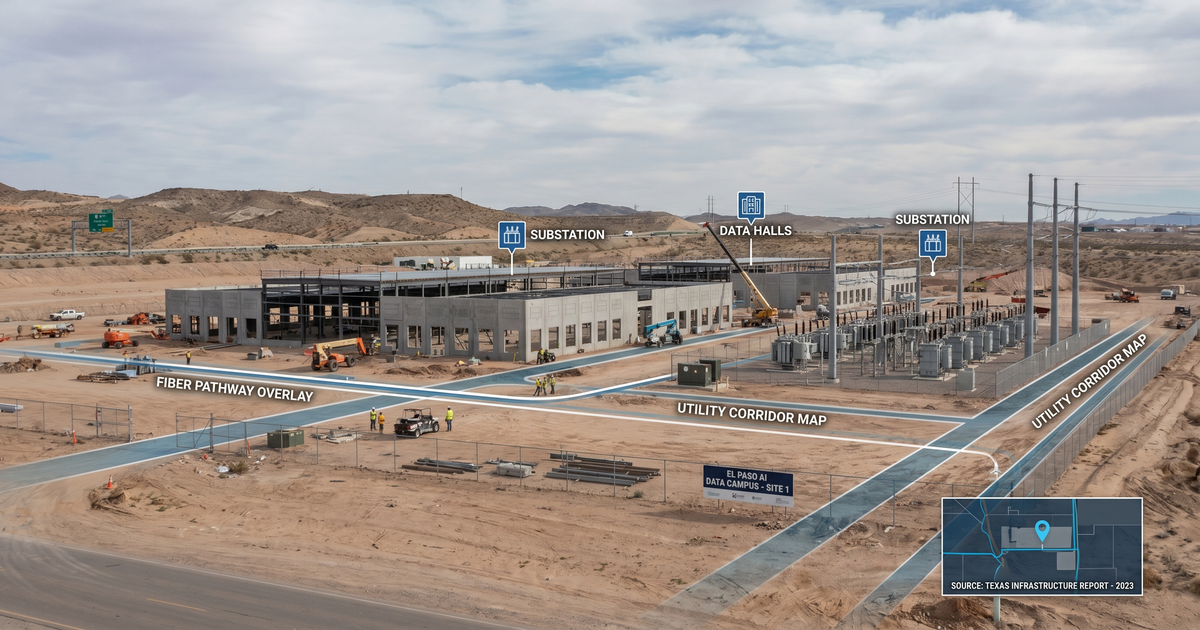
Meta Data Centers announced El Paso in October 2025 as an AI-optimized campus in Northeast El Paso. That first owner announcement described an initial investment of more than $1.5 billion, an almost 1.2 million-square-foot campus, and construction-opportunity paths tied to JE Dunn and Hensel Phelps. In March 2026, Meta updated the project with a much larger scale: more than $10 billion of investment, a campus designed to grow to 1GW, more than 300 operational jobs, and more than 4,000 construction workers at peak.
The public-record layer matters because it gives contractors a specific phase to track. TDLR TABS2026017750 lists Project Seafox / Seafox Addition at 7001 Stan Roberts Sr in El Paso. The filing identifies Wurldwide LLC as owner, Stantec as engineer of record, a $289 million estimated phase cost, 12 new buildings, five owner substations, roughly 600 acres of site work, and a schedule running from November 1, 2025 to February 28, 2029. That is the kind of record that turns a broad AI campus announcement into a trackable construction market.
| Item | Source-backed detail |
|---|---|
| Owner/operator | Meta; Wurldwide LLC is listed on the TDLR phase record. |
| Location | 7001 Stan Roberts Sr, Northeast El Paso, Texas. |
| Scale | Meta says the campus will grow to 1GW; TDLR lists a 600-acre Seafox Addition phase. |
| Schedule | TDLR lists November 2025 start and February 2029 completion for the Seafox phase. |
| Workforce | Meta expects more than 4,000 peak construction workers and more than 300 operational jobs. |
The named construction path is stronger than a generic news hit. Meta points construction information and opportunities toward JE Dunn and Hensel Phelps, and the March 2026 owner update names both as general contractors. JE Dunn's mission critical page supports the company's data-center and mission-critical construction capability. Hensel Phelps' mission critical page supports the same kind of construction-market relevance. The project-specific role still comes from Meta, not from those company capability pages, which keeps the sourcing clean.
TDLR adds the design-side public-record clue by naming Stantec as engineer of record for Project Seafox. Stantec's mission critical facilities page gives useful capability context, but the project-specific engineer role is anchored to the TDLR record. For LVN readers, that combination matters because the general contractors and engineer of record are the public names most likely to sit upstream of specialty-package movement.
| Company | Source-backed role | Why LVN cares |
|---|---|---|
| Meta | Owner/operator | Owns the campus scale, AI workload framing, jobs, and community commitments. |
| Wurldwide LLC | TDLR-listed owner entity | Useful alias for permit, site, and project-family searches. |
| JE Dunn | General contractor named by Meta | Likely upstream route for construction opportunities and trade-package visibility. |
| Hensel Phelps | General contractor named by Meta | Second source-backed GC path for plan-room, hiring, and package monitoring. |
| Stantec | Engineer of record on TDLR | Design and engineering signal tied to the public phase record. |
The City of El Paso data-center resource hub adds the local government layer. It frames the Meta/Wurldwide campus as a hyperscale AI-computing project, describes a five-phase development path, points to Phase 1 being underway, and preserves the public conversation around incentives, water allocation, permitting, and the McCloud power-plant review. A separate City draft data-center policy framework is not a contractor source, but it is useful context for power, water, noise, transparency, and community-policy pressure around large AI campuses.
For low-voltage firms, the direct lesson is to separate source-backed names from likely scope. The project will need fiber, structured cabling, OSP pathways, access control, CCTV, fire alarm interfaces, BMS/BAS controls, networking, DAS, grounding and bonding, labeling, documentation, testing, and commissioning discipline. But the public sources reviewed for this packet do not yet name the electrical contractor, low-voltage contractor, fiber/OSP contractor, security integrator, fire alarm contractor, controls integrator, DAS/networking partner, or commissioning firm. Those package names remain the gap to monitor.
| Low-voltage area | Why it shows up | Public signal to watch |
|---|---|---|
| Fiber and OSP | A 1GW AI campus needs diverse high-capacity network paths and campus backbone routes. | Utility crossings, duct-bank permits, carrier work, and fiber contractor references. |
| Structured cabling | Data halls, support spaces, security rooms, and operations areas need standards-driven pathways. | Rack, row, tray, labeling, test, and turnover package movement. |
| Security and CCTV | Perimeter, access, video, and secure-area controls are core mission-critical systems. | Integrator awards, access-control hardware, camera/VMS packages, and commissioning notes. |
| Fire alarm and controls | Life-safety interfaces, monitoring, and BAS/BMS coordination are unavoidable at this scale. | AHJ reviews, controls jobs, alarm contractor references, and commissioning documents. |
| Grounding and commissioning | AI data halls punish sloppy documentation, bonding, labeling, and test records. | QA roles, commissioning firms, closeout requirements, and turnover documentation. |
The jobs angle is also concrete. Meta's owner update raises the construction peak to more than 4,000 workers, and that number usually means much more than civil and steel work. It means site safety, prequalification, lift access, documentation control, punch-list discipline, fiber cleaning and testing, grounding checks, pathway coordination, and careful handoff between electrical, mechanical, controls, security, and IT-facing systems. For technicians trying to move into data-center work, this is the kind of project where BICSI fiber/copper training, OSHA site-readiness, documentation habits, and commissioning literacy matter.
The power and water context should stay in the account map. Meta names El Paso Electric and El Paso Water as partners in the March 2026 update. The City resource hub and draft framework keep power planning, water allocation, and public-policy review visible. For a low-voltage contractor, that does not create a direct package award by itself, but it tells you the project is large enough that utility milestones, substations, generation review, and site-infrastructure timing will influence when buildings and systems move.
What should contractors watch next? Start with TDLR updates under Project Seafox, Wurldwide LLC, Seafox Addition, and 7001 Stan Roberts Sr. Watch City of El Paso and El Paso County permit and inspection movement. Track JE Dunn and Hensel Phelps plan-room, prequalification, subcontractor, and hiring signals. Monitor Stantec references for design or engineering updates. Follow El Paso Electric, PUCT, El Paso Water, and McCloud-related public records for utility and power milestones. Search for package names tied to electrical, low-voltage, fiber, OSP, security, fire alarm, BAS/BMS, DAS, networking, grounding, and commissioning.
There is also a timing lesson for subcontractors. The TDLR date range runs from late 2025 into early 2029, and the City describes a five-phase campus. That does not mean every low-voltage package is visible today. It means the opportunity will likely show up in layers: site work and utilities first, then building shells and MEP coordination, then data-hall fit-out, security, controls, communications rooms, testing, commissioning, and turnover. Contractors who wait for a single public headline naming every package will probably be late to the relationship map.
The right account map should include the owner/operator path, the owner entity alias, the general contractor path, the engineer-of-record path, utility and water partners, and local public-record aliases. Search patterns should include Meta El Paso Data Center, Project Seafox, Seafox Addition, Wurldwide LLC, 7001 Stan Roberts Sr, TABS2026017750, Northeast El Paso data center, McCloud plant, and El Paso Electric Meta load. Those aliases matter because large projects often surface under legal entities, permit titles, street addresses, and utility records before they surface under the public brand name.
For technicians, the near-term preparation is practical. Fiber techs should be ready for cleanliness, testing, labeling, OTDR documentation, and high-density pathway discipline. Security techs should expect access control, CCTV, perimeter coverage, and commissioning evidence instead of casual small-commercial installs. Fire alarm and controls teams should expect coordination with life-safety review, mechanical systems, alarms, monitoring, and turnover documentation. DAS and networking teams should expect emergency-response coverage, carrier coordination, and clear boundaries between facility systems and IT systems. Grounding and bonding mistakes that are tolerated on ordinary jobs become expensive on mission-critical campuses.
For suppliers and service firms, the public sources also point to adjacent conversations. The City framework keeps water, power, noise, and community policy in public view. Meta's owner updates highlight El Paso Electric, El Paso Water, the Borderplex Alliance, and DigDeep. Those names do not equal low-voltage awards, but they do reveal where the project will keep creating public records and community-facing milestones. Utility expansions, substation work, generation review, water commitments, site-development permits, and construction-workforce updates are all places where the next useful contractor clue may appear.
LVN's stance should stay disciplined: this is a high-confidence construction and low-voltage opportunity because the campus scale, phase record, general contractors, and engineer are source-backed. It is not permission to invent an electrical subcontractor, a fiber contractor, a security integrator, or a commissioning firm. The valuable work now is to keep the evidence current, preserve the aliases, capture public screenshots while they are available, and route future contractor breadcrumbs into the project record quickly.
The conservative read is simple: Meta El Paso is already a source-backed AI data-center construction market. The GCs and engineer are visible. The public phase record is visible. The specialty package names are not fully visible yet. That is exactly the window where LVN Signal is useful: track the project family before every bid, job, and contractor breadcrumb has been flattened into old news.
Join 35,000+ Low Voltage Pros
Get weekly permit updates, tool deals, job opportunities, and industry news. No spam, unsubscribe anytime.