
Join Low Voltage Nation — Find project opportunities and showcase your company to thousands of industry professionals
Menlo Digital MD-VA3 gives LVN a Petersburg, Virginia AI data-center watch lane with 1.18M sq ft, 208 MW critical IT power, and open specialty packages.
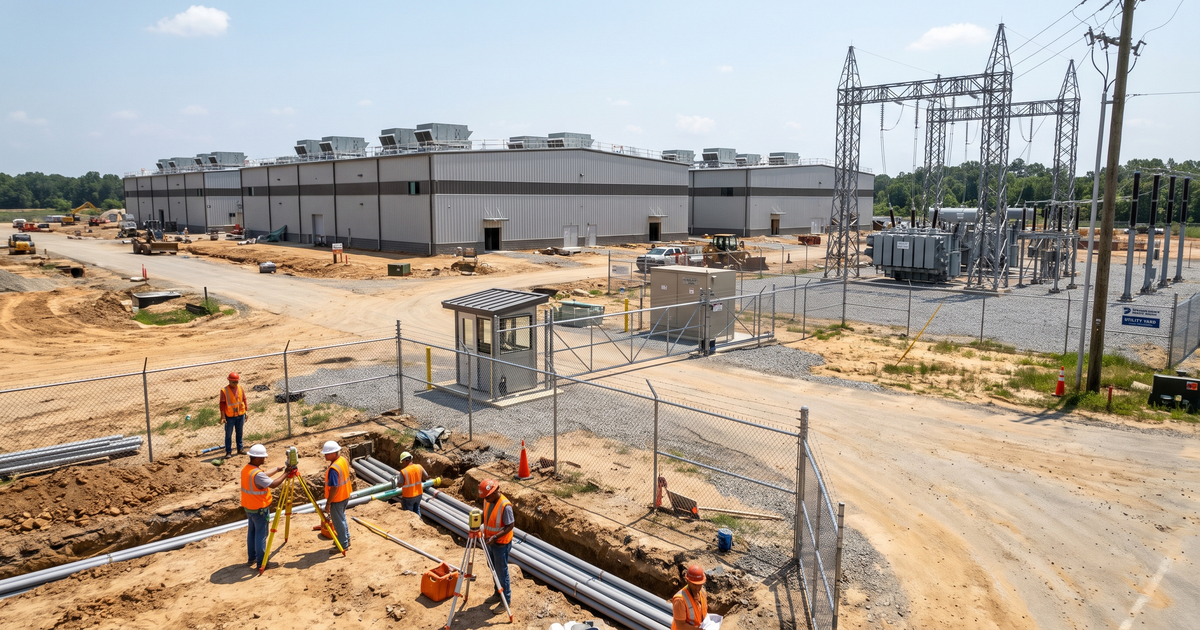
Menlo Digital MD-VA3 is today's clean LVN AI/data-center construction watch because the owner page gives enough project-level detail to separate it from generic Virginia data-center noise. Menlo Digital lists MD-VA3 at 2255 Jamestown Drive in Petersburg, Virginia as a coming-soon campus with 73.87 acres, four two-story buildings, 1,179,392 square feet, 26 data halls, Dominion Energy Virginia service, a 300 MW utility feed, and 208 MW of critical IT power.
The same site family is reinforced by Menlo Equities' property page, which lists 2255 Jamestown Drive as MD-DC3 under its digital-infrastructure portfolio, with about 74 acres, 1.2 million square feet, and 300 MW of secured power. For LVN, that is enough to treat Menlo Digital / Menlo Equities as the source-backed project family while keeping the actual trade-package holder fields open until public records or contractors name them.
The timing is current. WTVR / Richmond BizSense reported on July 21, 2026 that Petersburg has multiple data-center projects moving through the city pipeline. Data Center Dynamics also reported that four data centers are planned in Petersburg and included the Menlo 2255 Jamestown Drive campus in that wave. DCD uses a 104 MW full-buildout figure for the Menlo site, while Menlo's owner page states 208 MW critical IT power. This LVN packet keeps Menlo's 208 MW figure as the primary owner-source value and treats DCD's 104 MW number as secondary context until a public record explains the difference.
| Item | Source-backed detail | LVN read |
|---|---|---|
| Project | Menlo Digital MD-VA3 / MD-DC3 | Planned AI/hyperscale data-center campus in Petersburg. |
| Address | 2255 Jamestown Drive, Petersburg, VA 23803 | Specific enough for permit and plan-room monitoring. |
| Scale | 73.87 acres, four two-story buildings, 1,179,392 sq ft | Multi-building site with long-running specialty-package potential. |
| Power | 300 MW utility feed; 208 MW critical IT power | Use owner-page values as primary unless records update them. |
| Stage | Coming soon / local pipeline reporting | Watch permits, site plans, utility milestones, and early packages. |
Dominion Energy Virginia is important here because Menlo's page names it as the utility provider, and Dominion's data-center request page shows how the utility frames large-load data-center service in Virginia. For low-voltage contractors, utility service is not a direct scope award, but it tells you where the project will eventually intersect with substation, electrical-room, EPMS, controls, grounding, communications, and commissioning documentation.
DataCenterMap's Menlo MD-DC3 profile adds secondary building-profile context, but the public packet should stay conservative. Reviewed sources do not name a tenant or customer. They do not name a general contractor, EPCM, engineer of record, electrical contractor, fiber/OSP contractor, structured-cabling contractor, security integrator, fire alarm contractor, BAS/BMS/EPMS controls vendor, DAS/networking contractor, grounding contractor, or commissioning agent. Those are the open fields that make this useful for Signal instead of just a headline.
| Company / agency | Role | Evidence |
|---|---|---|
| Menlo Digital | Owner/operator project page | MD-VA3 campus page |
| Menlo Equities | Developer / property-platform context | 2255 Jamestown Drive page |
| Dominion Energy Virginia | Utility provider named by Menlo | Menlo project page and Dominion data-center request page |
| City of Petersburg | Local jurisdiction / pipeline context | WTVR / Richmond BizSense reporting |
The low-voltage opportunity starts at campus scale. Four two-story data-center buildings and 26 data halls imply major pathway, backbone, entrance, telecom-room, security, life-safety, monitoring, controls, and closeout coordination. The exact contracts are not public yet, but the systems to watch are predictable and worth tracking before the package names land on a bid board.
| System | Why it matters | Watch signal |
|---|---|---|
| Fiber / OSP | Carrier entrances, diverse paths, duct banks, vaults, MMRs, and campus backbone are core to a multi-building AI campus. | OSP permits, carrier route notices, fiber contractor postings, splice/test requirements. |
| Structured cabling | Data halls, support offices, operations spaces, and equipment rooms need disciplined cable tray, labeling, and testing. | Cabling packages, rack/row pathways, certification language, closeout requirements. |
| Access control / CCTV | Perimeter, gates, lobby/security entrances, loading areas, equipment yards, and data halls need layered security. | Security integrator names, badging, VMS, camera, gate, and perimeter packages. |
| Fire alarm | Large data halls require AHJ coordination, suppression interfaces, monitoring, and acceptance testing. | Fire alarm permits, FA submittals, inspection records, monitoring scope. |
| BAS / EPMS | AI power and cooling infrastructure depends on controls, alarms, trend logs, power monitoring, and handoff documentation. | BAS/BMS/EPMS packages, point lists, commissioning agents, integration scopes. |
| Grounding / commissioning | Mission-critical turnover depends on bonding discipline, testing, QA, redlines, and clean documentation. | Grounding specs, commissioning scopes, QA/QC staff, turnover requirements. |
The jobs and skills angle is practical even though reviewed sources do not disclose construction or permanent job counts. A site this size will reward teams that can pass data-center safety onboarding, work around heavy electrical and mechanical coordination, document cleanly, test fiber without contamination, label consistently, maintain grounding and bonding discipline, and support commissioning without turning closeout into chaos. BICSI copper/fiber training, FOA fiber discipline, OSHA site readiness, lift awareness, and clean as-built habits are the skills layer LVN should keep attaching to these stories.
For business development, the strongest angle is not to claim hidden award knowledge. It is to tell Menlo, Dominion-adjacent vendors, regional contractors, and Virginia low-voltage firms that LVN is already tracking the public-source project record and can update the article when package names, prequalification channels, or workforce needs become source-backed. That gives the post a reason to exist beyond search traffic.
The Petersburg angle also matters because it is outside the most saturated Northern Virginia shorthand. The address is still in Virginia, but it is not another generic Ashburn or Loudoun County headline. Petersburg sits in the Richmond metro orbit, and the local reporting frames this as part of a city-level data-center wave moving through industrial zoning. That creates a different watch pattern for contractors. Instead of assuming every package will surface through the same Northern Virginia data-center networks, LVN should watch Petersburg-specific permitting, local economic-development chatter, utility planning, regional civil work, and Richmond-area contractor activity.
The practical early scopes may not look glamorous. Before a cabling contractor gets a clean data-hall award, there can be survey, erosion-control, civil duct-bank, temporary power, fencing, access-road, utility-yard, grounding-grid, trailer, security, and site-network work. Those upstream signals are useful because they point to the firms already getting close to the project. When those names show up in permits, job posts, or contractor portfolios, LVN can connect them to later fiber, structured cabling, access-control, CCTV, fire alarm, controls, DAS, and commissioning opportunities.
Menlo's 26 data-hall figure is also worth slowing down on. A data hall is not a single low-voltage scope, but it usually drives repeatable packages: backbone routes, horizontal or zone cabling, cabinet/rack pathways, security boundaries, fire alarm devices and interfaces, monitoring networks, equipment-room handoffs, EPMS/BMS network drops, labeling standards, test reporting, and closeout documentation. On a four-building campus, repeatability matters. The contractor who can document the first hall cleanly has a stronger argument for later halls, but only if the owner, GC, and commissioning team trust the turnover process.
The other useful constraint is what not to say. The reviewed source set does not prove a construction start date, project capex, tenant, permanent job count, or named specialty contractor. Publishing those as facts would weaken the Signal record. The better version is simple: source-backed campus scale, source-backed power figures, source-backed owner/developer/utility context, and source-backed unknowns. That makes the article useful for contractors without pretending public sources know more than they do.
For a low-voltage contractor, the immediate action today is not to cold-call everyone with a generic data-center pitch. It is to build a watch file around the address and aliases, keep proof screenshots, map the owner/developer/utility context, and be ready when the first real package signal appears. That could be a building permit attachment, a site-package subcontractor reference, a controls or security job posting, a fiber route notice, a fire alarm plan review, a commissioning job description, or a contractor portfolio update. The value is the lead time between public project formation and public specialty-package naming.
The near-term watch list is narrow: Menlo Digital updates, Menlo Equities asset updates, City of Petersburg permits and site-plan records, Dominion Energy Virginia and Virginia SCC large-load or infrastructure filings, PJM interconnection references, regional plan rooms, contractor portfolios, and job postings tied to 2255 Jamestown Drive, MD-VA3, MD-DC3, Petersburg, or Richmond. The first named specialty packages are more likely to appear in those records than in broad AI infrastructure coverage.
Alias control matters. Track Menlo Digital MD-VA3, Menlo MD-DC3, Menlo Richmond, Menlo Petersburg, 2255 Jamestown Drive, Petersburg data center, Richmond Virginia data center, and Menlo Equities 2255 Jamestown Drive. Keep this separate from NuVu's I-95 / County Drive Petersburg campus, Wagner Properties at 1161 Wagner Road, Warrenton Group at 2233 Halifax Road, Menlo MD-VA1 Herndon, Menlo MD-VA2 Sterling, and other Northern Virginia or Richmond-area data-center rows.
Bottom line: Menlo MD-VA3 is a clean LVN Signal item because the owner page gives a real campus, real address, real power figures, and real scale, while the package names that matter to low-voltage contractors are still unknown. That is the useful window: a 1.18 million-square-foot Petersburg data-center campus with 208 MW of owner-stated critical IT power, a 300 MW Dominion feed, and a long list of specialty systems that should surface as the project moves from coming soon into permits, site work, and vertical construction.
Join 35,000+ Low Voltage Pros
Get weekly permit updates, tool deals, job opportunities, and industry news. No spam, unsubscribe anytime.