
Join Low Voltage Nation — Find project opportunities and showcase your company to thousands of industry professionals
Lincoln Public Schools is building a 47,000 sq ft alternative high school for students who have been expelled, suspended, or need behavioral support. Scheele-Kayton Construction holds a $19,569,000 contract. Five low voltage systems, an estimated $1.1M-$1.3M in LV work, and a security design that has almost nothing to do with the school-security conversation you are used to.
This is our first K-12 spotlight, and we picked it deliberately, because it is not a normal school.
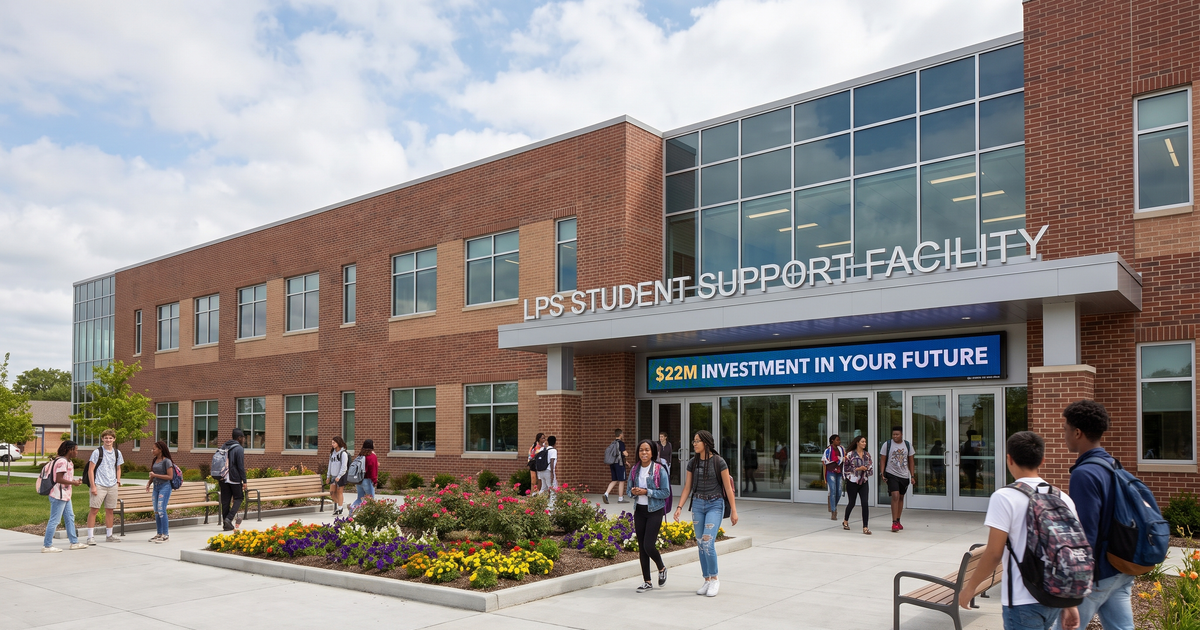
Lincoln Public Schools is building a 47,000 square foot Student Support Facility south of the existing Yankee Hill Education Center in southwest Lincoln, Nebraska. It is a one-story, Type IIB building on a newly annexed 20-acre site, and it will serve 100 to 125 students — up from about 80 today.
Who those students are is the entire design brief. The facility serves students who have been expelled or suspended, students who need behavioral or pro-social learning support, and students transferring into the district who need an unusual set of credits to graduate.
If you bid this the way you bid a comprehensive high school, you will be wrong about the security scope, wrong about the density, and wrong about the questions you should have asked before submitting.
The Numbers
- $22,020,290 — the permit value Signal carries
- $19,569,000 — the construction bid the Lincoln Board of Education approved on February 11, 2026, awarded to Scheele-Kayton Construction LLC of Lincoln
- ~$24.8 million — the program figure floated when the project was first proposed
- Funded from roughly $25 million remaining from the district's 2020 bond program, out of savings and bond proceeds
- Completion July 2027
That funding detail matters more than it looks. This is not a project waiting on a future referendum or a capital campaign. The money was voted in February 2020 and is already banked. Voters approved the bond with 62 percent support. Bond-savings-funded work is about as schedule-secure as public construction gets.
Five Systems, But Not The Five You Expect
Signal lists structured cabling, access control, CCTV, fire alarm, and AV. Standard list. Completely non-standard application.
Most school security conversations are about the perimeter: vestibule entry, door hardware, lockdown, mass notification, keeping a threat outside. That work exists here too. But an alternative and behavioral program's dominant security problem is internal — supervising movement, sight lines and de-escalation inside a building full of students who are there specifically because a comprehensive high school could not manage their behavior.
That shifts the design in concrete ways:
- Access control manages internal circulation, not just the front door. Zoned corridors, controlled transitions between program areas, and doors that are about routing students rather than excluding outsiders.
- Camera coverage follows sight lines and corridors, and it exists to document incidents and support staff, not primarily to watch a parking lot. Coverage gaps at corners, alcoves and stairwells are the ones that matter.
- Staff duress is real scope and it is routinely forgotten. Fixed or wearable duress that identifies location, integrates with paging and intercom, and calls up the nearest camera. If duress is not in the drawings on a building like this, ask why — because the staff will ask for it after occupancy, and retrofit is expensive.
- Intercom and paging need room-level granularity, so an office can talk to one classroom without broadcasting an incident to the building.
The Question You Must Ask Before You Bid
Buildings with de-escalation, calm, or seclusion spaces raise a question a commercial contractor never has to think about: where are you allowed to record, and for how long do you keep it?
Student records are protected under FERPA, and camera footage of identifiable students in a special-program setting can fall inside that protection. Districts vary enormously in policy on recording de-escalation spaces — some require it as documentation, some prohibit it, some allow live view without retention.
This is not your decision to make and it is not something to assume from the drawings. Ask the district in RFI: which spaces are recorded, which are live-view only, what the retention period is, and who holds the export authority. Then put the answer in your submittal. The camera count is easy. The policy is what makes the design defensible.
Small Building, High Density
Run the ratio. 47,000 square feet for 100 to 125 students is roughly 380 square feet per student. A comprehensive high school is commonly a fraction of that per head, because the square footage is dominated by large-format spaces — gyms, cafeterias, auditoriums — that carry very little low voltage per square foot.
An alternative school is mostly small classrooms, offices, counseling rooms, and program spaces. Almost every room is a device location. Device density per square foot runs higher here than in a big high school, which is why the usual K-12 percentage understates this building.
We benchmark comprehensive K-12 at roughly 4 percent of construction value. For this facility we are using a 5 percent base with a 1.15 system-count multiplier — 5.75 percent — because of the internal access control, camera density, duress, and the room-count-driven cabling. On the awarded $19,569,000 contract that is about $1.13 million; on the $22.02 million permit value it is about $1.27 million.
Call it $1.1M to $1.3M in low voltage.
Credit Recovery Is A Network Problem
"Students transferring in who need a unique set of credits" is a phrase with an infrastructure consequence. Individualized credit paths in 2026 means computer-based credit recovery — one-to-one devices, sustained video, proctored assessment.
Design the wireless for simultaneous device density in small rooms, not for coverage across a big open commons. Small rooms with hard walls, high per-student device counts, and continuous streaming is a very different AP layout problem than a cafeteria. And the AV scope skews toward classroom display and capture rather than assembly systems, because there is no auditorium here.
Ask About E-Rate
Here is the K-12 mechanism that contractors from other verticals consistently miss.
School districts fund a meaningful share of their network infrastructure through the federal E-Rate program, administered by USAC. Category 2 covers internal connections — structured cabling, switches, wireless access points, and supporting equipment — at a discount rate driven by district poverty level, against a budget allocation.
Why it matters to you: E-Rate has its own competitive bidding process, its own eligible-services list, its own filing windows, and its own documentation requirements, and it can run on a separate track from the construction contract. Some of what you would assume is in your scope may be procured through E-Rate instead, and some of it may be procured through E-Rate by you if you are set up for it.
Ask the district early which network scope sits inside the construction contract and which is going through E-Rate. Getting that boundary wrong is the K-12 equivalent of missing an owner-furnished package.
There Is A Second Job Behind This One
When the new facility opens, the existing Yankee Hill Education Center gets repurposed for the district's Individual Success Program — a comprehensive special education program for students with developmental disabilities.
That is a renovation of an occupied-then-vacated building for a program with its own set of requirements, and it follows directly behind this one. A contractor who performs on the new build is the obvious candidate for the conversion. Ask about it now, while you are in front of the district, rather than reading about the award later.
Who To Call
Scheele-Kayton Construction LLC of Lincoln holds the $19,569,000 contract. Local general contractor, local district, public procurement — which means the sub-bid process is open and the relationship is winnable by Nebraska and regional LV contractors rather than being locked up by a national.
Lincoln Public Schools is the owner. Public school work carries the usual gates: bonding, prevailing wage where applicable, and district-specific insurance and background-check requirements. That last one is not a formality on this project — staff and trades working in an occupied building with this student population will face background screening, and if your crew cannot clear it, you cannot staff the job.
Completion is July 2027, and the contract was awarded in February 2026, which means the systems buyout is happening now.
Track projects like this before the bid drops. LVN Signal monitors permits, bids, and construction news across the country and scores every project for low voltage opportunity. See what is in your market.
Join 35,000+ Low Voltage Pros
Get weekly permit updates, tool deals, job opportunities, and industry news. No spam, unsubscribe anytime.