
KNIPEX 74 21 200 High Leverage Diagonal Cutters Review: Built for Daily Abuse
Join Low Voltage Nation — Find project opportunities and showcase your company to thousands of industry professionals
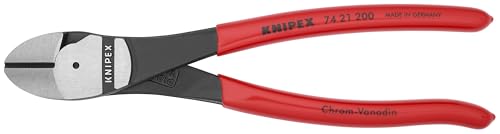
KNIPEX KNIPEX Tools 74 21 200, 8-Inch High Leverage Angled Diagonal Cutters
High leverage Diagonal Cutters for very tough, continuous use 20% reduction in required force compared to conventional diagonal cutters of the same length Precision cutting edges High leverage means less force required because the rivet is cloer to the cutting edge Cutting Capacity - up to 11/64" for medium wire, up to 1/8" for hard and up to 3/32" for piano wire
In-depth review of KNIPEX 74 21 200 High Leverage Angled Diagonal Cutters. German engineering, 20% less cutting effort, and real-world performance for LV techs.
Knipex
KNIPEX - the pliers brand
KNIPEX 74 21 200 High Leverage Diagonal Cutters Review: Are They Worth It for Low Voltage Work?
Every low voltage technician needs a reliable pair of diagonal cutters—dikes that can handle everything from zip ties to hardened screws without flinching. The KNIPEX 74 21 200 High Leverage Angled Diagonal Cutters have earned a devoted following among electricians and data techs alike. At around $40, they sit in the premium tier, but the question is: do they justify the price over cheaper alternatives?
After examining how these German-engineered cutters perform in real structured cabling and low voltage environments, here's what you need to know.
Quick Verdict
The KNIPEX 74 21 200 delivers exactly what it promises: effortless cuts through medium and hard wire with significantly less hand fatigue than standard diagonal cutters. The 12-degree angled head provides better clearance in tight spaces, and the 64 HRC cutting edges stay sharp through years of abuse. If you're cutting wire daily, these pay for themselves in reduced strain and longer tool life.
Rating: 4.7/5 — Premium performance at a reasonable price; minor deductions for handle comfort preferences.
Who This Is For (And Who Should Skip It)
Perfect For:
- Structured cabling technicians cutting zip ties, tie wraps, and small wire all day
- Low voltage installers who need clean cuts on 18-14 AWG stranded
- Anyone experiencing hand fatigue from standard diagonal cutters
- Techs who value longevity—these last decades, not months
Skip If:
- You rarely cut wire (a basic $15 pair will suffice)
- You need to cut cable larger than 4 AWG (get proper cable cutters)
- You prefer smaller, more compact cutters for tight spaces
- Budget is extremely tight (Klein's entry-level works fine)
Key Features That Actually Matter
20% Less Cutting Force Required
This isn't marketing fluff—it's physics. The high leverage design moves the pivot point closer to the cutting edge, giving you better mechanical advantage. After a full day of cutting zip ties and small wire, your hands notice the difference. The reduction in grip fatigue is real and significant if you're making dozens of cuts per hour.
12-Degree Angled Head
The angled head design isn't just aesthetic. When cutting flush against a surface—like trimming zip ties tight to a cable bundle—the angle gives your knuckles clearance you wouldn't have with straight cutters. In cramped telecom closets and ceiling plenums, this extra clearance prevents scraped knuckles and awkward hand positions.
64 HRC Induction-Hardened Cutting Edges
The cutting edges are hardened to approximately 64 HRC—harder than most competing cutters. This means they'll cut piano wire, nails, and hardened screws without the edges rolling or chipping. One technician reported using the same pair for over 25 years before needing replacements. That's not a typo.
Chrome Vanadium Heavy-Duty Steel Construction
The forged, multi-stage oil-hardened steel construction means these cutters are built for continuous heavy use. The forged-on axle eliminates the weak point found in riveted designs. You can abuse these daily on a construction site and they'll keep performing.
Real-World Performance
In the field, the KNIPEX 74 21 200 cuts with a satisfying precision that's immediately noticeable compared to cheaper alternatives. The blades meet cleanly without the twist or offset you sometimes get with stamped cutters. Wire ends come out clean rather than crushed or angled.
The 8-inch length hits a sweet spot for most hand sizes. Long enough for leverage, short enough to fit comfortably in a tool pouch. The plastic-coated handles provide decent grip, though some techs prefer the comfort grip version (74 22 200) for all-day use.
Cutting capacity is rated at 11/64" for medium wire, 1/8" for hard wire, and 3/32" for piano wire. In practice, these slice through 14 AWG solid like butter and handle occasional cuts on hardened screws without complaint. They're not designed for large cable—keep dedicated cable cutters for anything over 4 AWG.
The angled head proves its worth when flush-cutting zip ties on cable bundles. Instead of awkwardly rotating your wrist or leaving a sharp stub, you can cut tight without repositioning. Over hundreds of cuts, this adds up to real time savings and less frustration.
Build quality is unmistakably German. The joint action is smooth from day one—no break-in period required. The head has a polished finish that resists corrosion, while the body uses a black atramentized coating for durability.
What I Like (Pros)
- High leverage design — 20% less effort means less hand fatigue over full workdays
- Angled head — 12-degree angle provides knuckle clearance for flush cuts
- Exceptional edge hardness — 64 HRC cutting edges stay sharp for years
- Forged construction — chrome vanadium steel built for decades of use
- Clean cuts — precision edges produce clean wire ends, not crushed messes
- Smooth joint action — no stiff break-in period like some competitors
- Piano wire capable — handles hardened wire that destroys lesser cutters
- Made in Germany — consistent quality control and precision manufacturing
What Could Be Better (Cons)
- Handle comfort — basic plastic coating isn't as comfortable as comfort-grip alternatives
- Price premium — costs 2-3x more than basic diagonal cutters
- Overkill for light use — if you rarely cut wire, cheaper options suffice
- Not for large cable — capacity tops out around 4 AWG
- Can notch on hardened screws — repeated hard screw cutting may damage edges
- 8" only option for angled — no smaller size available in angled version
Specifications
| Specification | Value |
|---|---|
| Length | 8" (200mm) |
| Weight | 0.59 lbs (278g) |
| Head Angle | 12 degrees |
| Material | Chrome vanadium heavy-duty steel |
| Edge Hardness | ~64 HRC (induction hardened) |
| Handle Type | Plastic coating |
| Medium Wire Capacity | 11/64" (4.4mm) |
| Hard Wire Capacity | 1/8" (3.2mm) |
| Piano Wire Capacity | 3/32" (2.4mm) |
| Surface Finish | Polished head, black atramentized body |
| Country of Origin | Germany |
| Standard | DIN ISO 5749 |
KNIPEX vs Klein vs NWS: How Do They Compare?
| Feature | KNIPEX 74 21 200 | Klein D2000-48 | NWS 8" |
|---|---|---|---|
| Price | ~$40 | ~$30 | ~$35 |
| Length | 8" | 8" | 8" |
| Angled Head | Yes (12°) | No | No |
| Edge Hardness | 64 HRC | Not specified | High |
| High Leverage | Yes | No | Some models |
| Country of Origin | Germany | USA/Mexico | Germany |
| Break-in Required | No | Sometimes | No |
| Cuts Piano Wire | Yes | Yes | Yes |
Is It Worth the Price?
At roughly $40, the KNIPEX 74 21 200 costs about $10-15 more than comparable Klein or Channellock cutters. Is the premium justified?
If you're cutting wire daily, absolutely. The reduced hand fatigue from the high leverage design alone is worth the difference. Add in the decades-long lifespan (multiple techs report 15-25+ years from a single pair), and the cost-per-year is actually lower than replacing cheaper cutters every few years.
For occasional use—weekend projects or light duty work—the value proposition is less compelling. A $20 pair of Klein diagonal cutters will handle occasional tasks just fine.
The Bottom Line
The KNIPEX 74 21 200 High Leverage Angled Diagonal Cutters represent German engineering at its finest—purposeful design, premium materials, and build quality that lasts decades. The 12-degree angled head and high leverage mechanism aren't gimmicks; they're functional improvements that make a real difference during all-day use.
For low voltage technicians and structured cabling installers who cut wire regularly, these are the diagonal cutters to beat. The initial investment pays dividends in reduced fatigue, cleaner cuts, and tools that outlast the cheaper alternatives by years.
Check Current Price on Amazon →
Disclosure: This post contains affiliate links. If you purchase through these links, we may earn a commission at no additional cost to you.
Find Projects That Need This Tool
Looking for commercial jobs where quality cutting tools speed up your installs?
LVN Signal surfaces low voltage installation projects from permit data before they hit bid boards.
Frequently Asked Questions
What's the difference between KNIPEX 74 21 200 and 74 22 200?
The 74 21 200 has basic plastic-coated handles, while the 74 22 200 has multi-component comfort grips. The cutting mechanism is identical. Choose the 22 version if comfort during extended use is a priority.
Can KNIPEX diagonal cutters cut hardened screws?
Yes, occasionally. The 64 HRC cutting edges can handle hardened screws, though repeated cutting of very hard materials may eventually notch the edges. For regular screw cutting, consider a dedicated tool.
Are KNIPEX diagonal cutters worth it over Klein?
For daily use, most technicians find the KNIPEX high leverage design reduces fatigue noticeably. For occasional use, Klein's lower price makes them a reasonable choice. Both are quality tools.
How long do KNIPEX diagonal cutters last?
With normal use, KNIPEX cutters commonly last 15-25+ years. The forged construction and hardened edges maintain performance far longer than stamped alternatives.
Join 35,000+ Low Voltage Pros
Get weekly permit updates, tool deals, job opportunities, and industry news. No spam, unsubscribe anytime.