
Join Low Voltage Nation — Find project opportunities and showcase your company to thousands of industry professionals
Keel’s 110 MW gross Sharon campus reaches a draft permit milestone. Explore the named project team, brownfield conditions and potential low-voltage work.
Keel Infrastructure’s proposed AI campus in Sharon, Pennsylvania, has a fresh permitting milestone and an unusually useful public list of design partners. The September 26 Pennsylvania Bulletin records a tentative decision on construction-stormwater permit PAD430004 for the Mercer Node development. For low-voltage contractors, the immediate value is the chance to understand a developing project before installation packages are publicly identified.
The owner describes 110 megawatts of secured capacity. Its investor presentation labels that figure gross power. Current IT load, construction cost, tenant commitments and trade awards remain unverified in the reviewed sources. This is a brownfield redevelopment involving proposed new buildings and electrical infrastructure. The reporting below separates documented scope from LVN’s prospective trade analysis.
What the new filing establishes
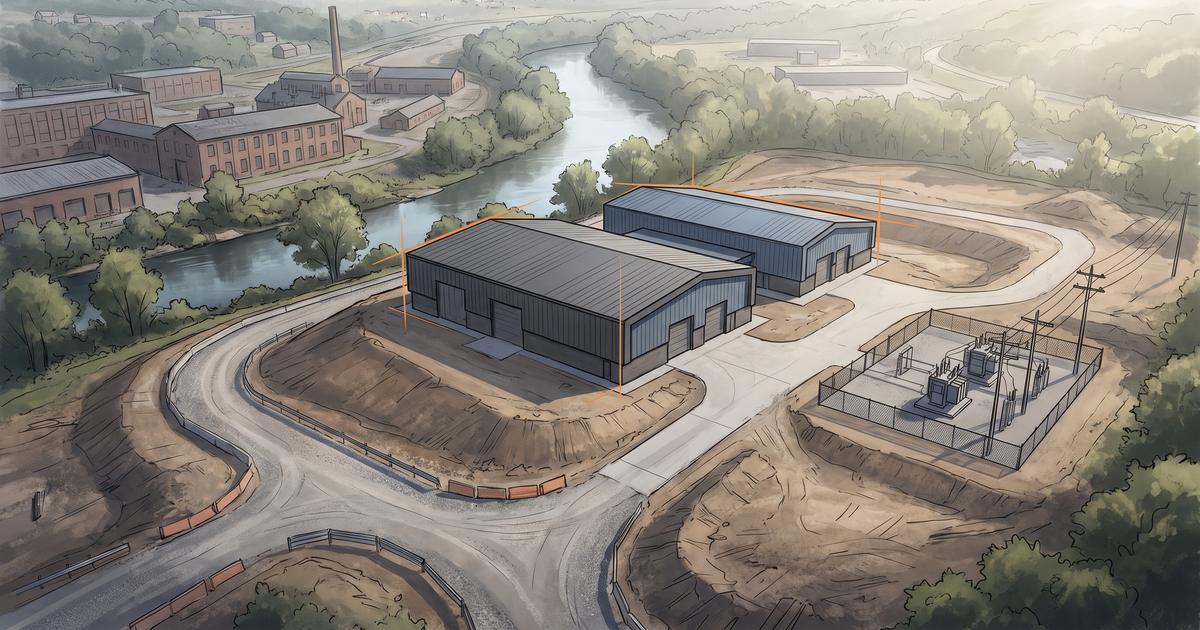
The September 26 permit notice, on printed pages 6388–6389, identifies Mercer Node Properties LLC as applicant and 200 and 201 Clark Street as the project address. It describes two buildings for data-center equipment, a substation, equipment yards, parking and access roads. Proposed earth disturbance covers 14.64 acres. Final permit issuance and a construction start are not established by this notice.
| Item | Reported position | Qualification |
|---|---|---|
| Location | Sharon, Pennsylvania | 200–201 Clark Street |
| Campus | 17 acres | Owner’s campus figure |
| Capacity | 110 MW gross | Secured; live IT load unknown |
| Proposed buildings | Two | Stormwater application scope |
| Earth disturbance | 14.64 acres | Distinct from campus area |
| Service timing | Earliest 2027 | Owner forecast |
| Project cost / jobs | Undisclosed in reviewed sources | No site estimate assigned |
The distinction between land area, disturbance and floor area matters when evaluating a lead. None establishes cable length, device count or usable data-hall space. A contractor still needs drawings and package boundaries to turn this information into a credible estimate. The address also provides a location reference; a map pin does not establish the limits of the campus or the work area.
Power and schedule: the milestones still ahead
Keel’s August 2026 presentation associates Sharon with FirstEnergy and PJM, lists an earliest ready-for-service date of 2027, and forecasts completion of its 80 MW substation development by year-end 2026. Those statements describe different milestones. Substation completion, energization, building turnover and a customer’s production deployment each require their own evidence.
The second-quarter development update reports Sharon land-development approvals and long-lead equipment progress while environmental permitting remained underway. It also describes the decommissioning of US Bitcoin mining operations for the HPC transition. Historical mining capacity should therefore be treated separately from a functioning AI facility.
In its prepared earnings remarks, management discusses transformer deliveries at Sharon, ongoing design work and prospective customers. It also describes final fiber-contract work across its three priority sites. These are useful signs of development activity, but the remarks do not identify Sharon’s carrier routes, fiber installers or a signed tenant. Prospective customer discussions leave commercial execution open.
Keel’s August 20 statement on Pennsylvania’s GRID initiative says its Sharon and Panther Creek permitting continued on schedule and was unaffected by the cited executive order. That is the developer’s stated position. The September draft notice supplies a later, specific permitting event; it does not resolve every remaining approval.
Brownfield conditions belong in the scope discussion
A July Pennsylvania remediation notice describes an approximately 17-acre former steel and pipe manufacturing property. Civil & Environmental Consultants submitted the notice for Mercer Node Development LLC. The filing identifies soil and groundwater contamination and planned 80 MW and 30 MW substations. It describes the Westinghouse Superfund site as adjacent, so that neighboring property should not be conflated with this development.
The September draft conditions reference a 2014 environmental covenant, an April 20, 2026 consent order and a site-specific manual covering safety and soil/groundwater management. New contamination and departures from existing earth-disturbance controls would require further coordination under the proposed conditions.
LVN’s practical interpretation is that below-grade pathways deserve early attention. A proposed fiber entrance, vault or equipment foundation may intersect work governed by environmental controls. Estimators should request the applicable project documents and ask who owns excavation, material handling, backfill, inspection and restoration. The public notice alone cannot establish an approved installation method or a crew’s training requirements.
The named project team
The owner’s Sharon campus page identifies six specialist partners. Their published roles provide a starting point for understanding design responsibility and power work.
| Organization | Published role | Evidence |
|---|---|---|
| Keel Infrastructure | Developer / owner parent | Corporate and campus disclosures |
| Mercer Node Development | Site development entity | Remediation notice |
| Mercer Node Properties | Permit applicant | September notice |
| CM Mission Critical | MEP engineering | Owner partner list |
| JHET Architects | Architecture | Owner partner list |
| L.A. Fuess Partners | Structural engineering | Owner partner list |
| TLD Design Consulting | Security / telecom consultant | Owner partner list |
| Civil & Environmental Consultants | Civil / environmental | Owner and state notice |
| Asplundh Engineering Services | Substation EPC | Owner partner list |
| FirstEnergy | Utility | August presentation |
TLD’s consulting role is particularly relevant to telecom and security firms. An installation award has not been established. Asplundh’s listed scope is substation EPC; the reviewed evidence does not identify it as the data-hall general contractor. The main GC/CM and individual electrical, cabling, fire, controls and commissioning contractors remain unverified.
Legal names also need care. The filed subsidiary list uses Mercer Node Property LLC, while the new permit uses Mercer Node Properties LLC. Application and property records would be needed to reconcile that spelling difference. Keel’s corporate transition announcement establishes its parent relationship to Bitfarms and subsidiaries. Its $458 million convertible offering is corporate funding, not a disclosed Sharon construction budget. The $819 million liquidity figure in the quarterly release also covers the company.
Where low voltage could enter the project
The following is LVN’s analysis of potential work categories. The strongest project-specific signals are the named telecom/security consultant and the owner’s broader fiber-contract progress. Quantities, procurement dates and installation appointments remain open.
| Potential work | Practical relevance | Needed before pricing |
|---|---|---|
| Fiber / outside plant | Campus entrances and backbone | Routes, demarcations, excavation scope |
| Structured cabling | Building and operational connectivity | Room layouts and cable schedules |
| Security / access | Controlled areas and monitoring | Device plans and integrator scope |
| Fire interfaces | Life-safety coordination | Approved design and responsibilities |
| Controls / networking | Equipment monitoring and alarms | Point lists and IT/OT ownership |
| Testing / turnover | Documented system acceptance | Test criteria and witnesses |
A useful first conversation would address delivery responsibility. Does the developer provide a powered shell, a fitted data hall, or some other defined handover? Which network and security systems sit in the landlord package, and which belong to a future customer? Public discussion of potential lease structures does not answer those questions for an executed contract.
For fiber teams, request the entrance strategy, pathway ownership, cable and connector schedule, acceptance criteria and carrier handoff points. For security and controls teams, ask about design authority, network ownership, licensing, integration responsibilities and the person who accepts the final system. These questions can reveal whether a package fits a contractor’s capabilities before substantial estimating effort is committed.
Phased work also makes documentation valuable. A proposal can state how labels, test results, redlines and device schedules will be delivered and reconciled at turnover. That is a service approach contractors can prepare now; it should not be presented as a published Sharon specification. No defensible low-voltage dollar estimate can be calculated from the available project cost and quantity information.
Jobs, trades and skills to prepare
The reviewed sources provide no verified Sharon construction headcount, permanent employment total or site-specific hiring list. Keel’s August 20 release forecasts hundreds of construction and operations jobs across its Pennsylvania developments, without assigning a Sharon total. General corporate recruiting does not establish an opening on this campus. Relevant prospective trades include communications infrastructure, civil/OSP coordination, security, controls and commissioning, with actual hiring dependent on final packages and schedules.
For technicians, useful preparation includes fiber inspection and cleaning, loss testing, OTDR interpretation, consistent labeling, test-file management, pathway coordination and grounding/bonding awareness. Security and controls work adds system configuration, interface testing and disciplined turnover records. These are general capability areas, not announced qualification requirements for Sharon.
The Fiber Optic Association’s workforce resources offer training and career-development references. BICSI’s course catalog is another starting point for communications-infrastructure education. OSHA Outreach addresses general hazard awareness; employer, task and site requirements still need separate confirmation. Before committing crews, request the actual onboarding, access and training criteria from the responsible contractor.
What would make this a stronger bid opportunity?
The next useful evidence would include a final permit decision, current construction documents, a confirmed customer arrangement, named procurement contacts and released trade packages. Evidence of substation completion and energization would sharpen the schedule, while a GC/CM appointment would clarify a route for qualification. Each should be checked against the specific Sharon scope.
For now, a focused qualification package can describe relevant experience, testing equipment, documentation samples and available service coverage. Avoid assuming that an owner’s partner listing is an invitation to bid. Ask for the procurement route and current package status before assigning an estimator or reserving labor.
Explore LVN Signal to research construction opportunities, named organizations and source-backed project details. Sharon is a useful early lead for teams comfortable with industrial redevelopment and coordinated telecom, security and power infrastructure. Its value today is the documented development path and the questions contractors can now ask with precision.
Reporting checked September 27, 2026. Featured and social artwork are AI concept illustrations, not site photographs or approved design documents.
Join 35,000+ Low Voltage Pros
Get weekly permit updates, tool deals, job opportunities, and industry news. No spam, unsubscribe anytime.