
Join Low Voltage Nation — Find project opportunities and showcase your company to thousands of industry professionals
Hut 8 River Bend is under construction in Louisiana. Explore its 245 MW IT lease, Jacobs EPCM role, forecast jobs and potential low-voltage work.
Hut 8's River Bend AI data center in West Feliciana Parish, Louisiana, has reached vertical construction, with 245 megawatts of contracted IT capacity and Jacobs leading engineering, procurement and construction management. For low-voltage contractors, the development presents a substantial potential market for fiber, communications, security and controls. The immediate commercial question is who will procure those packages and when.
Hut 8's August 4 construction update reports work on the campus substation and initial deliveries of long-lead equipment. It targets the first data hall for Q2 2027. That combination of physical progress and a stated delivery target makes River Bend worth watching closely as installation and commissioning responsibilities become clearer.
River Bend at a glance
| Item | Reported position | Qualification |
|---|---|---|
| Location | West Feliciana Parish, Louisiana | Near St. Francisville |
| Construction | Vertical and substation work | Owner update, August 2026 |
| IT capacity | 245 MW contracted | Fluidstack lease |
| Utility capacity | 330 MW supporting supply | Entergy Louisiana relationship |
| First data hall | Q2 2027 target | Future delivery |
| Phase 1 investment | Up to $10 billion | Data center and compute |
| Trade packages | Awards unverified | Procurement details needed |
The owner's campus page identifies 627 acres and another 2,361 acres under option. Those figures describe the current site footprint and a possible land expansion. They do not establish completed facilities across the optioned acreage. The exact parcel point was not verified for this report; a St. Francisville map reference should be treated as a nearby city location.
Schedule language also needs a date attached. Jacobs' January 8 award announcement gave Q1 2027 for the initial hall. Hut 8's later quarterly update gives Q2 2027. This report uses the later owner target. Neither announcement establishes a completed hall, energized IT load or an accepted commissioning milestone.
Five dollar figures with different meanings
The broadest investment figure is up to $10 billion for Phase 1 data center and compute infrastructure, as described on Hut 8's campus page. It covers a wider investment basis than a building contract. Applying a generic low-voltage percentage to that headline would produce an estimate without a defensible construction scope.
The project's April 30 financing close was a $3.25 billion note offering. The proceeds support the 245 MW facility and related substation, return prior equity contributions and fund debt-service reserves. J.P. Morgan was lead bookrunner; Goldman Sachs and Morgan Stanley were joint bookrunners. The notes carry a 6.192% coupon and mature in 2042. Their size therefore includes uses beyond direct construction expenditure.
The Fluidstack lease announcement supplies a third measure: $7 billion of base-term contract value across 15 years. That is future lease value. The release also discussed a prospective loan arrangement; the subsequent bond close is the relevant completed financing milestone.
The newest announcement, Hut 8's September 28 revolving credit facility, adds $1.07 billion of parent-level liquidity. Its reference to $7.5 billion of project financing combines River Bend with Beacon Point in Texas. Neither number should be presented as a fresh River Bend construction award. A separate approximately $16 million local water investment has its own defined scope.
Who is involved, and what each role establishes
Hut 8's Anthropic and Fluidstack partnership explains the customer chain: Hut 8 develops infrastructure, Fluidstack operates the high-performance clusters, and Anthropic uses the resulting AI compute capacity. Fluidstack is the named tenant in the lease announcement. Google's role is a financial backstop for lease and related obligations.
| Organization | Confirmed role | Scope boundary |
|---|---|---|
| Hut 8 | Owner and developer | Campus development |
| Fluidstack | Tenant and cluster operator | 245 MW IT lease |
| Anthropic | AI compute customer | Announced partnership |
| Financial backstop | Lease obligations | |
| Jacobs | EPCM lead | Installation awards unverified |
| Vertiv | Infrastructure partner | Equipment schedule unverified |
| Entergy Louisiana | Electric utility | 330 MW initial relationship |
| West Feliciana Parish | Local water partner | Planned infrastructure transfer |
| Louisiana Economic Development | State development agency | Project and jobs reporting |
Jacobs' EPCM appointment gives contractors a named delivery organization to research. Its Hut 8 project profile describes power-system integration, supply-chain coordination and construction management at River Bend. A named EPCM organization does not settle which firm holds the electrical, fiber, security or controls installation contract. Those subcontract relationships remain unverified in the sources reviewed.
Vertiv is named alongside Jacobs in the owner's lease release. Its separate Hut 8 infrastructure collaboration announcement discusses selected projects across the developer's broader roadmap. It does not establish a River Bend-specific OneCore equipment list, rack density, installation award or quantified delivery savings.
Capacity, expansion and local infrastructure
The initial contracted basis is 245 MW of critical IT capacity, supported by 330 MW of utility capacity. Future expansion has separate conditions. Fluidstack holds a right of first offer for up to another 1,000 MW of IT capacity at River Bend, subject to power expansion. A further optional 1,050 MW tranche in the Anthropic partnership concerns Hut 8's pipeline beyond this campus. The partnership's 2,295 MW headline should not become a River Bend operating-capacity claim.
For an estimator, this means sizing work against the issued phase and drawings. Announced expansion can justify relationship development, but it cannot supply cable quantities, route lengths, security device counts or a confirmed construction sequence.
The May 19 water agreement covers a new well, about eight miles of water main and other system improvements intended for transfer to West Feliciana Parish. Completion was expected in the second half of 2026; an acceptance record was not verified for this report. Hut 8 also describes planned closed-loop cooling and protection of the local water supply. Those remain attributed owner commitments, without independently verified operating water-use measurements here.
Entergy Louisiana's utility relationship likewise does not establish a dedicated nuclear-power contract. The nearby River Bend generating station is a separate facility. Procurement and technical decisions should follow the campus's documented service arrangements.
Where low-voltage work could emerge
The following is LVN's analysis of potential work around a campus of this type. It identifies areas to qualify with the project team. No package quantities, installer appointments or open solicitations were verified.
| System | Potential work | Question to resolve |
|---|---|---|
| Fiber / outside plant | Entrances and backbone | Who owns routes and ducts? |
| Structured cabling | Facility support networks | Who buys each package? |
| Access control / CCTV | Secure areas and monitoring | Which integrator is selected? |
| Fire alarm | Life-safety interfaces | What does the design require? |
| BAS/BMS controls | Monitoring and integration | Who owns the point lists? |
| Networking | Facility IT/OT connections | Where are handoff boundaries? |
| Commissioning | Testing and turnover | Who accepts the evidence? |
Fiber contractors can prepare by separating carrier entrances, campus backbone and facility distribution in their capability statements. A useful qualification discussion would establish route diversity, duct ownership, splice locations, testing responsibility and the party accepting each handoff. None of those details can be derived from the campus megawatt figure alone.
Security and controls firms have similar interface questions. Ask which systems belong to the facility owner, the tenant, equipment suppliers or another installation package. Clarify device furnishing, network configuration, programming, integration testing and documentation before pricing. Overlapping responsibilities can create expensive gaps even when individual systems appear familiar.
The first hall's target date also makes turnover planning relevant. Potential bidders should ask about phased access, construction sequencing, witness testing, punch-list closure and the format of as-built records. These are preparation questions; the public announcements do not establish River Bend's specific acceptance procedures.
A focused supplier introduction should identify the work your team can perform, the geography it can serve and comparable completed projects. Ask for the correct procurement contact and qualification process before sending a detailed estimate. Evidence of test-documentation quality, supervision capacity and reliable handover may make that conversation more useful than a broad claim to handle every campus system.
Jobs, trades and practical preparation
Louisiana Economic Development's announcement forecasts roughly 1,000 workers at peak Phase 1 construction and at least 75 direct permanent jobs. It estimates 193 additional indirect jobs, for 268 potential jobs in total. These are economic and employment forecasts. They do not establish current vacancies, on-site staffing today or a low-voltage share of the workforce.
For technicians, useful preparation includes fiber end-face inspection, cleaning, splicing, loss testing, labeling and clear test records. The Fiber Optic Association workforce guide offers general training context. Its fiber testing reference is a starting point for understanding loss measurement; the actual package specifications must define required methods, instruments and acceptance limits.
BICSI training provides communications-infrastructure education. OSHA Outreach provides hazard-awareness training and does not replace training required for particular tasks. No River Bend-specific certification mandate was verified. Contractors should confirm onboarding, site access, lift operation, bonding coordination and safety requirements directly through the responsible employer or procurement team.
The next milestones to watch
The most useful updates would identify procurement owners, named trade contractors, package release dates and verified power and commissioning milestones. Water-system completion and parcel-level documentation would add local context. Any expansion announcement should state its capacity basis, power conditions and construction phase so contractors can distinguish future development potential from work ready to price.
River Bend already has a contracted initial phase, completed project financing and owner-reported construction progress. The next commercial step is to connect those facts to a buyer and an issued scope. Explore the project and related construction opportunities in LVN Signal, then use the linked primary sources to qualify the timing and team before committing estimating resources.
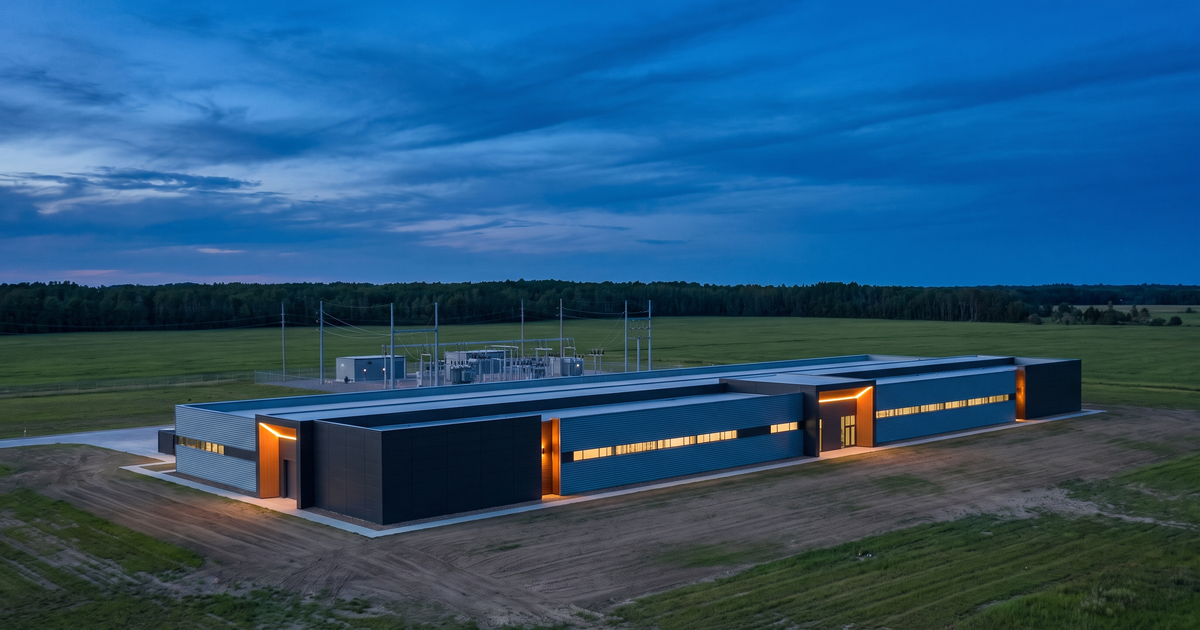
Reporting checked September 30, 2026. Featured and social artwork are AI-generated concepts, not actual site photographs or approved designs.
Join 35,000+ Low Voltage Pros
Get weekly permit updates, tool deals, job opportunities, and industry news. No spam, unsubscribe anytime.