
Join Low Voltage Nation — Find project opportunities and showcase your company to thousands of industry professionals
County records establish a proposed Hueco Ranch dome campus in Texas. Review conflicting scale claims, contractor gaps and prospective low-voltage work.
ServerDome Global’s proposed Hueco Ranch campus puts an unusual building concept into the West Texas data-center pipeline: large dome-shaped facilities near Desert Haven in Hudspeth County. The project has reached public discussion, and its developer is promoting substantial capacity. For low-voltage contractors, the useful question is how that proposal progresses into permitted work, named buyers and defined installation packages.
The strongest public evidence reviewed establishes a development proposal with unresolved delivery details. Hudspeth County’s October 9 message to residents identifies ServerDomes and the Desert Haven location, while explicitly qualifying information supplied by project representatives. The county’s October 27 Commissioners Court agenda then places the developer’s presentation, advisory support and a proposed road-use agreement before the court. A verified mass-earthwork permit, current general-contractor identity and low-voltage award were not found in the reviewed material.
Hueco Ranch at a glance
| Item | Reported position | Qualification |
|---|---|---|
| Location | Desert Haven, Hudspeth County, Texas | County-confirmed area |
| Developer | ServerDome Global | Named by county |
| Stage | Planning and permitting | Earthwork authorization unverified |
| Capacity | 350 MW marketed | IT/gross basis undefined |
| Land | CEO: 2,000 acres; 700-acre first phase | Website figure conflicts |
| Delivery | First 80 MW in 16 months marketed | Timing anchor unverified |
| Trade awards | GC and LV installers unknown | No open package verified |
What the county agenda establishes
Page two of the October 27 agenda separates three relevant items. Item eight concerns the developer’s infrastructure presentation; item nine concerns identifying a special adviser for good-neighbor agreements; item ten concerns a road-use agreement pending proper bond filing. Those entries establish matters scheduled for consideration. The reviewed agenda does not supply a recorded vote, executed agreement, accepted bond or building permit.
That distinction affects estimating. A contractor considering travel, mobilization or a local partner needs the current authorization and construction sequence before allocating resources. Road access may become important for deliveries and underground utility coordination, but a proposed road agreement alone does not establish when a cabling crew can enter the site.
The same agenda includes a separate El Paso Community College APEX Accelerator presentation. Its appearance on the page does not establish a Hueco Ranch training contract or procurement program. Businesses should verify whether any future supplier-support event is actually connected to this development before presenting it as a project opportunity.
Reconciling the scale and schedule claims
The developer’s project page markets 350 MW of planned capacity and an initial 80 MW delivery in 16 months. It does not establish whether those numbers describe critical IT load or another power measure, and the schedule’s starting point remains unclear. Energized capacity has not been verified. Those omissions prevent a defensible conversion from the headline MW number into racks, fiber counts or equipment quantities.
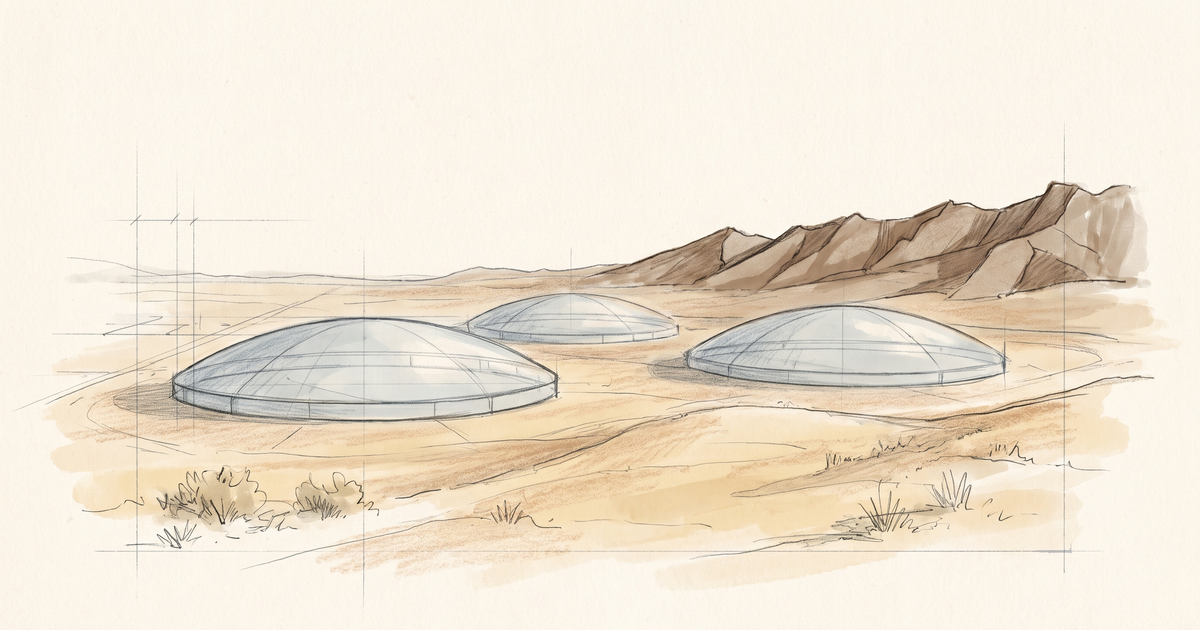
The public land descriptions also differ. KFOX’s October 12 report of CEO David Keegan’s October 10 letter gives a 2,000-acre site and a 700-acre first phase, correcting earlier 24,000-acre reporting. It describes ten domes, each 500 feet across and 65 feet high. The live developer page still displays 24,000 acres and labels the project Utah, while the company homepage places Hueco Ranch in Texas. County geography provides the clearer location evidence. The dimensions remain an attributed concept pending verified drawings.
Baxtel’s October 11 account reports an October 7 groundbreaking ceremony. Later, KTSM’s October 27 report, carried by AOL, attributes an early-December leveling target to Keegan and says mass earth movement was awaiting a permit expected within 30–45 days. It also reports a longer-term one-gigawatt ambition without defining the power basis. These statements leave the permitted construction start and delivery sequence unresolved.
DCD’s November 2 report describes a $10 billion project, construction activity and secured first-phase tenants. The county notice and CEO-letter coverage carry a $15 billion claim. No financing close, construction-only budget or executed tenant agreement was verified for this report. November 2 is the trade article’s publication date; the reported ceremony took place earlier.
Who is named, and which roles remain open
| Organization | Reported role | Evidence limit |
|---|---|---|
| ServerDome Global | Developer | County identifies involvement |
| Hudspeth County | Public infrastructure review | Approval outcome unverified |
| Kaufman & Company | Investment participant reported by DCD | Current commitment unconfirmed |
| Lonestar Kaufman | ServerDomes partnership reported by DCD | Hueco-specific role unconfirmed |
| GC / electrical / LV installers | Names unverified | No project award established |
The current Kaufman and Lonestar pages require particular care. The live Lonestar page describes ZeroPoint and other development concepts; it does not independently establish the ServerDomes relationship reported in trade coverage. That discrepancy leaves the current Hueco role unresolved. A portfolio reference or logo on a project sign cannot establish who will issue a subcontract, how a venture is controlled or whether financing has closed.
For suppliers, the first useful conversation would identify the contracting entity, current design team and procurement contact. Ask whether a package covers base-building systems, tenant fit-out, outside plant or facilities controls. Each can have a different buyer and delivery date. A broad corporate partnership announcement should be followed by project-specific confirmation before it becomes a sales forecast.
Where low voltage could enter the project
The following interfaces are LVN’s prospective contractor analysis. They describe preparation questions for a campus of this type; no issued design, bill of materials or specialty award was verified. The dome concept adds a reason to ask about pathways and installation access early, while the actual architectural and engineering documents must control any estimate.
| Interface | Useful preparation | Evidence to request |
|---|---|---|
| OSP and fiber | Routes, entrances, civil coordination | Carrier and civil drawings |
| Structured cabling | Pathways, testing, labeling | Fit-out scope and quantities |
| Access and video | Device and network coordination | Security design and buyer |
| Fire interfaces | Monitoring and acceptance planning | Approved life-safety design |
| Controls and OT | Integration boundaries and records | Controls architecture |
| Commissioning | Test evidence and turnover | Acceptance requirements |
Outside-plant teams can prepare a capabilities package showing comparable duct-bank coordination, entrance construction and fiber testing. Their project questions should cover route diversity, easements, crossings, handoff points and responsibility for restoration. The campus footprint alone cannot answer those questions. Survey and civil documents are necessary to understand real distances and installation constraints.
Inside the buildings, estimators should establish the boundaries between rack connectivity, operational networks, security and building controls. Cable pathways, bonding, service access and future expansion space can influence labor and material choices. For a dome-shaped building, ask how the final design accommodates supports and maintenance access. Avoid deriving a tray layout from a promotional rendering.
Commissioning should appear in the initial scope discussion. Ask who approves test procedures, which parties witness acceptance, how deficiencies are tracked and what files must be delivered at turnover. A bid that includes installation but leaves testing responsibilities vague can be difficult to compare with a complete package. For security and controls work, establish who supplies network addresses, configures devices and coordinates integrated testing. These are questions for the eventual design and procurement teams. They are not evidence that any particular system has been selected for Hueco Ranch.
Power and cooling claims also create coordination questions. The county and CEO accounts describe behind-the-meter gas generation and closed-loop cooling plans. The reviewed material does not verify generator permits, fuel agreements or guaranteed water impacts. A controls integrator would need an equipment list, points schedule, alarm responsibilities and acceptance sequence before defining its work. Those documents also help clarify the boundary between electrical installation, equipment vendors and network integration.
Jobs, trades and useful preparation
The county relays forecasts of approximately 800 construction jobs and 200–300 permanent roles, explicitly attributing them to project representatives. These are projections, with no current project vacancies verified. Candidates should look for an identified employer, work location, start date and application route before treating a headline job count as a hiring notice.
Fiber inspection, cleaning, testing and documentation are practical areas to strengthen. The Fiber Optic Association’s workforce resources provide a starting point for training research; BICSI provides ICT education and credential information. These are general resources. Neither link establishes a Hueco Ranch hiring partnership or a project-specific certification requirement.
Contractors can also organize representative test records, as-built examples, crew capabilities and safety documentation. Keep that package specific: distinguish in-house skills from partner capacity and identify who handles field quality control. Training and documentation become more useful when they match a buyer’s published requirements. The developer’s contact page is a general inquiry route; no open tender or guaranteed response is implied.
What would make the opportunity actionable
The next meaningful evidence would include a recorded road-agreement outcome, bond and earthwork documentation, confirmed construction leadership, issued utility plans and identifiable specialty procurement. Current investor confirmation, tenant commitments and a dated power-delivery schedule would help resolve the larger commercial picture. These are evidence gaps to watch, rather than predictions that a particular milestone will occur.
For now, Hueco Ranch belongs on a contractor’s early-stage research list. Keep estimates tied to an explicit scope and ask for a dated procurement schedule before reserving crews. Follow LVN Signal for construction intelligence with the source context attached, and explore the AI/data-center map. The Hueco Ranch location marker uses Desert Haven as a locality reference; it does not identify a surveyed parcel or site entrance.
Reporting checked November 3, 2026. Featured and social artwork are AI-generated planning concepts. They do not document site conditions, approved architecture or installed equipment.
Join 35,000+ Low Voltage Pros
Get weekly permit updates, tool deals, job opportunities, and industry news. No spam, unsubscribe anytime.