
Join Low Voltage Nation — Find project opportunities and showcase your company to thousands of industry professionals
Hedgehog's Navarro County campus targets 600MW by end-2027, backed by Idemitsu and a separate 1.5GW TCEQ fuel-cell power filing.
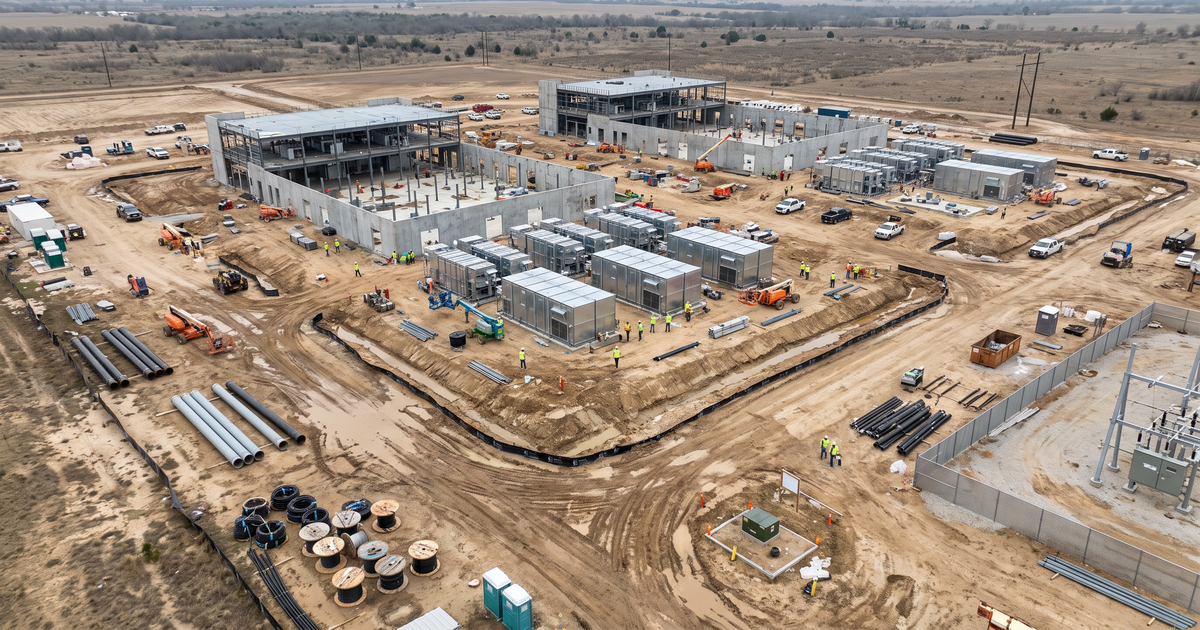
Hedgehog USA's Navarro County powered-land campus is today's LVN AI data-center construction watch because the power strategy is moving ahead before a tenant, building team, or specialty package roster is public. The July 21 Hedgehog announcement says the Texas campus can support up to 600 megawatts of data-center capacity by the end of 2027 under a long-term energy-supply agreement with Idemitsu.
The strongest public record sits underneath that announcement. A Texas Commission on Environmental Quality filing identifies the Hedgehog Power Generation Plant in Rice, Navarro County. The registration describes 4,615 Bloom Energy Server 6.5 solid-oxide fuel-cell blocks with approximately 1,500MW of total electrical generation capacity. That is a power-plant design figure, not disclosed data-center IT load.
Those two numbers must stay separate. The 600MW figure is Hedgehog's announced data-center capacity target for the campus by the end of 2027. The roughly 1,500MW figure is the TCEQ-filed fuel-cell power-generation design. Reviewed sources do not disclose the campus's building-level critical IT load, data-hall phasing, building count, building square footage, tenant, or contracted customer.
| Project fact | Source-backed detail | LVN read |
|---|---|---|
| Project | Hedgehog Navarro County powered campus | Early powered-land development near Rice, Texas. |
| Data-center capacity | Up to 600MW by end of 2027 | Campus capacity target; IT load remains undisclosed. |
| Power design | About 1,500MW of Bloom fuel cells | TCEQ-filed generation design, not IT load. |
| Energy partner | Idemitsu | Long-term natural-gas and energy-supply path. |
| Financial advisor | Marathon Capital | Advising the sale of 100% of the project. |
| Construction team | Not yet publicly named | GC, engineer, electrical, and LV packages remain watch items. |
Hedgehog describes itself as a power-first developer. In the company announcement, it says the Navarro County site combines land ownership, mineral and surface rights, pipeline infrastructure, and a behind-the-meter design before customer engagement. The objective is to offer hyperscale and enterprise users a site where energy infrastructure is advanced ahead of the traditional utility queue.
The location becomes more specific through company leadership. A project post from Hedgehog CEO Jeff Barber identifies the site near Rice, about 40 miles south of Dallas, and describes onsite high-pressure gas lines, carrier access, land control, and the Bloom air-permit path. That corporate-leadership post is useful context, but formal permits and owner announcements remain the controlling sources for public claims.
The TCEQ registration package is important because it is not a generic corporate capability page. It names Hedgehog USA, Rice, Navarro County, the new power-generation plant, the Bloom Energy Server 6.5 technology, the number of modular server blocks, and the approximate 1,500MW electrical output. It also frames the facility as new construction subject to Texas air-quality permitting.
Fuel-cell power changes the construction map, but it does not remove the need for conventional mission-critical systems. A large modular generation field still requires gas distribution, electrical collection, protection, controls, monitoring, communications, security, fire and life-safety coordination, grounding, network architecture, data integration, and commissioning. The final responsibility split will depend on the EPC, electrical, controls, and data-center building contracts.
| Company / agency | Source-backed role | Evidence |
|---|---|---|
| Hedgehog USA | Powered-land developer and project owner | Announcement |
| Idemitsu | Long-term energy-supply partner | Agreement |
| Marathon Capital | Exclusive financial advisor | Advisor page |
| Bloom Energy | Fuel-cell technology named in permit design | TCEQ filing |
| TCEQ | State environmental permitting authority | Public record |
| Navarro County | Local jurisdiction | Location profile |
Idemitsu's role is source-backed to the specific Hedgehog agreement, while a separate Idemitsu corporate release shows the energy company's broader U.S. data-center strategy. Idemitsu has been developing natural-gas supply and onsite-power services for AI data centers through its American subsidiary. That capability context supports the partnership without implying that every system or vendor from another Idemitsu project is assigned here.
Marathon Capital's role is equally specific. The firm's current news listing identifies its Hedgehog and Idemitsu advisory mandate. The project announcement says Marathon remains exclusive financial advisor for the sale of 100% of the project, covering development, commercialization, and market positioning. A future buyer or operating partner could materially change the procurement map.
No reviewed primary source names the data-center tenant or customer. No source names a hyperscaler, neocloud, colocation operator, or enterprise off-taker. The sale process and powered-land positioning suggest that customer and ownership announcements may arrive before final building packages. LVN should treat any rumored tenant as unconfirmed until Hedgehog, a buyer, a customer, a permit, or another primary record names it.
The same restraint applies to contractors. Reviewed sources do not name a general contractor, EPC or EPCM, architect, engineer of record, electrical contractor, low-voltage integrator, fiber or outside-plant contractor, structured-cabling firm, security integrator, fire alarm contractor, BAS/BMS/EPMS/SCADA provider, DAS/networking contractor, grounding contractor, or commissioning authority.
| Low-voltage lane | Why it matters | Watch signal |
|---|---|---|
| Fiber and OSP | Campus, carrier, MMR, and building connectivity | Carrier agreements, duct banks, handholes, splice and test packages. |
| Structured cabling | Data halls, support rooms, controls, and operations | Pathway drawings, copper/fiber specs, labeling and certification standards. |
| Security | Large powered campus and critical infrastructure | Fence, gate, access-control, CCTV, intercom, and SOC packages. |
| Fire and life safety | Fuel cells, electrical yards, batteries, and data halls | Detection, alarm, suppression interfaces, and AHJ approvals. |
| BAS / EPMS / SCADA | Power, cooling, alarms, telemetry, and orchestration | Controls narratives, point lists, network boundaries, and vendor awards. |
| Commissioning | Integrated reliability across power and IT facilities | CxA award, functional scripts, witness testing, and turnover standards. |
The earliest low-voltage opportunity may appear outside the data halls. Sitewide access control, surveillance, gate controls, fiber backbone, OSP pathways, construction networking, temporary security, environmental monitoring, power-plant controls, SCADA communications, and substation telemetry can move before a finished data-center building package. Firms should watch both the powered-land infrastructure and the future tenant buildings.
The TCEQ filing creates a clear controls and integration lane. Thousands of modular fuel-cell blocks require supervisory monitoring, alarms, communications, status data, coordinated shutdown logic, instrumentation, electrical interfaces, and maintenance visibility. The public record does not name the controls architecture or integrator, so LVN can identify the system family without assigning the package.
Behind-the-meter generation also creates responsibility boundaries. The data-center operator, power-plant operator, energy supplier, EPC, electrical contractor, controls integrator, utility interface, cybersecurity team, and commissioning authority must agree on telemetry, protection, network segmentation, alarm ownership, time synchronization, remote access, failover behavior, and incident response.
Security scope may span separate owners. A powered-land developer can control the campus perimeter and generation field while a tenant controls the data-hall security stack. That can produce separate access-control databases, visitor-management workflows, camera standards, intercom systems, guard operations, and security operations centers. The integration contract matters as much as the device count.
Fiber strategy is another open question. Leadership materials reference carrier availability, but reviewed primary records do not name the carriers, route diversity, entrance facilities, meet-me rooms, long-haul providers, dark-fiber owners, or construction contractor. A 600MW campus target will need resilient campus pathways and diverse external routes, but those details should remain watch items until documented.
Fire and life-safety design will need coordinated treatment of the fuel-cell field, gas systems, electrical equipment, battery storage if used, support buildings, future data halls, and emergency operations. Contractors should watch TCEQ records, fire-marshal permits, civil/site plans, building permits, and equipment submittals for the first source-backed package boundaries.
For technicians and subcontractors, useful preparation includes OSHA and site-safety readiness, mission-critical references, lift and equipment credentials, fiber cleaning and inspection, fusion splicing, OTDR and optical-loss testing, copper certification, cable-tray and pathway coordination, grounding and bonding, access-control commissioning, VMS configuration, fire alarm acceptance support, controls point-to-point testing, and disciplined redlines and as-builts.
Prequalification matters because this is still a powered-land sale and development process, not a public bid list. Firms should have current insurance, bonding, EMR and safety data, workforce counts, geographic coverage, project references, QA/QC plans, submittal workflows, testing equipment lists, field supervision, scheduling capability, closeout standards, and manufacturer certifications ready before the buyer or building team is announced.
The project stage should remain planned. Hedgehog has public land and power-development signals, a TCEQ filing, an energy agreement, and a financial advisor. Reviewed sources do not yet provide a vertical data-center building permit, named construction team, mobilization notice, foundation start, steel package, or data-hall construction milestone. Power infrastructure advancement is real, but it is not the same as a completed data-center construction start.
The capacity story is valuable precisely because it is easy to misstate. The roughly 1,500MW fuel-cell filing may give the project room to support more than the initial 600MW data-center target, provide redundancy, serve phased growth, or support other loads. The current sources do not resolve that allocation. LVN should not subtract, convert, or infer IT load from the generation design.
The practical watch list is concrete: TCEQ permit status, Navarro County incentives and land records, Rice-area permits, civil filings, water and wastewater plans, utility and interconnection records, gas infrastructure, buyer and tenant announcements, building permits, EPC and engineer appointments, carrier routes, construction hiring, and vendor or subcontractor prequalification.
Alias control will keep Signal clean. Track Hedgehog Navarro County, Hedgehog Rice Texas, Hedgehog powered-land campus, Hedgehog Power Plant, Navarro County 600MW data center, and Hedgehog Bloom 1.5GW. Keep the project distinct from Riot's Corsicana facility and other Navarro County mining or data-center developments.
The outreach angle is legitimate now. LVN has a source-backed project record and can update it when Hedgehog, Idemitsu, Marathon Capital, a buyer, a tenant, or a named contractor releases verified information. Companies can claim their LVN profile, correct the record, share a vendor or hiring route, sponsor the coverage, or provide source-backed trade-partner updates.
Bottom line: Hedgehog's Navarro County campus belongs in LVN Signal because the developer, location, energy partner, financial advisor, TCEQ power-plant filing, technology, and capacity framework are public. The data-center buildings and package holders are still mostly unknown. That is the useful preconstruction window for fiber, controls, security, fire, networking, grounding, and commissioning firms to prepare before the construction roster hardens.
Join 35,000+ Low Voltage Pros
Get weekly permit updates, tool deals, job opportunities, and industry news. No spam, unsubscribe anytime.