
Join Low Voltage Nation — Find project opportunities and showcase your company to thousands of industry professionals
Google's Project Spade in New Florence, Missouri is still planned, but the public record already gives LVN a low-voltage watchlist for fiber, security, controls, jobs, and utilities.
Project Spade puts New Florence on the AI infrastructure map
Google's Project Spade in New Florence, Missouri is a planned AI and hyperscale data-center campus with enough public detail to matter before the first specialty contractors are named. The official signal came from Google's Missouri investment announcement and the Missouri Department of Economic Development: Google is putting a $15 billion infrastructure package into Missouri that includes a new data center in Montgomery County, energy affordability work, local infrastructure capacity, and workforce development.
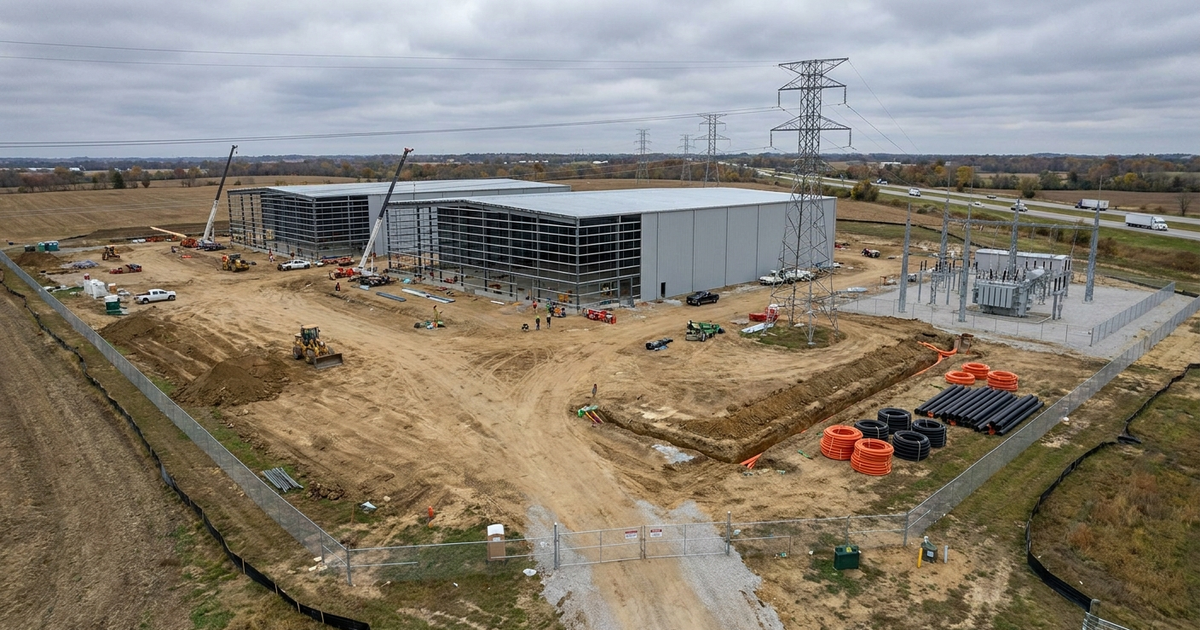
The local project page makes the construction story more specific. Project Spade's Montgomery County site says construction is anticipated to begin in late 2026 and describes two initial data-center buildings plus support buildings. It also frames the campus as a closed-loop, non-evaporative, air-cooled facility, with no water used for cooling and only standard domestic water needs during the initial phase. For low-voltage contractors, that combination matters: the job is still early, but the building count, power story, cooling strategy, and workforce package all point toward a campus-scale account map.
Trade coverage adds the project-family detail. Data Center Dynamics ties Project Spade to a roughly 934-acre site near I-70 and Highway 19, Related Digital development context, a reported 1.2 GW utility-capacity target, two large buildings, and about 2,000 construction jobs. Baxtel's Project Spade profile also tracks the campus as a planned Google hyperscale data-center development in New Florence and describes two planned buildings of roughly 800,000 square feet each. Those capacity and square-footage figures are not the same as an official Google IT-load disclosure, so they should be handled as market-source context, not as the owner's published critical-load number.
| Item | Public detail | LVN read |
|---|---|---|
| Location | New Florence, Montgomery County, Missouri | Rural I-70 corridor project with major site, power, road, and workforce implications. |
| Stage | Planned; construction anticipated in late 2026 | Early enough for account mapping before specialty names are public. |
| Initial build | Two data-center buildings plus support buildings | Campus pathways, telecom rooms, security, fire/life-safety, and controls will phase with building delivery. |
| Investment | $15 billion Missouri infrastructure package | Large enough to support multi-year vendor, labor, and training demand. |
| Capacity context | Market sources report about 1.2 GW utility capacity | Track power, substation, backup, OSP, and carrier-fiber milestones. |
The named-company map is useful, but the package names are still missing
The strongest confirmed name is Google as owner, operator, and end user. The second construction-market name is Related Digital, which DCD and Baxtel connect to the Project Spade campus. I am treating Related Digital as source-backed developer context rather than an announced general contractor. No public source in this packet names the GC, EPCM, electrical subcontractor, low-voltage contractor, security integrator, fire alarm contractor, BAS/BMS controls integrator, DAS/network contractor, or commissioning agent.
The utility and public-side map is clearer. Google says its data-center energy approach is built around paying for its operational and infrastructure costs, and the Missouri announcement says Google is supporting more than 500 MW of additional capacity through Ameren while bringing the Capacity Commitment Framework to Missouri with Ameren and Evergy. The Missouri DED release repeats the same energy and workforce commitments and adds the local economic-development frame: thousands of construction jobs over the build period and hundreds of direct long-term roles once the facility operates.
The workforce names matter for LVN because they tell contractors where the labor pipeline is being built. Google and Missouri identify the Construction Laborers and Contractors Joint Training Fund of Eastern Missouri, the Laborers and Contractors Training Center, and related training support for more than 2,300 construction laborers, including 1,500 apprentices, over two years. That is not a low-voltage contractor award. It is a practical warning that the project will be shaped by site access, safety, workforce readiness, documentation, testing discipline, and multi-trade coordination.
| Company or group | Public role | Evidence |
|---|---|---|
| Owner / operator / end user | Google and Missouri announcements | |
| Related Digital | Reported developer context | DCD and Baxtel project coverage |
| Ameren | Generation-capacity partner | Google and Missouri announcements |
| Evergy | Capacity-framework partner | Google and Missouri announcements |
| Missouri DED | State economic-development source | May 20, 2026 release |
| Greater Montgomery County EDC | Local project-page partner | Project Spade site |
| Construction Laborers and Contractors Joint Training Fund | Workforce training partner | Missouri DED release |
Where low voltage shows up first
At this stage, the low-voltage opportunity is mostly upstream. Nobody should claim a low-voltage package has been awarded unless a source names it. The useful move is to map the systems that become unavoidable on a Google-scale AI campus and watch the evidence that tends to appear before a formal specialty announcement: land disturbance, utilities, substations, civil packages, site trailers, GC prequalification, security packages, controls roles, fiber construction, carrier entrance work, permit language, inspection records, and commissioning jobs.
Fiber is the first obvious category. A 934-acre planned campus near a highway interchange needs diverse routes, outside plant, carrier coordination, duct banks, vaults, entrances, meet-me spaces, telecom rooms, labeling, cleaning, testing, and closeout documentation. The FOA workforce resources and BICSI optical fiber training are not project-specific requirements, but they are relevant preparation paths for technicians who want to move into this kind of mission-critical work.
Structured cabling and pathways come next. Data-center buildings create long runs of cable tray, sleeves, penetrations, telecom spaces, support cabling, labeling conventions, test records, and documentation standards. BICSI copper training is a useful baseline for techs who need to show discipline around standards, testing, and documentation. On a campus like this, sloppy labels and weak turnover packages become real project risk, not cosmetic mistakes.
Physical security and life safety will also become large scopes. Access control, CCTV, visitor management, gate/perimeter systems, video storage, alarm monitoring, fire alarm interfaces, fire/life-safety coordination, and public-safety communications all become part of the building turnover path. BAS and BMS controls are another critical layer because Project Spade is framed around closed-loop, non-evaporative air cooling and energy performance. Controls integrators, security integrators, fire alarm contractors, DAS/network partners, and commissioning teams should all be watching this project, even if their names are not public yet.
| System | Why it matters | Evidence to watch |
|---|---|---|
| Fiber / OSP | Carrier entrances, diverse routes, and campus backbone are central to AI capacity. | Fiber permits, utility crossings, carrier jobs, duct bank work, vaults. |
| Structured cabling | Buildings need pathways, telecom spaces, labeling, testing, and closeout records. | Cable tray packages, telecom-room scopes, QA jobs, installer postings. |
| Access control / CCTV | Hyperscale campuses require perimeter and building security layers. | Security integrator awards, camera/VMS packages, gate and badge systems. |
| Fire alarm / DAS | Large hardened buildings require AHJ coordination and life-safety interfaces. | Fire alarm permits, inspections, public-safety radio coverage notes. |
| BAS / BMS controls | Cooling, alarms, trends, and equipment integration are tied to operations. | Controls jobs, commissioning scopes, mechanical package milestones. |
| Grounding / bonding | Racks, pathways, telecom spaces, and equipment rooms need disciplined bonding. | Electrical specs, QA records, commissioning and turnover documents. |
Jobs, skills, and timing
The jobs story is larger than the permanent headcount. Google and Missouri describe thousands of construction jobs during the build and hundreds of direct roles after the facility is operating. The Project Spade site lists 300 local jobs created, while trade coverage cites about 2,000 construction jobs. Those numbers should be read together: the low-voltage opening is not just the permanent data-center operations team. It is the construction sequence, subcontractor bench, site safety pipeline, documentation burden, and the handoff from buildout to commissioning.
For technicians, this is a skills-stack story. Fiber cleaning and testing, copper/fiber termination, cable tray and pathway discipline, grounding and bonding, security rough-in, camera layout support, fire alarm coordination, BAS/BMS coordination, DAS awareness, lift/site safety, labeling, punch-list management, redlines, and closeout documentation are all practical skills that translate to this type of job. OSHA outreach training is table stakes for the site environment, not a differentiator by itself.
For contractors and vendors, the next move is account discipline. Track Project Spade, Google, Related Digital, Greater Montgomery County EDC, Montgomery County, Missouri DED, Missouri DNR, Ameren, Evergy, and Missouri PSC records. Watch for land disturbance, wells and water, wastewater, substation, interconnection, backup generation, fiber, site-security, and building-permit signals. Keep the naming variants straight: Project Spade, Google New Florence, Montgomery County data center, Related Digital New Florence, Tree Farm Road, I-70 / Highway 19, and Spade Property Owner LLC. Also keep it distinct from AWS Project Green, Crusoe Warrenton, and Google's other Missouri project names.
Why LVN Signal is tracking it now
Project Spade is still a planned project, not an active low-voltage bid list. That is exactly why it belongs in the LVN Signal workflow now. Once the GC, electrical contractor, fiber/OSP contractor, security integrator, fire alarm contractor, controls integrator, DAS/network contractor, and commissioning agent are publicly named, the best early account-mapping window has already narrowed.
For LVN members, the practical takeaway is simple: do not invent the missing contractors, but do not ignore the project because those names are missing. The public record already shows a Google-scale campus, a late-2026 construction target, two initial data-center buildings, a large Missouri investment, a major power-capacity story, workforce funding, and a clear set of low-voltage systems that will have to show up before turnover. That is enough to start watching the right records, companies, skills, and job postings now.
LVN Signal is built for this kind of early construction intelligence: projects, named companies, jobs, systems, and source evidence before the market has turned into recycled press-release noise. Track Project Spade in Signal, then use the public sources above to decide where outreach, hiring, training, and vendor monitoring should start.
Join 35,000+ Low Voltage Pros
Get weekly permit updates, tool deals, job opportunities, and industry news. No spam, unsubscribe anytime.