
Join Low Voltage Nation — Find project opportunities and showcase your company to thousands of industry professionals
Google is the confirmed operator and Beale Infrastructure the developer of an under-construction Tulsa County campus with a planned $1 billion investment, four-phase framework, on-site substation, and open delivery team.
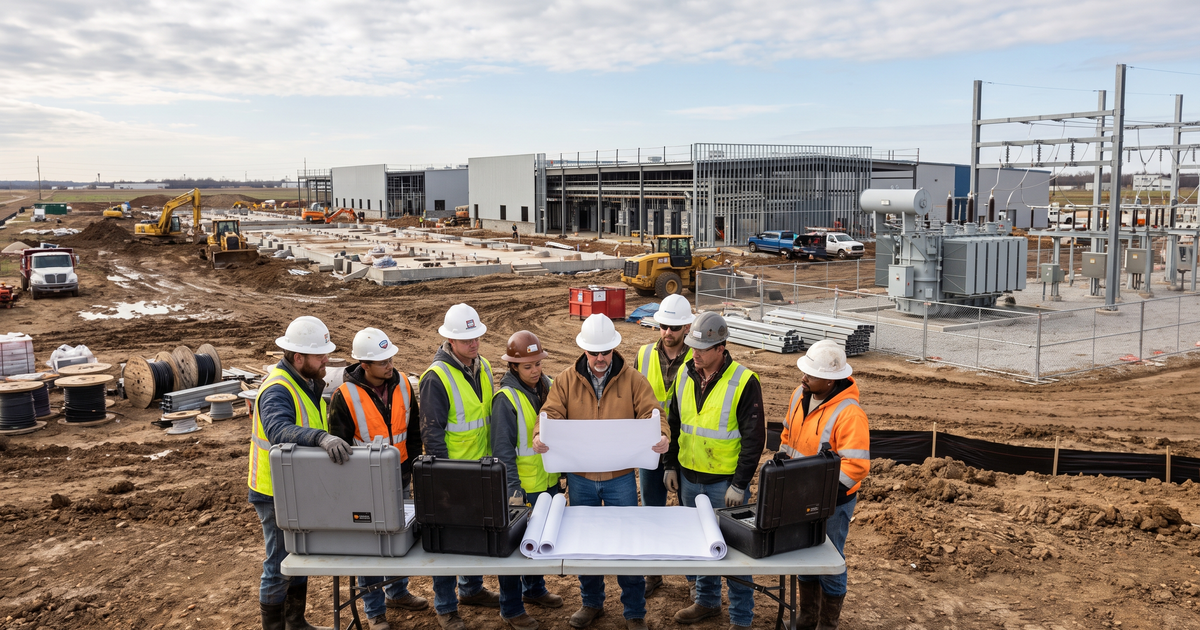
Google is now the confirmed operator of Project Clydesdale, a phased hyperscale data-center campus already under construction in unincorporated Tulsa County just west of Owasso, Oklahoma. Beale Infrastructure is the publicly named developer. The site sits around Whirlpool Drive and East 76th Street North beside Cherokee Industrial Park, and the current public record describes a long construction runway rather than a single finished building.
The operator reveal came through the Tulsa Regional Chamber on August 19. Beale had broken ground in October 2025 under the Project Clydesdale name. Its current Tulsa County project profile now describes four planned phases, multiple data centers and support buildings, an on-site substation, utility upgrades, and an approximately seven-year campus buildout.
That combination makes the project important to low-voltage contractors, electrical firms, fiber crews, security and life-safety integrators, controls specialists, manufacturers, and commissioning teams. The campus is moving, the operator and developer are known, and most delivery firms and specialty packages are still absent from reviewed public sources.
Project Clydesdale at a glance
| Item | Current public record |
|---|---|
| Location | Whirlpool Drive and East 76th Street North, Tulsa County, Oklahoma |
| Stage | Under construction; phase one underway and phase two planned |
| Campus | Approximately 506 acres in Beale's current project profile |
| Incentive area | Approximately 399 acres in the executed county plan |
| Investment | $1 billion planned investment announced by Beale |
| Phase framework | Four planned phases; at least $700 million per developed phase |
| Building basis | At least one approximately 200,000-square-foot data center per completed phase |
| Capacity | Campus utility MW and critical IT load remain undisclosed |
The acreage figures describe different source-defined boundaries. Beale uses approximately 506 acres for the wider campus. Tulsa County's executed tax-incentive agreement and project plan describes an approximately 399-acre project and incentive area. Those numbers should not be forced into one parcel measurement.
The financial figures also need separation. Beale's October 2025 groundbreaking announcement provides the cleanest structured project figure: a planned $1 billion capital investment. The county plan separately establishes a minimum of $700 million in private investment for each phase that is actually developed, with one initial phase and as many as three additional phases. The possible four-phase framework does not prove a committed $2.8 billion final budget.
Google's broader Oklahoma spending belongs in a separate bucket. The company has reported more than $15 billion invested across the state since opening its Pryor data center in 2011, but that statewide total is not Project Clydesdale construction capex. The same discipline applies to Google's statewide power agreements: they show the scale of its Oklahoma infrastructure strategy without revealing this campus's service capacity.
What the phase plan says
The county plan contemplates at least one data-center building of approximately 200,000 square feet in each completed phase, together with utility structures, support buildings, offices, and campus infrastructure. Exact building count, final square footage, siting, and delivery order remain subject to change. It is therefore reasonable to track a multi-building program, but premature to publish a fixed four-building total.
Beale's current schedule lists a fall 2025 construction start, a first-quarter 2027 start for phase two, and third-quarter 2027 completion for phase one. It also describes approximately seven years of campus construction. The earlier groundbreaking release discussed thousands of construction jobs during a five-year initial-phase buildout. Those are two developer schedule descriptions, not a guaranteed final-campus completion date.
The August operator announcement calls the campus under construction. That supports the current stage without proving that a particular data hall, shell, electrical yard, substation, or fit-out package has reached a specific milestone. Building permits, inspection records, energization notices, equipment deliveries, and contractor portfolios will be the stronger evidence for phase-by-phase progress.
The named organizations and open delivery roles
| Organization | Source-backed role | Evidence |
|---|---|---|
| Data-center operator and end user | Operator announcement | |
| Beale Infrastructure | Publicly named campus developer | Project profile |
| Quartz Mountain Properties LLC | Company and legal developer party in county agreement | Executed plan |
| Public Service Company of Oklahoma | Electric provider and utility-upgrade partner | Utility site |
| Washington County Rural Water District No. 3 | Water-system upgrade partner | Developer profile |
| Tulsa County | Land-use and incentive authority | Executed plan |
The legal relationship among Google, Beale, Quartz Mountain Properties, landowners, financing entities, and construction affiliates still needs documentation. The executed county agreement names Quartz Mountain Properties and qualifying affiliates as the company or developer party and contemplated an unrelated third-party operator. The later Chamber announcement identifies that operator as Google. The reviewed sources do not establish that Quartz Mountain is owned by Beale or explain the complete project-company structure.
Kimley-Horn is credited for the rendering used with the Chamber announcement. A rendering credit alone does not establish that the firm holds the campus civil, architectural, MEP, or program-management contract. No reviewed source names the data-center general contractor, construction manager, EPCM, architect, civil engineer, MEP engineer, electrical contractor, substation contractor, fiber or structured-cabling firm, security integrator, fire-alarm contractor, controls vendor, DAS contractor, equipment supplier, carrier, grounding contractor, or independent commissioning authority.
That distinction matters for business development. Google and Beale are confirmed project participants. PSO and the rural water district are confirmed utility participants. Every specialty delivery role listed above remains a watch category until a permit, bid notice, project page, job posting, supplier announcement, or contractor portfolio ties a firm to the work.
Power, water, and campus infrastructure
PSO is the named electric provider. The project includes a new on-site substation funded by Beale and transmission and distribution upgrades intended to strengthen regional reliability. Public sources do not disclose the campus service MW, critical IT load, interconnection identifier, service voltage, substation design team, protection and controls package, SCADA or EPMS architecture, energization sequence, testing firm, or commissioning responsibility.
Those unknowns create a clear tracking path. Substation permits, Southwest Power Pool records, PSO filings, equipment orders, relay and protection work, transmission construction, temporary power, permanent-service milestones, and energization notices can expose the electrical delivery team before the full data-center team is publicly announced.
Water infrastructure is also part of the project. The Chamber announcement describes 1.5 miles of new water lines and upgrades, while Beale's current project page describes approximately three miles of new 12-inch line within the rural water system. Those descriptions may reflect different scopes or updated plans. Engineered utility drawings, permits, and awarded civil packages are needed before either number is treated as final as-built length.
Where low voltage shows up
| System | Likely campus need | What to watch |
|---|---|---|
| Fiber and OSP | Multiple buildings, utility assets, gates, and diverse entrances | Duct banks, carriers, splicing, OTDR |
| Structured cabling | Data halls, offices, support buildings, and controls networks | Pathways, labeling, testing, turnover |
| Access and CCTV | Secure perimeter and phased mission-critical buildings | Gates, VMS, credentials, analytics |
| Fire and life safety | Data halls, electrical rooms, fuel and support systems | Alarm, suppression interfaces, acceptance tests |
| Controls and OT | Substation, cooling, power, water, and facility monitoring | BMS, EPMS, SCADA, telemetry |
| DAS and radio | Large buildings and secure campus operations | Public-safety coverage and AHJ review |
| Grounding and bonding | Telecom rooms, racks, pathways, and electrical coordination | Test records, QA, closeout |
| Commissioning | Phased energization and integrated-system turnover | Scripts, witness tests, trend logs |
Outside plant should be one of the earliest low-voltage lanes. A multi-building campus needs carrier entrances, campus backbone routes, vaults, handholes, duct banks, diverse pathways, high-count fiber, and connections to support and utility buildings. Civil, electrical, and telecom contractors will need clean boundaries for conduit ownership, grounding, access, testing, labeling, and as-built documentation.
The on-site substation and distribution work increase the controls burden. Protection relays, utility telemetry, substation communications, SCADA, EPMS, generator and UPS interfaces, cooling controls, alarms, and central operations platforms eventually need coordinated networks and tested data exchange. The final package split among electrical, controls, network, and commissioning firms is not public.
Security will extend from the property edge to the data hall. Likely requirements include vehicle gates, visitor processing, access control, video surveillance, intercoms, credentialing, perimeter detection, redundant network paths, and documented failover. Fire alarm, suppression interfaces, public-safety radio coverage, and integrated testing will add separate authority and turnover requirements. These are source-grounded campus needs, not announced awards.
Jobs, trades, and readiness
Beale estimates 400 to 800 construction jobs annually over an approximately seven-year campus buildout. Its current profile also expects more than 50 full-time operational positions plus contractor roles in operations, maintenance, and security. The earlier groundbreaking release described as many as 100 permanent high-paying technical roles. These are developer estimates, and they are not active job counts or employer-specific openings.
The operator announcement also ties Google's Oklahoma investment to an electrical workforce program with the electrical training ALLIANCE. The stated target is to train existing workers and add more than 160 apprentices in Oklahoma by 2030. That is a statewide workforce figure, not Project Clydesdale headcount.
Contractors preparing for the campus should assemble mission-critical references, safety records, bonding and insurance capacity, prequalification documents, QA plans, manufacturer certifications, testing procedures, staffing depth, and examples of disciplined digital closeout. Fiber teams should be ready to document inspection, cleaning, loss testing, OTDR traces, polarity, labeling, and as-builts. Security and controls firms should be ready to show large-campus networking, cybersecurity coordination, redundancy, phased turnover, and integrated testing.
Useful skills paths include BICSI education and certification for ICT design, installation, and project management; Fiber Optic Association training for OSP, splicing, inspection, and testing; and NFPA training for fire, electrical, and life-safety coordination. None of those links represents a project hiring promise. They are practical readiness resources while contractor and package information develops.
The next public checkpoints
The most useful near-term documents will be Tulsa County building, electrical, stormwater, wastewater, environmental, and road permits. Plan indexes can identify active buildings, package values, design professionals, contractors, and inspection milestones. Utility filings and equipment announcements can clarify PSO capacity, the on-site substation, service voltage, protection and controls, SCADA, testing, and energization.
Phase tracking should hold Beale's public schedule to evidence: first-quarter 2027 for phase-two construction and third-quarter 2027 for phase-one completion. Building inspections, certificates of occupancy, utility energization, data-hall turnover, commissioning records, and owner hiring will show whether those milestones are being reached.
The open business-development lanes are substantial: GC or EPCM, architecture and engineering, substation and electrical work, carrier and OSP fiber, structured cabling, security, fire alarm, BMS and EPMS, public-safety DAS, grounding and bonding, network integration, equipment supply, testing, and independent commissioning. Contractors should treat each as unawarded until a source names the holder.
LVN Signal will keep tracking Project Clydesdale as permits, project-team announcements, trade partners, suppliers, job postings, utility milestones, and phase evidence surface. For firms pursuing the work, the immediate move is to document capability, monitor Beale, Google, PSO, Tulsa County, and workforce channels, and be ready when the delivery structure becomes public.
Join 35,000+ Low Voltage Pros
Get weekly permit updates, tool deals, job opportunities, and industry news. No spam, unsubscribe anytime.