
Join Low Voltage Nation — Find project opportunities and showcase your company to thousands of industry professionals
Project Avalon near Buffalo, West Virginia, is an eight-building Google data-center plan with state air and federal waters applications, named civil and permitting firms, and major power, fiber, security, controls, and commissioning packages still undisclosed.
Google's proposed Project Avalon campus near Buffalo, West Virginia, has moved far enough into public review to expose an unusually detailed picture of the site plan and supporting equipment. The current record describes eight data-center buildings across a 1,699-acre property, with a construction footprint of roughly 1,254 acres. It also identifies the site owner, air-permit consultant, civil/site-plan engineer, a proposed utility corridor, water infrastructure, cooling towers, and a large standby-generation fleet.
The project is still in permitting. The West Virginia Department of Environmental Protection application and the U.S. Army Corps of Engineers public notice are applications, not final authorizations or proof that vertical construction has begun. Google's official Buffalo project site likewise describes the campus as early stage.
For low-voltage contractors, integrators, manufacturers, commissioning firms, and skilled trades, this is the useful point in the cycle: important infrastructure is visible, several professional roles are named, and most delivery packages remain open in the public record.
Project Avalon at a glance
| Item | Current public record |
|---|---|
| Location | Charleston Road near Buffalo, Putnam County, West Virginia |
| Stage | Planned; state air and federal waters applications under review |
| Campus | Eight data-center buildings on a 1,699-acre site |
| Construction footprint | Approximately 1,254 acres in the federal notice |
| Current target | Operating startup around July 2029 in the August 20 legal notice |
| Verified capacity | Utility MW and critical IT load remain undisclosed |
The state air filing identifies Cumulus Group LLC as site owner and permit applicant for facility 079-00208 and application R13-3782. A separate West Virginia announcement confirms Google purchased land in Putnam County and received High Impact Data Center Project approval for a multibillion-dollar campus. That description establishes scale, but it is not a fixed construction budget. No reviewed primary source supplies a definitive project capex, building square footage, phase-by-phase investment, or project-specific employment count.
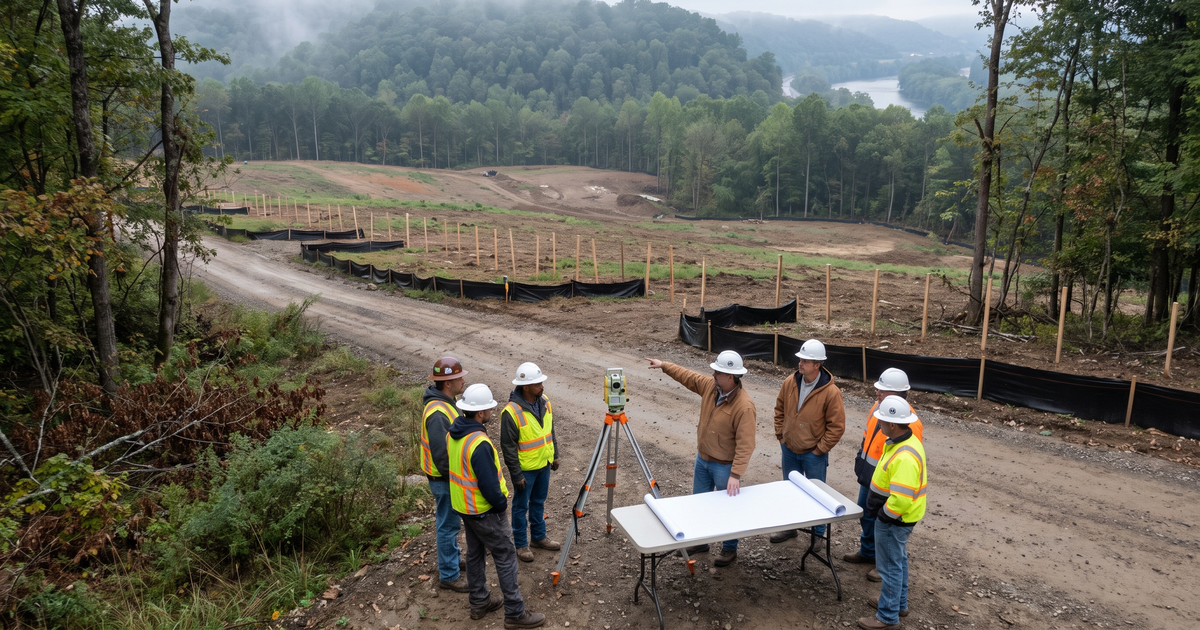
The federal notice gives the broader physical program. In addition to eight data-center buildings, it describes electrical substations, office hubs, parking, stormwater systems, utility infrastructure, roughly 14.19 miles of internal roads, three crossings of Eighteenmile Creek, and 184 acres for spoil placement. Two 30-inch Kanawha River intake pipes would be installed by horizontal directional drilling. A water-treatment plant, wastewater-treatment plant, and wastewater outfall are also part of the preferred alternative.
Those figures need careful separation. The 1,699 acres describe the full site. Approximately 1,254 acres describe the proposed construction footprint. The federal filing's 34.43 wetland acres and 45,541 stream feet are proposed aquatic-resource impacts under review; they are neither building area nor already-authorized impacts.
The named team and the roles still open
| Organization | Source-backed role | Evidence |
|---|---|---|
| Announced owner/operator and campus developer | Project site | |
| Cumulus Group LLC | Site owner and permit applicant | WVDEP index |
| SOLA Environmental | Air-permit consultant and application preparer | Company site |
| Kimley-Horn | Site-plan and civil engineer | Mission-critical page |
| Appalachian Power | Utility and construction-power plan reference | Grid context |
SOLA Environmental prepared the 179-page air application. Its public capabilities include air permitting, dispersion modeling, water permitting, and hyperscale data-center work. That supports the permitting role stated in the filing. It does not establish SOLA as the campus architect, MEP engineer, EPCM, general contractor, controls designer, or commissioning authority.
The May 21 Project Avalon plot plan carries Kimley-Horn branding. The firm's mission-critical practice covers campus planning, site design, utilities, roads, water, power, and fiber coordination. The current evidence supports a civil/site-plan role only. It does not yet identify the project architect, MEP engineer, construction manager, general contractor, electrical contractor, or low-voltage design team.
The plot plan also labels proposed substations, a proposed 345-kV line, and Appalachian Power temporary and permanent construction-power elements. Google says it will fund the electrical infrastructure needed for the data center, including substations and transmission upgrades. The final large-load service agreement, campus MW, service phasing, energization dates, relay and protection package, and substation contractors remain undisclosed.
Why the equipment schedule matters
WVDEP's air application is valuable because it supplies an equipment design basis before construction awards are public. It lists 288 mission-critical standby generators rated at 2,750 kW each, four 1,000-kW auxiliary generators, two 1,000-kW fire-pump engines, 128 evaporative cooling towers, and 294 diesel belly tanks.
The aggregate generator nameplate should not be converted into campus capacity. Standby generators are emergency equipment. Their combined rating does not prove the utility service, critical IT load, average operating demand, or phased data-hall capacity. The filing also models multiple possible generator makes and states that manufacturer selection is pending, so the current record does not support assigning the package to a specific vendor.
The cooling schedule points to a substantial controls and water-infrastructure program. The current basis of 128 evaporative cooling towers, paired with river intake, treatment, discharge, and wastewater facilities, creates future requirements around water-treatment instrumentation, equipment networking, leak and level monitoring, BMS integration, fire/life-safety interfaces, alarms, trending, acceptance testing, and commissioning. Final make-up demand, treatment capacity, discharge volume, tower vendor, and controls integrator have not been disclosed.
Where low voltage shows up
| System | Likely project need | What to watch |
|---|---|---|
| Fiber and OSP | Eight buildings, substations, plants, gates, and remote assets | Carrier routes, duct banks, splicing, testing |
| Security | Large perimeter and multiple controlled facilities | Gates, access control, CCTV, VMS |
| Fire and life safety | Data halls, fuel systems, plants, and support hubs | Fire alarm, suppression interfaces, testing |
| Controls and OT | Cooling, generation, power, water, and wastewater | BMS, EPMS, SCADA, telemetry, networking |
| DAS and radio | Multi-building mission-critical campus | Public-safety coverage and authority review |
| Commissioning | Phased energization and integrated systems | Scripts, witness tests, turnover records |
Outside plant is one of the clearest early lanes. The campus spans both sides of Charleston Road and includes long internal routes, stream crossings, utilities, substations, water plants, and support hubs. Contractors should watch for diverse carrier entrances, duct-bank and handhole packages, campus backbone routes, high-count fiber, fusion splicing, OTDR and insertion-loss testing, telecom grounding, labeling standards, and digital closeout requirements.
Security scope could extend well beyond building access control. A property of this scale may require perimeter detection, vehicle gates, visitor processing, video surveillance, VMS infrastructure, guard communications, intercoms, credentialing, and redundant network paths. Those are logical watch categories based on the campus plan, not announced awards.
Power and cooling systems also expand the integration burden. Generator controls, fuel monitoring, relay protection, EPMS, cooling-tower controls, water instrumentation, fire-alarm interfaces, and central operations platforms must eventually exchange reliable status and alarm data. The package boundaries between electrical, mechanical controls, security, network, and commissioning firms will matter as much as the hardware.
Jobs, skills, and contractor readiness
Google's project site describes typical opportunities across construction, electrical, HVAC, security, fiber optics, and facility maintenance. It also provides a direct contact route for subcontractor interest. That route should be treated as an expression of interest, not a current invitation to bid or evidence of prequalification.
Firms preparing for the campus should assemble mission-critical references, EMR and safety records, bonding and insurance capacity, quality-control plans, manufacturer certifications, staffing depth, testing procedures, commissioning experience, and complete digital-turnover examples. Fiber teams should be ready to document cleaning, inspection, OTDR, insertion-loss testing, polarity, labeling, and as-built discipline. Security and controls firms should be ready to show large-campus networking, cybersecurity coordination, integration testing, and phased turnover.
The civil program also creates enabling-work opportunities before a data hall is ready for fit-out. Temporary construction communications, gate and laydown-yard security, site cameras, trailer connectivity, fiber extensions, radio coverage, utility telemetry, and remote monitoring can arrive alongside clearing, grading, roads, bridges, and water work. Early packages often set standards that later building phases inherit, so documentation and pathway coordination at this stage can influence the full campus.
Manufacturers and distributors should watch the same sequence. Long-lead electrical, cooling, network, life-safety, and security equipment may need design support, approved-equals work, logistics planning, storage, startup assistance, and field service well before final turnover. Public records currently support the opportunity categories, but they do not name awarded vendors or authorized purchase orders.
Useful training paths include BICSI education and certification for ICT installation, design, and project management; NFPA training for fire and electrical coordination; and Google's careers portal for owner-side roles. Project-specific local hiring, apprenticeship partners, wage commitments, and trade-package counts remain undisclosed.
The next public checkpoints
The strongest near-term checkpoints are regulatory and site-related. WVDEP application R13-3782 still needs to move through completeness review, technical evaluation, public comment, and a final decision. The Corps application LRH-2025-00056-KAN still faces waters and wetlands review, mitigation, consultation, and permit conditions. A July 2029 operating target appears in the August 20 statutory notice, but it remains an applicant schedule rather than a guaranteed completion date.
Construction status should change only when public evidence shows final permits, notice to proceed, grading or site-work mobilization, building permits, or vertical work. Procurement visibility will improve when Google or its delivery team names a construction manager, GC/EPCM, architect, MEP engineer, electrical contractor, major equipment vendors, or bid-list route.
The specialty opportunity is broad but still unawarded in reviewed sources: transmission and substations; relay protection and SCADA; electrical; carrier and outside plant; structured cabling; access control and video; fire alarm; BMS, EPMS, and DCIM; water and wastewater controls; public-safety DAS; grounding and bonding; testing; and independent commissioning.
LVN Signal will keep tracking Project Avalon as those permits, contractors, suppliers, job postings, and package releases surface. For contractors and manufacturers, the practical move now is to document capability, use Google's official Buffalo contact route, follow the named engineering and utility channels, and avoid treating an early permit design as a final construction award.
Join 35,000+ Low Voltage Pros
Get weekly permit updates, tool deals, job opportunities, and industry news. No spam, unsubscribe anytime.