
Join Low Voltage Nation — Find project opportunities and showcase your company to thousands of industry professionals
TDLR records show two Google-linked Journey data-center filings in Haskell County: $800M, 495,702 sq ft, Housebound Group LLC as owner, HDR as design firm, and open low-voltage package names.
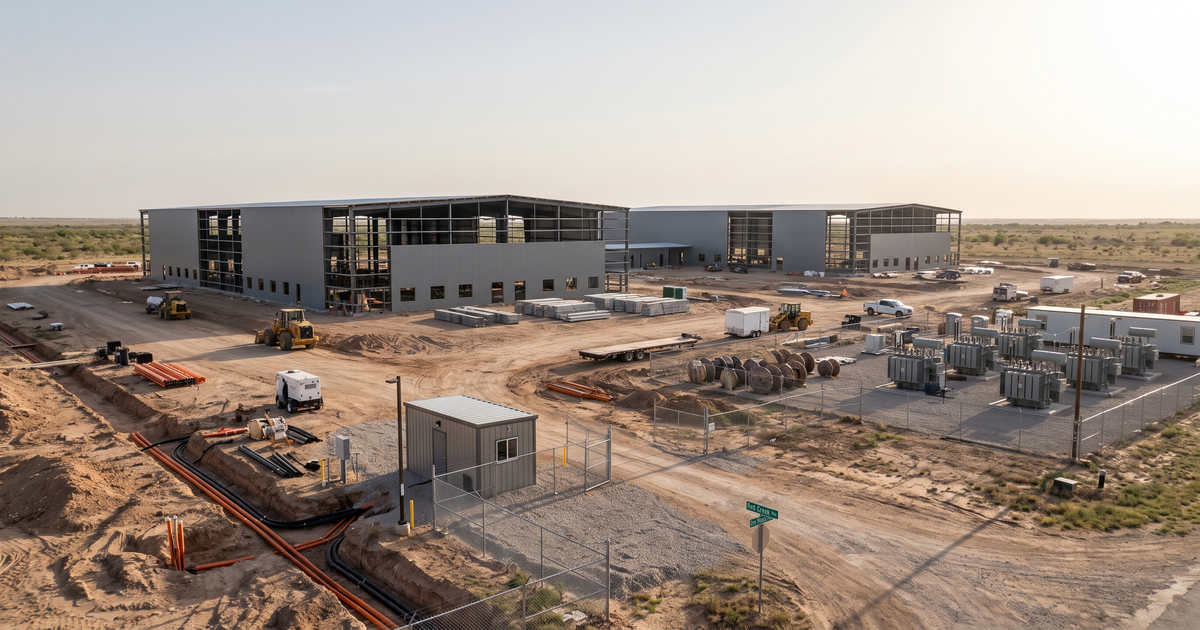
Google's Haskell County project family is now a live LVN Signal watch because two public Texas Department of Licensing and Regulation filings have moved the opportunity from general regional investment news into named building records. TDLR Journey 1A and TDLR Journey 2A both list data-center facility work at 1362 Red Creek Rd in Haskell County, Texas. Each filing carries a $400 million estimated cost, each names Housebound Group LLC as owner, and each names HDR Engineering Inc as design firm. Together, the two current filings support an $800 million public-record scope across 495,702 square feet of data-center work.
The broader project family is source-backed by Google's own Haskell County presence. Google's Haskell County page says the company is investing in the local community and points contractors and suppliers toward a formal local-vendor path through the Texas vendor inquiry form. That matters for LVN readers because the strongest near-term sales motion is not guessing the unnamed specialty contractors. It is getting organized around Google, Housebound Group LLC, HDR, TDLR/TABS records, Haskell County, vendor intake, and future plan-room or permit records before the low-voltage package map becomes obvious.
| Item | Source-backed detail | LVN read |
|---|---|---|
| Project family | Google / Housebound Journey Haskell County | Two public data-center filings at the same Red Creek Road address. |
| Journey 1A | $400M; 285,282 sq ft; April 1, 2026 start; August 21, 2027 completion | First current Journey building watch item. |
| Journey 2A | $400M; 210,420 sq ft; June 23, 2026 start; October 27, 2027 completion | Second current Journey building watch item. |
| Owner on filings | Housebound Group LLC | TDLR owner entity; use with Google project-family context. |
| Design firm | HDR Engineering Inc | Source-backed design firm on both filings. |
The most important discipline is capacity discipline. The reviewed public record supports $800 million of current Journey filing value and 495,702 square feet across Journey 1A and Journey 2A. It does not disclose building-level MW, critical IT load, utility provider, general contractor, EPCM, electrical contractor, low-voltage contractor, security integrator, fire alarm contractor, BAS/BMS contractor, DAS/networking contractor, grounding contractor, or commissioning provider. LVN should keep those fields open until an owner, public record, utility record, job posting, plan-room source, or contractor page names them.
Data Center Dynamics ties the Housebound Group filings to Google's Haskell project family and summarizes the same two Journey records as an $800 million pair of Haskell data-center projects. Baxtel provides project-profile context for Google South Haskell. Those trade and profile sources are useful for discovery, but the article should anchor hard construction claims in TDLR and Google pages. The practical contractor takeaway is simple: the public record is now specific enough to track, but not mature enough to pretend the award list is known.
| Company | Role | Evidence |
|---|---|---|
| Project-family / operator context | Google Haskell County | |
| Housebound Group LLC | TDLR owner on Journey 1A and 2A | TDLR Journey 1A |
| HDR Engineering Inc | Design firm | TDLR Journey 2A |
| Texas Department of Licensing and Regulation | Public building records | Journey 1A / Journey 2A |
| Haskell County | Local jurisdiction context | Google local page |
| HDR | Engineering company context | Company site |
The open contractor map is the opportunity. A project with a known address, owner entity, design firm, start date, completion date, square footage, and current filing value gives contractors enough to start targeted monitoring. It does not justify cold-claiming that cabling, security, fiber, fire alarm, or controls work has been awarded. The useful posture is to prepare proof of data-center work, safety records, bonding and insurance, fiber testing capability, access-control and CCTV experience, fire alarm coordination, controls integration, and commissioning documentation before procurement becomes public.
| System | Why it matters | Watch signal |
|---|---|---|
| Fiber / OSP | Hyperscale campuses need diverse routes, carrier entrances, and tested backbone paths. | Conduit, duct-bank, MMR, splicing, carrier, OTDR, and handhole records. |
| Structured cabling | Data halls require disciplined pathway, rack, row, labeling, and certification work. | Fit-out filings, rack/row language, test reports, and closeout requirements. |
| Access control / CCTV | Large data-center sites need perimeter, building, visitor, and secure-area controls. | Integrator awards, gate packages, camera/VMS language, and construction access systems. |
| Fire alarm | Life-safety systems must coordinate with suppression, monitoring, AHJ review, and turnover. | Fire alarm permits, inspections, acceptance testing, and specialty contractor records. |
| BAS/BMS / networking | Cooling, alarms, monitoring, security, and facility systems need reliable controls networks. | Controls integrator, EPMS/BMS, network, trend-log, and commissioning records. |
| Grounding / commissioning | Power-dense facilities punish weak documentation and sloppy handoff packages. | Grounding specs, bonding tests, commissioning agent notices, and QA/QC job posts. |
Journey 1A and Journey 2A also show why alias tracking matters. Public records and trade coverage can refer to Google Haskell, Google South Haskell, Project Journey, Journey 1A, Journey 2A, JNR1A, JNR2A, Housebound Group LLC, 1362 Red Creek Road, TABS2026023821, and TABS2026023839. A contractor watching only one name will miss signals. The same project can surface through TDLR, county records, Google vendor intake, engineer pages, plan-room notices, utility filings, job postings, and trade coverage under different labels.
The jobs and training angle is practical, not speculative. Reviewed sources do not publish a specific Journey construction labor peak or permanent operations headcount for these two filings. But the systems implied by a hyperscale data-center build point to the familiar LVN readiness stack: OSHA/site onboarding, lift access, data-center safety culture, cable tray and pathway coordination, copper and fiber labeling, fiber cleaning and inspection, OTDR and power-meter documentation, access-control and CCTV commissioning, fire alarm acceptance, BAS/BMS point verification, grounding and bonding, closeout documentation, and mission-critical QA discipline.
Estimators and BD teams should watch for a few concrete triggers. First, TDLR/TABS updates may show inspection movement, owner changes, design-firm updates, or additional Journey filings. Second, Haskell County and regional public records may surface site-work, road, water, emergency-services, or utility coordination. Third, Google vendor intake gives local companies an official route to make themselves visible. Fourth, HDR-related records or plan-room trails may eventually point to design packages, bid lists, or downstream contractors. Fifth, job posts can reveal active roles before a formal award announcement appears.
For low-voltage firms, the prep list is direct. Build a source watch around Google, Housebound Group LLC, HDR Engineering Inc, TDLR/TABS, Haskell County, county appraisal and permit records, Texas utility and interconnection records, local economic-development notes, plan-room/prequalification channels, and job postings. Keep a capability sheet ready for fiber/OSP, structured cabling, access control, CCTV, fire alarm, BAS/BMS, networking, DAS, grounding, and commissioning. Do not send a generic sales note. Send a note that proves you understand the two Journey filings and can support mission-critical delivery when packages open.
The field-readiness question is not just who gets the first cable pull. On a hyperscale site like this, low-voltage teams may need to coordinate with civil, electrical, utility, mechanical, security, and commissioning groups long before permanent data halls are turned over. Temporary construction networks, site cameras, trailer connectivity, access-control setup, badging workflows, security fencing, carrier coordination, fiber pathway planning, grounding details, and documentation standards can all appear early. Teams that wait for a clean cabling bid title may miss the relationship-building phase and the early technical questions that shape later scopes.
That is why the Haskell record is useful even with unknown package holders. It gives estimators a real address, real filing numbers, real dates, and a real design-firm reference. It gives account teams a Google vendor-intake path and a Housebound/HDR project trail to monitor. It gives operations leaders a reason to check whether crews have current safety credentials, data-center references, test-equipment calibration records, lift certifications, fiber cleaning kits, labeling standards, redline discipline, and closeout templates. The public information is not enough to price the job, but it is enough to prepare for a serious pursuit.
The comparison set also needs guardrails. This is not Google / Intersect Meitner in Gray and Roberts counties. It is not Google Project Spade in Missouri, Google Jackson County Alabama, Google West Memphis, OpenAI Freebird, Vantage Frontier, IREN Sweetwater, or Galaxy Helios. It is part of a wider Texas and North America AI-infrastructure surge, but the specific owner entity, address, filing numbers, design firm, and source trail are different. LVN should keep the Haskell record separate so contractors do not merge unrelated bid paths.
The strongest next evidence would be a public general-contractor or EPCM announcement, electrical and low-voltage subcontractor names, utility/substation filings, additional Journey or Haskell data-center building records, local permits, plan-room notices, or job postings tied to Haskell. Until then, the correct framing is an early but high-confidence construction-intelligence watch: two filed data-center buildings, $800 million in current public-record value, nearly half a million square feet, Google project-family context, Housebound Group LLC as filing owner, HDR as design firm, and many high-value low-voltage scopes still unnamed.
Bottom line: Google / Housebound Journey Haskell belongs in LVN Signal because the public record is now specific enough for contractors to track. The current filings identify the site, scope, value, square footage, schedule, owner entity, and design firm. The unfilled blanks are the business-development window. Fiber, structured cabling, security, fire alarm, BAS/BMS, networking, DAS, grounding, and commissioning contractors should treat Haskell as a watch-list project now, while preserving the discipline that no specialty package is confirmed until public evidence names it.
Join 35,000+ Low Voltage Pros
Get weekly permit updates, tool deals, job opportunities, and industry news. No spam, unsubscribe anytime.