Join Low Voltage Nation — Find project opportunities and showcase your company to thousands of industry professionals
Google is putting $1.5B into its Jackson County, Alabama data-center campus across 2026 and 2027, with power, workforce, and low-voltage signals worth tracking.
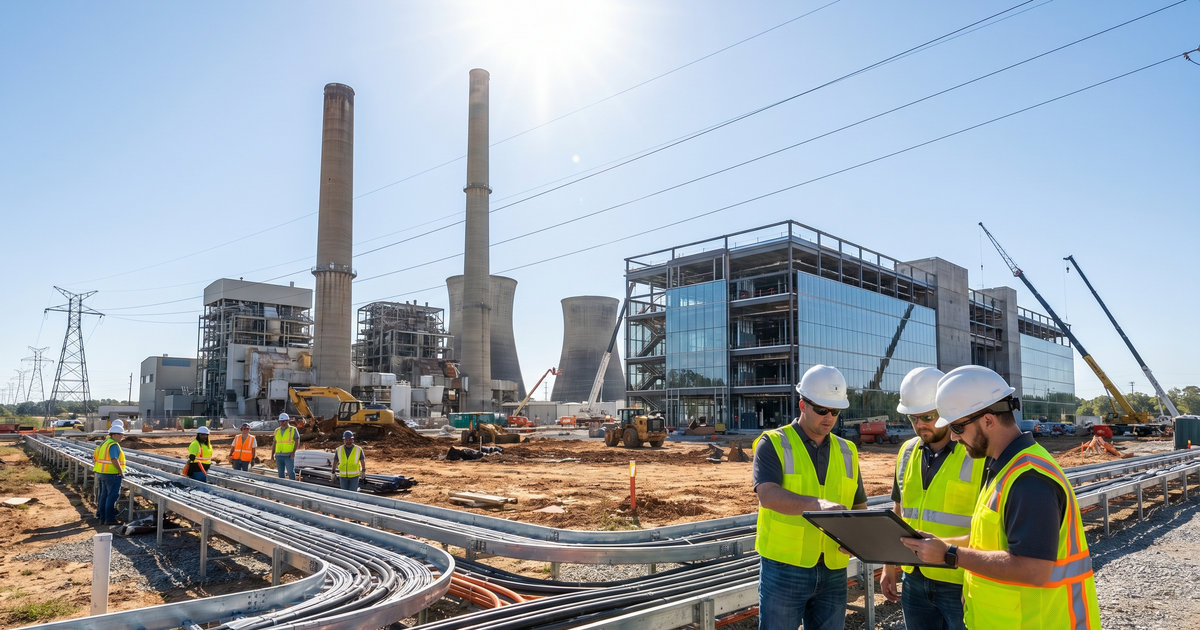
Google's newest Jackson County, Alabama announcement is not just another hyperscale headline. It is a construction and infrastructure signal around an operating campus that already matters to the Tennessee Valley data-center market. The company says it will invest $1.5 billion across 2026 and 2027 to expand its Jackson County data-center campus, a site built on the former Tennessee Valley Authority Widows Creek coal plant. For LVN readers, that makes the story useful before the specialty contractor names are public: power infrastructure, campus fiber, structured cabling, access control, CCTV, fire alarm interfaces, BMS/BAS controls, networking, DAS, grounding, documentation, and commissioning will all have to fit around a live hyperscale environment. Google's own location page also keeps the local hiring and contractor context visible, which is useful when later job postings start naming operations, controls, fiber, or site-support requirements.
The strongest source is Google's June 2026 announcement, backed by Google's official PDF announcement. Google frames the expansion as a 2026-2027 investment in its Jackson County data-center campus and says it will cover 100% of the power it uses plus the direct infrastructure costs driven by the expansion. That detail matters because power is the first bottleneck in modern AI infrastructure. When a campus expansion is tied to generation, grid reliability, demand-response language, and a former power-plant site, the low-voltage work is not isolated inside the building. It is tied to utility coordination, pathway planning, monitoring, controls integration, turnover documentation, and the site operations model.
The campus context is also source-backed. Google's Jackson County data-center location page says Google has invested more than $2 billion in Alabama since building its Jackson County data center in 2018. The same page points to local hiring, a skilled workforce, solid energy infrastructure, and the former coal-plant reuse story. This is not a greenfield site where every public record starts from zero. It is an existing Google data-center community with an active operating footprint and a new capital wave layered on top.
| Item | Source-backed detail | LVN read |
|---|---|---|
| Owner | Existing hyperscale campus expanding | |
| Location | Jackson County, Alabama | Bridgeport / Widows Creek area |
| Investment | $1.5B across 2026-2027 | Active expansion phase worth tracking |
| Stage | Expansion announced and underway | Watch public records and package movement |
| Power | Google-funded usage and direct infrastructure | Grid, monitoring, controls, and CX signals matter |
Power is the center of the story. Google says it has contracted more than 300 MW of new generation capacity in the Tennessee Valley region. It also points to the 2025 Google, Kairos Power, and TVA advanced nuclear agreement that could supply up to 50 MW of advanced nuclear power to Google data centers in Tennessee and Alabama. Kairos Power's Google page describes the broader Google/Kairos fleet agreement and says the Hermes 2 Demonstration Plant in Oak Ridge will deliver up to 50 MWe to the TVA grid powering Google data centers in Tennessee and Alabama. None of that names the low-voltage integrators yet, but it does tell contractors what kind of site this is: power-first, reliability-first, and documentation-heavy.
That distinction is important. A data-center expansion can create visible scopes without publicizing every trade partner at the announcement stage. The first public names are usually the owner, utility, power partner, public agency, workforce partner, or community partner. The specialty companies often surface later through permits, job postings, plan-room notices, subcontractor prequalification language, inspection records, vendor pages, or LinkedIn hiring. The right posture is to track the named source-backed companies now and keep the missing scopes open instead of guessing.
| Company / group | Role | Evidence |
|---|---|---|
| Owner/operator | Announcement | |
| TVA | Utility / power region | Google PDF |
| Kairos Power | Advanced nuclear partner | Kairos page |
| CAANEAL | Energy-affordability partner | CAANEAL page |
| NACC | Workforce training context | Program page |
The named-contractor gap is the useful part for LVN Signal. Public evidence reviewed for this run did not name the general contractor, EPC/EPCM, electrical contractor, low-voltage contractor, fiber/OSP contractor, security integrator, fire alarm contractor, BAS/BMS controls firm, DAS/networking integrator, grounding/bonding specialist, or commissioning provider for the 2026-2027 expansion phase. That should stay unknown in the public record until a primary source, public filing, contractor page, or job posting names the role. The absence of names does not make the opportunity weak. It means the market has not yet exposed the package map.
For low-voltage and electrical-adjacent companies, the practical read is not a single bid notice. It is a watch cycle. Expansion at an operating hyperscale site may show up as multiple packages: campus entrance and duct-bank work, carrier coordination, fiber backbone upgrades, MMR/IDF buildout, pathway and cable tray, secure-area access control, perimeter and interior video, fire alarm interfaces, controls integration, alarming, BMS/BAS points, public-safety wireless, equipment-room grounding, labeling standards, test records, and commissioning documentation. These are the scopes that become real when drawings, inspections, and turnover requirements start moving.
| System | Why it matters | Watch signal |
|---|---|---|
| Fiber / OSP | Carrier paths, campus backbone, diverse routing | OSP permits, duct banks, carrier work |
| Structured cabling | Data halls and support spaces need clean pathways | Fit-out packages, tray, labels, test records |
| Security | Hyperscale operations require controlled access | Integrator awards, access/CCTV inspections |
| Fire alarm | Life-safety interfaces touch the full facility | AHJ reviews, FA permits, acceptance tests |
| BMS / controls | Cooling and power reliability need monitoring | Controls jobs, trend logs, CX milestones |
| DAS / networking | Large hardened spaces need coverage and IT/OT separation | DAS design, network integrator signals |
The workforce trail is another reason this belongs in Signal. Google says the expansion builds on hundreds of full-time jobs and brings more than 1,000 contract workers to the site during construction. It also ties the announcement to local training and education, including Alabama A&M University, Northeast Alabama Community College, Wallace State Community College, and Jackson County schools in the broader Google Career Certificate and STEM context. Northeast Alabama Community College's data-center option is especially relevant because it is a local pathway for data-center and IT support skills near the campus.
The trade-skill angle is concrete. Data-center projects reward technicians who can work safely under site controls, read drawings, protect fiber, clean and test connectors, document labels, coordinate with electrical and mechanical trades, understand hot/cold operations discipline, and produce turnover packages that survive owner QA. BICSI copper/fiber training, FOA fiber discipline, OSHA site safety, lift training, access-control manufacturer training, fire alarm certifications, and controls commissioning experience all matter more on this kind of site than generic commercial-install experience.
Google also uses the announcement to tie the expansion to community and energy affordability programs. It names a $2 million Energy Impact Fund with TVA and the Community Action Agency of Northeast Alabama, plus STEM funding for Jackson County students. Those details are not low-voltage scopes by themselves, but they show the stakeholder layer around the build: utility, community agencies, schools, workforce programs, and public pressure around ratepayer impact. In AI data-center work, that stakeholder layer often shapes timelines and public-record trails.
External trade coverage from Data Center Dynamics corroborates the $1.5 billion expansion framing and Widows Creek campus background, although local CLI link checks saw a 403 on that article while browser capture succeeded. Google's own links remain the primary basis for the article. The public facts to preserve are narrow: $1.5 billion across 2026 and 2027, Jackson County campus expansion, Google paying its power and direct infrastructure costs, more than 300 MW of new generation contracted in the TVA region, up to 50 MW of advanced nuclear power through the Kairos/TVA path for Google data centers in Tennessee and Alabama, and more than 1,000 construction-phase contract workers.
There is also a sequencing lesson here for contractors. A hyperscale owner can announce capital, power commitments, community programs, and workforce support before the local market sees the construction package names. That means the first useful work is not calling this a finished contractor map. It is building a clean evidence trail: which public agencies touch the site, which utility partners are named, which workforce programs are close enough to supply talent, which job postings mention data-center operations, and which contractor pages later claim a role. When those signals appear, they can be matched against the systems already visible in the project profile.
For small and mid-size low-voltage firms, that timing matters. Prime packages at Google-scale campuses often flow through larger builders, electrical contractors, security integrators, controls firms, or commissioning teams. The practical opening may be a subcontractor role, manpower support, testing and documentation support, pathway labor, fiber cleanup, labeling remediation, or punch-list closeout rather than a direct owner contract. Tracking the project early gives contractors time to prepare certifications, safety records, insurance, labor availability, tool calibration, fiber test gear, and references before the package names are public.
The next useful signals are specific. Watch Google supplier engagement, TVA and Kairos updates, Jackson County and Bridgeport-area public records, Alabama permitting, local job postings, plan-room language, contractor announcements, and trade pages for names tied to GC, electrical, low-voltage/fiber, OSP, structured cabling, security, fire alarm, controls, DAS/networking, grounding, and commissioning. This is exactly the kind of expansion where the early announcement is only the first layer. The opportunity becomes clearer when the site starts leaving contractor breadcrumbs.
For LVN, the bottom line is simple: Google Jackson County is a source-backed AI/data-center expansion with strong power and workforce signals, but the specialty contractor map is still open. That is a useful record for contractors and techs because it is early enough to monitor, specific enough to source, and large enough to matter.
Join 35,000+ Low Voltage Pros
Get weekly permit updates, tool deals, job opportunities, and industry news. No spam, unsubscribe anytime.