
Join Low Voltage Nation — Find project opportunities and showcase your company to thousands of industry professionals
GlobalAI's 400,300-square-foot Building C20 retrofit is nearing a Weld County decision with a 35 MW utility request, explicit structured-cabling scope and major delivery packages still undisclosed.
GlobalAI's first Windsor-area data-center phase is approaching a decisive Weld County vote with a detailed retrofit plan, a constrained utility path and several technology scopes already visible in the public record. The September 1 Planning Commission voted 7-0 to recommend approval of USR26-0019. The Board of County Commissioners is scheduled to take final action on September 9.
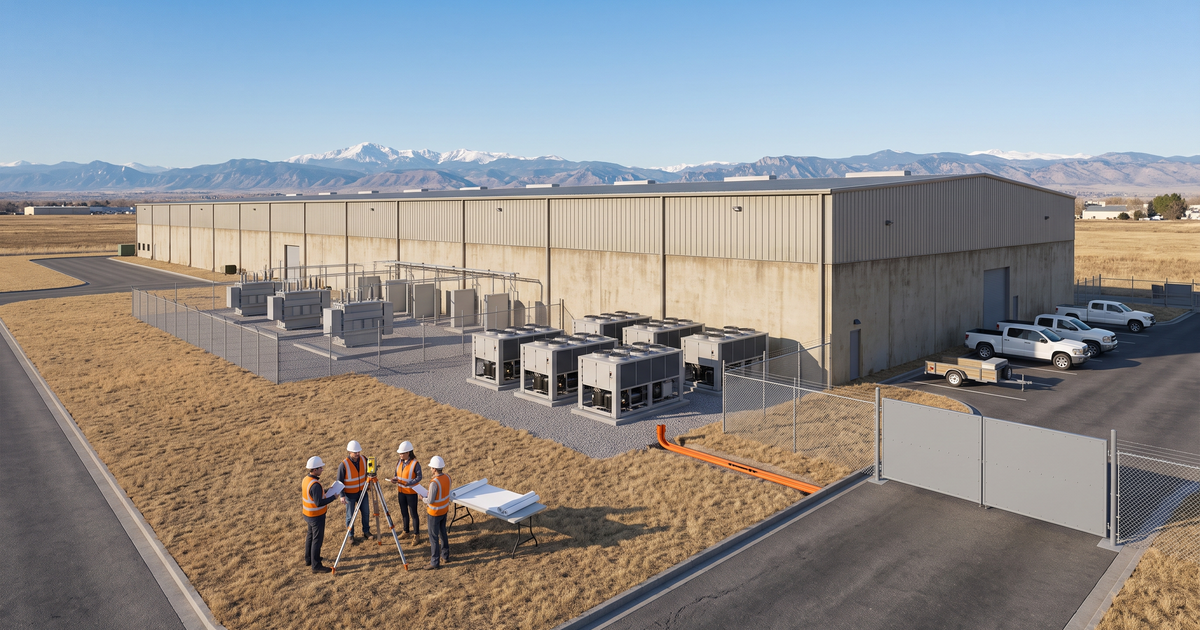
The current request covers approximately 41 acres and the existing Building C20 at 2000 Howard Smith Avenue, part of the former Kodak and Carestream industrial campus near Windsor and Greeley, Colorado. County materials describe roughly 400,300 square feet of adaptive reuse for an AI data center. They expressly include servers, networking hardware and structured cabling. The site plan also shows 13 air-cooled chillers, 11 transformers and associated electrical infrastructure.
Poudre Valley Rural Electric Association identifies 35 megawatts as the requested connected load, subject to a declining service curve. That figure belongs to the utility request. It does not disclose critical IT load, contracted tenant capacity or the eventual rack and GPU deployment. The customer, project construction budget, building-permit status, general contractor and specialty package holders also remain undisclosed.
GlobalAI Windsor C20 project snapshot
| Project fact | Current public figure | How to read it |
|---|---|---|
| Current phase | Existing Building C20 retrofit | First phase of a wider campus concept |
| Building area | About 400,300 sq. ft. | Existing industrial building |
| Review area | About 41 acres | USR26-0019 application area |
| Connected load | 35 MW requested | PVREA service figure; IT load undisclosed |
| Current equipment plan | 13 chillers; 11 transformers | Shown on the county-filed site plan |
| Current stage | Planning Commission recommended approval | County Board action scheduled September 9 |
The most complete primary record is Weld County's USR26-0019 case file. Its attachments include the current site plan, corrected planning questionnaire, electricity and water letters, acoustical work, staff memos, draft findings and September 1 Planning Commission minutes. The county's separate hearing notice identifies GlobalAI (Colorado) LLC as the applicant and sets the September 9 Board hearing.
GlobalAI's Weld County project page presents the broader vision as reuse of the former Carestream property. It forecasts more than 1,500 construction jobs and 200 permanent roles across a larger development. The page also labels its details and projections preliminary. For current opportunity tracking, the Phase 1 county record is the narrower and more actionable source.
A retrofit with mission-critical construction scope
Adaptive reuse changes the sequence compared with a ground-up campus. Existing shell conditions, structural capacity, pathways, utility entrances and legacy systems must be surveyed and reconciled before data-hall fit-out can move at full speed. That work can create early packages for selective demolition, scanning, temporary services, core drilling, cable-tray coordination, equipment-room preparation and documentation.
The filed Phase 1 description reaches deeper than a simple zoning label. County staff identifies servers, networking hardware, structured cabling, switchgear, uninterruptible power supplies and power distribution units. The current site plan places air-cooled chiller and transformer pads around the existing building. Planning Commission minutes separately describe 11 emergency generators totaling 27.5 MW. Those design facts indicate a dense electrical, controls, life-safety and communications integration effort, while leaving procurement status open.
The equipment counts should not be read as an installation report. The project is still in land-use review, and the reviewed sources do not establish that every component is purchased, set, energized or commissioned. They do show enough physical definition for contractors to watch design releases, long-lead orders, permit packages and project-team announcements.
The power numbers have different meanings
PVREA's county-filed will-serve documentation uses a requested connected load of 35 MW at a 0.95 power factor. Available capacity is time-limited: 35 MW through the second quarter of 2028, 27 MW through the first quarter of 2029 and 23 MW through the first quarter of 2030. The utility warns that capacity could decline further. The PVREA public site provides the utility context; the project-specific curve is documented in the county attachment file.
A separate hearing discussion references approximately 27.5 MW routed through shared Building C33 infrastructure. Another 27.5 MW figure describes the combined rating of 11 emergency generators. These values describe distinct parts of the project. None establishes the critical compute load inside C20.
GlobalAI has also discussed future Bloom Energy solid-oxide fuel cells. Corrected Phase 1 materials remove fuel cells from the present scope, and county staff says a future on-site generation layout would require later design review. Global AI's companywide goal of one gigawatt by 2029, described on its corporate site, is a portfolio roadmap rather than Windsor C20 capacity.
The declining utility curve makes schedule coordination especially important. A service agreement, rights to shared electrical infrastructure, the treatment of loads above Tri-State's threshold and any customer-funded improvements can affect procurement and commissioning. Firms involved in EPMS, generator controls, protective relaying, networked metering and integrated systems testing should watch for the electrical basis of design and utility responsibilities.
The named project and utility team
The public file names several organizations around the permit and design effort. Their sourced roles are narrower than a final construction contract. Phoenix Construction represents the applicant and has a named Phase 1 project executive. Phoenix, I.C. Thomasson and Legacy Collaborative appear on the current site-plan title block. I.C. Thomasson, now part of Salas O'Brien, also prepared acoustical work. The record reviewed by LVN does not conclusively identify a general contractor of record.
| Organization | Sourced role | Evidence |
|---|---|---|
| GlobalAI (Colorado) LLC | Property owner, applicant and intended operator | Project page |
| Phoenix Construction LLC | Applicant representative and Phase 1 project team | Firm site |
| I.C. Thomasson / Salas O'Brien | Site-plan MEP and acoustical team | Firm site |
| Legacy Collaborative LLC | Site-plan title-block contributor | Firm site |
| Poudre Valley REA | Serving electric distribution utility | Utility site |
| City of Greeley | Current and conditional future water provider | Water and Sewer |
| Town of Windsor | Existing C20 sanitary-sewer provider | Project information |
The county record leaves meaningful delivery roles unfilled in public: general contractor or construction manager, architect of record, final civil and structural boundaries, electrical and mechanical package holders, fire protection, specialty technology integrators and commissioning authority. Project-specific evidence also does not connect GlobalAI's corporate technology partners to Windsor construction or tenancy.
Global AI announced a $441 million senior secured credit facility led by J.P. Morgan. The release describes companywide growth capital. It does not allocate that amount to Windsor or disclose a C20 construction budget, equipment budget, permit value or committed spend.
Where low voltage shows up in C20
Structured cabling is explicitly included in the current request, making this project unusually direct for LVN readers at the land-use stage. Networking hardware and servers are also named. Additional systems follow from the filed equipment, the secure single-tenant operating model and the requirements of a mission-critical retrofit. Package ownership is still open.
| System lane | Current basis | Opportunity signal |
|---|---|---|
| Structured cabling | Explicit in the Phase 1 description | Rack, pathway, labeling and test package |
| Carrier and OSP fiber | AI data halls require resilient connectivity | Route, vault and diverse-entrance plans |
| Access control and CCTV | Secure single-tenant operating model | Security consultant or integrator award |
| Fire alarm interfaces | Existing building plus generators and UPS | Permit submittals and sequence releases |
| BAS/BMS | 13 air-cooled chillers on current plan | Controls architecture and sequences |
| EPMS/DCIM | Switchgear, UPS, PDUs and transformers | Monitoring platform and point list |
| Generator controls | 11 generators described in minutes | Paralleling and alarm-integration scope |
| Commissioning | Mission-critical retrofit turnover | CxA, IST scripts and customer acceptance |
Retrofit risk makes documentation a competitive advantage. Contractors should expect field verification, legacy-system identification, coordinated pathways, grounding and bonding details, clean fiber inspection and testing, copper certification, redlines, as-builts and structured turnover packages. Integrated testing must align network, life safety, cooling, power monitoring and standby generation under failure conditions.
Phase 1 uses an air-cooled, closed-loop approach rather than cooling towers. That reduces one class of water demand but still creates controls, alarming and leak-detection work. Greeley's executed pre-annexation agreement provides a path for treated-water service through March 31, 2028, subject to Water and Sewer Board approval and later annexation requirements. Permanent service still depends on infrastructure, fees and water-rights compliance.
Jobs, trades and qualification routes
The corrected Phase 1 questionnaire forecasts approximately 90 workers on the day shift and 60 on the night shift during construction. It then estimates about 10 day-shift and eight night-shift operating employees. These are project planning forecasts. They do not establish current headcount, active requisitions, labor agreements or awarded trade packages.
GlobalAI's broader community page forecasts more than 1,500 construction jobs and 200 permanent roles across the wider development. The difference matters. Contractors sizing an immediate pursuit should use the 150-worker Phase 1 forecast and confirm the actual schedule, delivery model and package list. Technicians should follow named contractors and verified job postings as they appear.
Useful preparation includes data-center safety, secure-site access, lift training, cable-tray and pathway coordination, fiber cleaning and inspection, Tier 1 and Tier 2 testing, grounding and bonding, labeling, closeout documentation and integrated systems testing. The BICSI Installer program, Fiber Optic Association certifications, NICET fire-alarm certification and ISA Certified Control Systems Technician program provide relevant qualification routes.
For companies, the practical pursuit checklist is project-specific: confirm Phoenix's delivery role; identify the permit applicant for each discipline; locate subcontractor prequalification requirements; document mission-critical references; prepare safety and quality metrics; and track long-lead electrical and mechanical awards. A credible issued package and accountable prime contractor are stronger opportunity signals than a campus-scale employment headline.
Approval and enforcement remain schedule gates
The September 1 vote was advisory. Weld County's Board of County Commissioners retains final authority over the special-review request at its September 9 hearing. Approval would establish the land-use path for Phase 1 but would not substitute for building, electrical, mechanical, fire, stormwater or generator-related permits.
Colorado Public Radio's records review documented three stop-work orders and a July 20 order to abate tied to unpermitted activity. Applicant counsel told the Planning Commission that the matter had been resolved. The reviewed record does not establish an issued data-center building permit or formal closeout of every enforcement item. Contractors should verify lawful restart status before mobilizing.
The Town of Windsor's project page also clarifies jurisdiction: the site is in unincorporated Weld County, and Windsor has not approved the project. That distinction affects where to follow land-use, permit, utility and public-hearing records.
What can unlock executable work
The September 9 Board decision is the nearest milestone. After that, the strongest signals will be an issued resolution and permit sequence, documented enforcement closeout, a defined GC or CM role, a PVREA service agreement, shared-substation responsibilities and long-lead transformer, switchgear, UPS, PDU, generator and chiller orders.
For the low-voltage market, watch the carrier plan, outside-plant routes, meet-me-room and diverse-entrance design, structured-cabling release, security and life-safety submittals, BAS/BMS and EPMS point schedules, generator-control integration, commissioning scope and subcontractor prequalification. Those documents can turn a general project lead into an executable pursuit.
GlobalAI Windsor C20 is a high-confidence project because its address, building, acreage, utility request, current equipment concept, applicant and decision path are documented. Its remaining unknowns are commercially important: customer, critical IT load, project cost, lawful construction start and package ownership. That is the window for disciplined follow-up.
Follow GlobalAI Windsor C20 in LVN Signal for the Board decision, power path, project-team changes, trade packages, jobs and low-voltage opportunities as the retrofit advances.
Join 35,000+ Low Voltage Pros
Get weekly permit updates, tool deals, job opportunities, and industry news. No spam, unsubscribe anytime.