
Join Low Voltage Nation — Find project opportunities and showcase your company to thousands of industry professionals
Galaxy acquired about 500 acres in McGregor for a 74MW first phase, private campus substation, and multi-hundred-megawatt AI/HPC expansion path.
Galaxy has acquired about 500 acres in McGregor Industrial Park for a new AI and high-performance-computing campus. The owner's announcement says the initial phase is expected to reach 74 megawatts, with first power targeted for 2028 and a path toward a multi-hundred-megawatt campus through 2030.
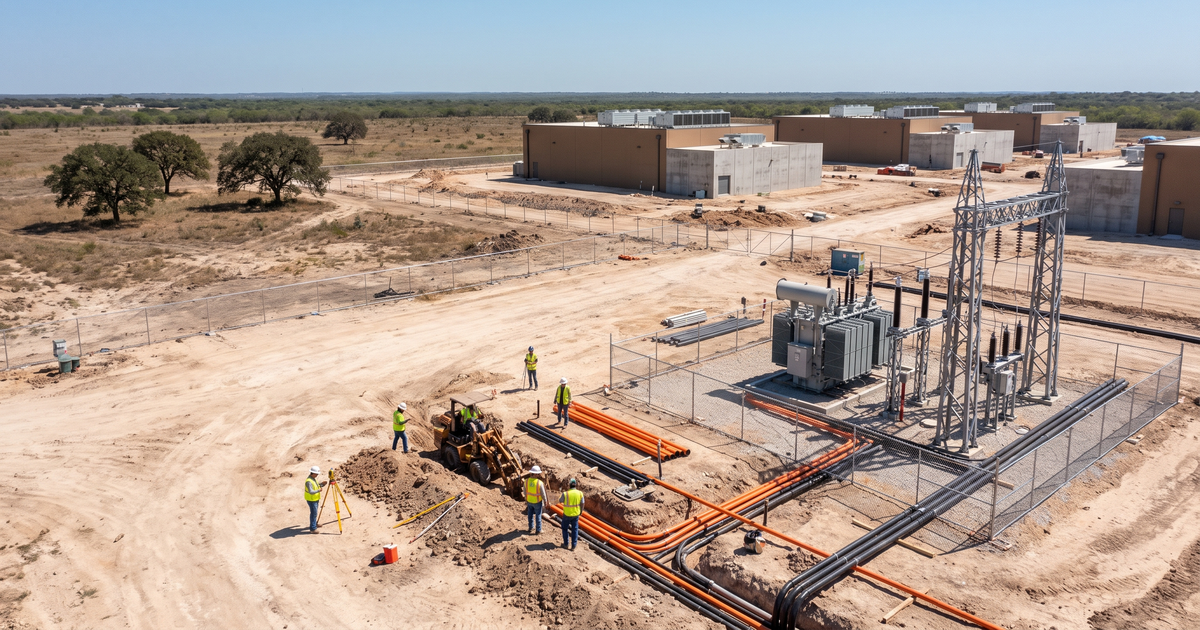
Project Merlin is early, but it is no longer a generic site-search rumor. The land transaction is public, the city approved the plan, Galaxy named its economic-development and utility partners, and an initial interconnection-facilities agreement is in place. The owner also says it will privately fund and build a campus substation and related infrastructure.
The capacity language needs discipline. Seventy-four megawatts is Galaxy's expected initial development phase. Multi-hundred-megawatt scale is future campus potential tied to additional transmission infrastructure. Public sources reviewed for this report do not disclose building-level critical IT load, the number or size of data-center buildings, or a committed tenant.
| Project fact | Source-backed detail | LVN read |
|---|---|---|
| Location | McGregor Industrial Park, Texas | Exact parcel address remains unresolved. |
| Land | About 500 acres acquired | Owner-controlled site in preconstruction. |
| Initial phase | Expected to reach 74 MW | First power targeted for 2028. |
| Expansion | Multi-hundred-MW potential | Depends on later transmission capacity. |
| Cooling | Closed-loop design | Controls and commissioning remain major lanes. |
| Workforce | Several hundred build jobs | Trade-partner opportunities expected. |
The Galaxy-issued release names the McGregor Economic Development Corporation and Heart of Texas Electric Cooperative as project partners. Galaxy says it has secured an agreement covering the initial utility interconnection facilities and will bear the cost of its private substation and associated infrastructure.
That power path is commercially important. A campus substation can create scope around utility fiber, protection and control interfaces, SCADA, metering, communications cabinets, grounding, security, remote alarming, network boundaries, and turnover testing. None of those packages should be treated as awarded until a primary or public record names the firms.
Heart of Texas Electric Cooperative is the source-backed utility and interconnection partner. The reviewed sources do not yet identify the upstream transmission owner, service voltage, substation configuration, feeder count, interconnection point, transformer plan, energization milestones, or whether later expansion will require separate ERCOT or PUCT proceedings.
Local reporting provides investment and employment context. KWTX's council coverage describes Project Merlin as a more-than-$400-million proposal with more than 30 permanent jobs, while KXXV reports the roughly 499-acre land sale, private power investment, water concerns, and closed-loop cooling commitments.
Those figures are useful but should be framed correctly. The $400-million-plus number comes from local council-presentation reporting, not a Galaxy announcement of total full-campus capital expenditure. The 30-plus permanent jobs are also local reporting. Galaxy's own release supports several hundred trade-partner and construction jobs during development.
| Company / agency | Source-backed role | Evidence |
|---|---|---|
| Galaxy | Owner, operator, and developer | Acquisition announcement |
| McGregor EDC | Land and development partner | Official site |
| City of McGregor | Local approval and infrastructure context | Economic development |
| HOTEC | Utility and interconnection partner | Utility site |
| GC / design team | Not publicly named | Monitor permits, portfolios, and plan rooms. |
| Specialty trades | Not publicly named | Do not infer awards from market familiarity. |
No reviewed source names a general contractor, EPC or EPCM firm, architect, civil engineer, MEP engineer, electrical contractor, low-voltage integrator, structured-cabling contractor, fiber or outside-plant contractor, security integrator, fire alarm contractor, BAS/BMS/EPMS integrator, DAS contractor, grounding contractor, or commissioning authority.
That missing roster is the central contractor watch. Galaxy has a site, utility partner, initial interconnection agreement, power target, cooling direction, and public schedule. The next useful evidence will come from plats, site plans, permits, professional registrations, utility filings, environmental records, contractor portfolios, supplier announcements, job postings, and plan-room activity.
The City of McGregor and McGregor EDC are practical starting points for local records. The current Signal map uses a McGregor city fallback because the exact parcel and construction entrance have not been verified. A city-level point is more honest than inventing a precise address from the industrial-park name.
| Low-voltage lane | Why it matters | Watch signal |
|---|---|---|
| Fiber / OSP | Carrier entrances, diverse paths, campus backbone, and utility links | Easements, conduit, handholes, MMRs, splicing, and carrier notices. |
| Structured cabling | Data halls, operations, support rooms, and controls networks | Pathways, standards, labeling, testing, and turnover requirements. |
| Security | Critical-infrastructure perimeter and controlled access | Gates, access control, CCTV/VMS, intercom, and SOC integration. |
| Fire alarm | Data halls, electrical spaces, cooling, and AHJ acceptance | Detection, monitoring, interfaces, and sequence testing. |
| BMS / EPMS | Closed-loop cooling, electrical visibility, alarms, and remote operations | Point lists, controls networks, SCADA links, and trending. |
| Commissioning | Integrated power, cooling, controls, security, and life safety | CxA award, scripts, witness tests, and operator training. |
Fiber and outside plant should be watched early. A new 500-acre campus needs diverse telecom entrances, campus duct banks, handholes and maintenance holes, splice points, utility communications, meet-me rooms, backbone distribution, construction-phase connectivity, and documented optical testing. Carrier names and fiber routes have not been disclosed.
Structured cabling scope will depend on the eventual building and tenant architecture. AI and HPC environments can place large portions of the high-speed fabric inside customer-furnished systems, while still leaving substantial owner scope in MMRs, operations areas, support spaces, wireless, security, controls networks, management systems, and the pathways connecting them.
Security design will likely extend from the industrial-park boundary into each future building. Practical watch items include vehicle barriers, gates, guard facilities, visitor processing, credentialing, biometric readers, access control, video surveillance, analytics, intercom, duress, key management, security operations integration, retention policy, and acceptance testing.
Fire and life safety will require coordination with data halls, electrical rooms, generators, battery systems, cooling systems, warehouses, offices, and site infrastructure. Detection, releasing interfaces, supervisory points, monitoring, emergency-power behavior, cause-and-effect matrices, integrated tests, and authority-having-jurisdiction acceptance all create package boundaries.
Closed-loop cooling does not eliminate controls work. Pumps, valves, heat exchangers, leak detection, environmental sensors, water-quality monitoring, alarm routing, sequence control, energy optimization, failover, trending, and operator dashboards still need BMS, EPMS, DCIM, OT-network, and commissioning integration.
The private substation adds another coordination layer. Protection and control, station communications, SCADA, revenue and owner metering, utility telemetry, network segmentation, grounding grids, lightning protection, security, fire detection, remote alarms, and documentation can cross utility, electrical, controls, and low-voltage boundaries.
DAS, public-safety radio, cellular, Wi-Fi, and private wireless requirements remain unknown. A large campus can create coverage challenges across data halls, support buildings, yards, security posts, loading areas, substations, and emergency-response zones. Requirements should be confirmed through design and jurisdiction records, not assumed.
Grounding and bonding should be coordinated across the utility interconnection, private substation, structural steel, lightning protection, generators, switchgear, UPS systems, cable tray, racks, telecom rooms, OSP entrances, security devices, controls panels, and cooling systems. Responsibility for testing and final documentation remains undisclosed.
Commissioning connects these disciplines. Mission-critical turnover typically requires factory tests, site acceptance, power-quality checks, controls point-to-point verification, alarm testing, cooling sequences, network readiness, security and fire interfaces, failure-mode tests, integrated systems testing, operator training, and clean digital closeout.
Contractors can prepare before awards surface. Useful readiness includes OSHA and mission-critical safety, lift and site-access credentials, fiber cleaning and inspection, fusion splicing, OTDR and optical-loss testing, copper certification, pathway coordination, grounding and bonding, access-control and VMS commissioning, fire alarm acceptance support, controls point-to-point testing, redlines, labeling, and turnover documentation.
Prequalification packages should show insurance, bonding capacity, EMR and safety performance, available workforce, Central Texas coverage, industrial or data-center references, QA/QC plans, testing equipment, manufacturer certifications, field supervision, schedule controls, commissioning experience, and examples of as-builts and digital closeout.
Galaxy's 2026 newsroom index lists McGregor separately from the company's Helios campus. That distinction matters for clean tracking. Project Merlin is in McGregor and McLennan County; Helios is in Dickens County. Contractor or capacity evidence from Helios should not be copied onto McGregor without a project-specific source.
The public watch list is concrete: Galaxy releases and jobs, McGregor council and EDC records, McLennan County filings, HOTEC and transmission activity, ERCOT and PUCT records where applicable, TDLR/TABS, TCEQ, plats and permits, engineering portfolios, plan rooms, supplier registrations, and operations or commissioning hiring.
Schedule signals should be separated by discipline. The 2028 first-power target does not mean every building or low-voltage package starts at once. Land development, utility and substation work, campus roads, underground infrastructure, shell construction, electrical rooms, network entrances, security, life safety, controls, data-hall fit-out, and commissioning will each move on different procurement and inspection paths. Contractors should watch for source-backed bid and prequalification notices tied specifically to McGregor rather than treating the campus announcement as an open solicitation.
Alias control will also matter. Track Galaxy McGregor, Galaxy Project Merlin, Project Merlin, McGregor Industrial Park data center, GXMG LLC, 500-acre McGregor campus, and Galaxy's second Texas data-center campus. Keep the record distinct from Galaxy Helios, Nexus Apex Hubbard, DataBank Red Oak, Flexential Talty, and other Central or North Texas projects.
The business-development angle is credible without claiming an open bid. LVN now has a source-backed record for the owner, land acquisition, local partners, utility partner, initial capacity, schedule, cooling direction, substation plan, and workforce signal. Galaxy and future project partners can correct the record, claim profiles, share verified package or hiring details, or sponsor continued coverage.
Bottom line: Galaxy Project Merlin is an early but high-confidence construction watch. The first phase is expected to reach 74 MW and receive power in 2028. The next high-value evidence is the exact parcel, transmission and substation filings, building plans, design team, contractor roster, fiber path, specialty package awards, and commissioning schedule.
Join 35,000+ Low Voltage Pros
Get weekly permit updates, tool deals, job opportunities, and industry news. No spam, unsubscribe anytime.