
Join Low Voltage Nation — Find project opportunities and showcase your company to thousands of industry professionals
Galaxy Helios Phase II has CoreWeave capacity, TDLR filings, Stantec named, and unresolved specialty low-voltage package names.
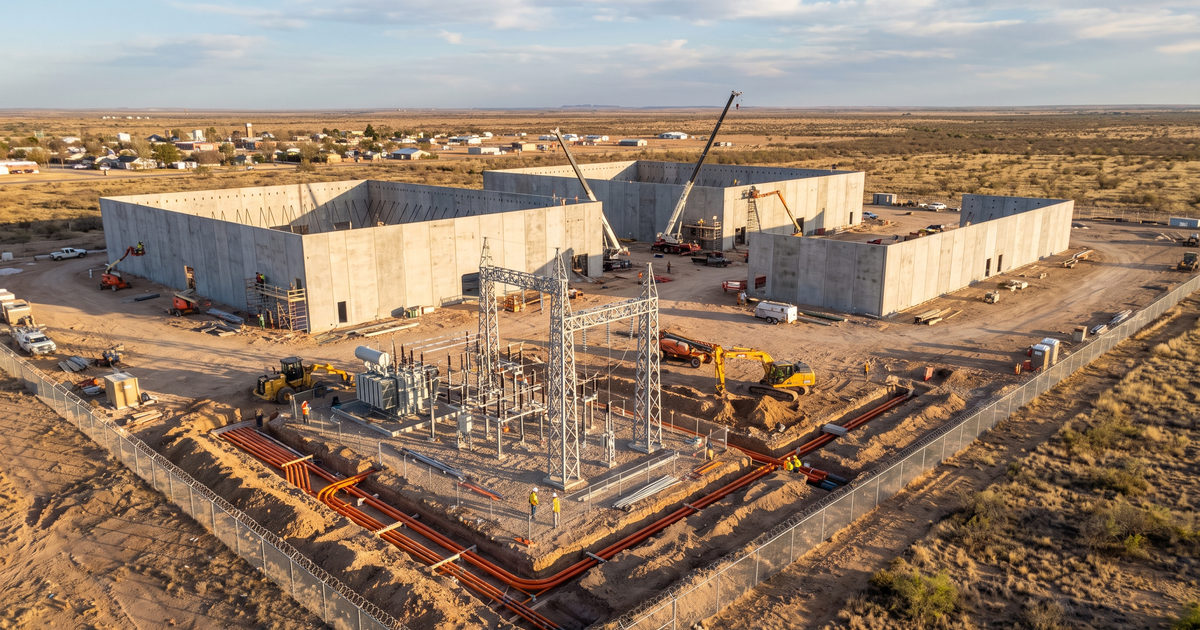
Galaxy's Helios campus in Afton, Texas has moved from crypto-era power campus into a live AI infrastructure construction watch. Galaxy announced on July 6, 2026 that Phase I at Helios was delivered to CoreWeave, with about 200 MW of gross power capacity and about 133 MW of critical IT load now delivered. The same announcement says Phase II development is continuing on schedule.
The new LVN signal is not only that Phase I is complete. It is that Phase II has a public capacity commitment and a public construction filing trail. Galaxy's CoreWeave Phase II commitment says the option adds about 260 MW of incremental critical IT load at Helios, bringing CoreWeave's total Helios commitment to about 393 MW of critical IT load. That is a large enough load to keep fiber, structured cabling, physical security, fire alarm, BAS/BMS, networking, grounding, and commissioning firms watching the project family.
Galaxy's data-center infrastructure page frames Helios as power-ready AI and HPC infrastructure for customers that need scalable compute capacity. That owner/operator context matters because it supports the construction narrative without forcing a tenant rumor. CoreWeave is source-backed as the customer named by Galaxy. Reviewed public sources did not name a separate hyperscaler, electrical contractor, low-voltage contractor, security integrator, fire alarm contractor, BAS/BMS firm, DAS provider, networking integrator, grounding contractor, or commissioning agent.
| Project Fact | Source-Backed Detail | LVN Read |
|---|---|---|
| Owner/operator | Galaxy operates Helios as AI/HPC data-center infrastructure. | Source-backed owner/operator. |
| Customer | CoreWeave is named by Galaxy for Phase I and Phase II commitments. | Source-backed AI/HPC demand signal. |
| Phase I | 133 MW critical IT load delivered to CoreWeave. | Delivered capacity, not a future rumor. |
| Phase II | About 260 MW incremental critical IT load under the CoreWeave option. | Next construction and fit-out watch. |
| Combined commitment | About 393 MW critical IT load committed to CoreWeave. | Capacity context; building-level TDLR records do not disclose IT load. |
The public-record trail is unusually useful. TDLR TABS2026014892 lists Helios 2 at 1003 FM 193 in Afton / Dickens County with an estimated cost of $900 million, 349,594 square feet, a March 13, 2026 start, and a February 8, 2027 completion. TDLR TABS2026014893 lists Helios 3 at the same address with an estimated cost of $1.3 billion, 349,594 square feet, an April 6, 2026 start, and an August 29, 2027 completion. TDLR TABS2026014894 lists Helios 4 with another $1.3 billion estimated cost, 349,594 square feet, a July 15, 2026 start, and a November 29, 2027 completion.
Together, those three Phase II TDLR filings show about $3.5 billion of estimated construction value and 1,048,782 square feet across three data-center / office buildings. The filings name Galaxy Helios II LLC as owner and Stantec Architecture, Inc. as design firm. That is enough to treat the project as active construction intelligence, while still keeping the specialty package map honest.
| Organization | Source-Backed Role | Evidence |
|---|---|---|
| Galaxy | Owner/operator and Helios infrastructure platform. | Phase I delivery. |
| Galaxy Helios II LLC | TDLR owner entity for Helios 2, 3, and 4. | TDLR Helios 2. |
| CoreWeave | AI/HPC customer with 393 MW committed critical IT load. | Galaxy/CoreWeave commitment. |
| Stantec Architecture | TDLR design firm for Phase II filings. | TDLR Phase II filing. |
| STG Design | Design firm on the separate Phase I Helios Light Speed filing. | TDLR Phase I filing. |
The capacity language needs discipline. The 133 MW figure is Phase I critical IT load delivered to CoreWeave. The 260 MW figure is incremental Phase II critical IT load under the CoreWeave option. The 393 MW figure is the combined committed critical IT load to CoreWeave at Helios. The TDLR building records support square footage, cost, address, owner entity, design firm, and construction dates; they do not disclose building-level IT critical load.
For low-voltage contractors, Helios Phase II is important because the project has both public construction filings and an AI/HPC customer commitment. The trade work should be watched at the systems level until source-backed awards appear. The likely watch areas include campus fiber, OSP, MMR and data-hall connectivity, structured cabling pathways, access control, CCTV, fire alarm interfaces, BAS/BMS and EPMS coordination, facility networking, possible DAS/public-safety coverage, grounding and bonding, labeling, testing, closeout documentation, and commissioning support.
| LV System | Why It Matters | Watch For |
|---|---|---|
| Fiber / OSP | Large AI campuses need diverse paths, carrier entrances, and clean testing. | Duct banks, MMRs, splice/test packages, carrier work. |
| Structured cabling | Data-hall fit-out depends on pathway discipline and documentation. | Cable tray, rack/row cabling, labeling, closeout QA. |
| Access control / CCTV | Customer-ready AI capacity requires layered physical security. | Perimeter, gates, ACS, VMS, camera schedules. |
| Fire alarm / life safety | AHJ acceptance can drive schedule risk on large buildings. | FA permits, monitoring paths, acceptance tests. |
| BAS/BMS / networking | Cooling, power, security, and operations need reliable IT/OT networks. | Controls integrator, EPMS/BMS, commissioning scripts. |
The jobs and skills angle is also practical. Reviewed owner and public-record sources did not publish a Phase II job count, so LVN should not invent one. The useful training signal is the work mix: fiber installation and testing, structured cabling, grounding and bonding, cable tray and pathway coordination, fire alarm interfaces, access-control and CCTV integration, BMS/BAS controls, IT/OT networking, documentation, safety, lift work, data-center access discipline, and commissioning readiness.
The next high-value public signal is a named general contractor, EPCM, engineer-of-record beyond the TDLR design-firm listing, electrical contractor, low-voltage or fiber contractor, structured cabling contractor, security integrator, fire alarm contractor, BMS/BAS controls firm, DAS/networking provider, grounding/bonding contractor, or commissioning agent. Monitor Galaxy, CoreWeave, TDLR/TABS, Dickens County, ERCOT, Afton-area public records, plan-room and prequalification channels, and job postings for Helios 2, Helios 3, and Helios 4.
The clean Signal read is this: Galaxy Helios Phase II is a source-backed AI/HPC construction update with Galaxy as owner/operator, CoreWeave as customer, Stantec as TDLR design firm for the new Phase II buildings, and roughly $3.5 billion of Phase II TDLR construction value. The low-voltage package holders are still unnamed. That makes Helios a strong LVN watch-list project right now, not after every package has already been awarded.
Join 35,000+ Low Voltage Pros
Get weekly permit updates, tool deals, job opportunities, and industry news. No spam, unsubscribe anytime.