
Fluke Networks CableIQ CIQ-100 Review: The Qualification Tester That Cuts Troubleshooting Time in Half
Join Low Voltage Nation — Find project opportunities and showcase your company to thousands of industry professionals
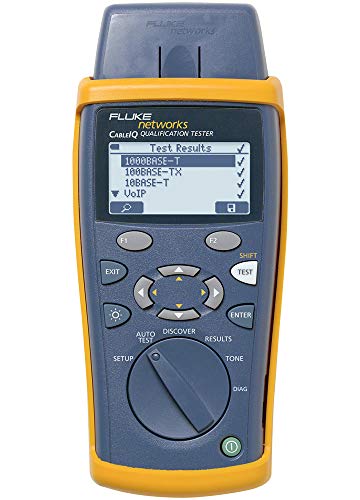
Fluke Networks Fluke Networks CIQ-100 Copper Qualification Tester, Qualifies and Troubleshoots Category 5-6A Cabling for 10/100/Gig Ethernet, Coax and Voip, Blue
Fluke Networks Cableiq Qualification Tester - Speed Testing, Twisted Pair Cable Testing, Voip Testing, Cable Length Testing, Cable Fault Testing, Fiber Optic Cable Testing, Cable Tracing, Coaxial Cable Testing, Wiremap, Cable Signal Testing, Continuity Testing, ... - Twisted Pair, Optical Fiber - Gigabit Ethernet - 10/100/1000base-t, 1000base-x - 4number Of Batteries Supported - Aa - Alkaline
In-depth review of the Fluke Networks CableIQ CIQ-100 copper qualification tester. Learn who it's for, key features, pros and cons, and whether it's worth the investment in 2025.

Fluke Networks
Fluke Networks
Fluke Networks CableIQ CIQ-100 Review: The Qualification Tester That Cuts Troubleshooting Time in Half
An in-depth look at Fluke's copper qualification tester for low voltage technicians who need to verify bandwidth capability without full certification.
Quick Verdict
The Fluke Networks CableIQ CIQ-100 is a qualification tester that sits in the sweet spot between basic cable testers and full certifiers. At around $1,600, it's a significant investment, but for techs who troubleshoot existing copper infrastructure daily, the four-second bandwidth qualification test and graphical fault display pay for themselves in saved labor hours.
Best for: Network maintenance teams, service technicians troubleshooting existing cabling, and contractors who need to verify bandwidth capability without full TIA/ISO certification.
Check Current Price on Amazon →
Who This Is For (And Who Should Skip It)
Perfect for:
- Network maintenance technicians – Troubleshoot cabling issues without escalating tickets
- Low voltage service techs – Verify existing cable can support VoIP, 10/100, or Gig upgrades
- IT departments – Qualify cabling before network equipment upgrades
- Residential integrators – Test voice, data, and coax in home networks (with CIQ-KRQ kit)
Skip it if:
- You need TIA/ISO certification – This qualifies, it doesn't certify. For warranty documentation and standards compliance, you need a DSX CableAnalyzer.
- PoE load testing is critical – CableIQ detects PoE but cannot load test. In fact, connecting to active PoE can damage the unit.
- You're buying new equipment – CableIQ is discontinued. The LinkIQ is Fluke's current replacement with better PoE capabilities.
Key Features That Actually Matter
Four-Second Bandwidth Qualification
The headline feature is the Autotest that tells you in four seconds whether a cable can support Voice/10/100, VoIP, or Gigabit Ethernet. A green checkmark means pass. No interpretation required, no spec sheets to compare. When you're standing in a cramped telecom closet with a stack of trouble tickets, that instant clarity is worth its weight.
Intelligent Graphical Wiremap
Unlike testers that spit out a cryptic string of numbers, CableIQ displays an actual visual representation of the cable. Opens, shorts, split pairs, and crossovers appear exactly where they occur, with distance proportional to cable length. When you're trying to find a fault in a 200-foot run buried in a ceiling plenum, that visual feedback beats scrolling through number codes.
Advanced Diagnostics
Beyond pass/fail, CableIQ measures insertion loss, crosstalk, and impedance—then compares those values against appropriate limits for the qualification test you selected. This is what separates it from $50 continuity testers. When a cable "works" but users complain about dropped packets, these diagnostics pinpoint the cause.
Coax and Voice Testing
One unit handles twisted-pair Cat5e through Cat6a, coaxial cable, and voice wiring. For integrators who work across media types, this consolidates multiple testers into a single 1.2-pound handheld.
Real-World Performance
After pulling the CableIQ out of its soft case dozens of times in the field, the design choices make sense. The unit feels solid in your hand without being fatiguing—important when you're testing patch panel after patch panel for hours. The four AA batteries last through a full workday of testing, and since it requires no calibration, there's no annual service cost eating into your margins.
The graphical wiremap display might seem like a gimmick until you're troubleshooting a miswired jack that someone terminated years ago. Seeing exactly which pins are crossed, and at what distance, beats the guessing game that cheaper testers force you into. On one job, I traced what three other techs had called a "bad cable" to a split pair 47 feet from the patch panel—the kind of fault that passes basic continuity but tanks Gigabit performance.
The remote adapter system deserves mention. Each smart remote can perform both wiremap and full qualification tests, and you can store up to seven tests before walking back to the main unit. When you're terminating a floor's worth of drops, that workflow efficiency adds up. The optional CIQ-KIT includes six remote IDs and the IntelliTone 200 probe for cable tracing—the combination most working techs actually need.
What I Like (Pros)
- Four-second Autotest – Instantly know if cable supports 10/100/1000/VoIP without guesswork
- Graphical fault display – See exactly where problems are, not just that they exist
- No calibration required – Zero annual service costs, always ready to test
- Tests multiple media – Cat5e through Cat6a, coax, and voice in one unit
- Rugged build quality – The rubber overmold survives drops onto concrete floors
- Remote ID workflow – Test up to seven runs without returning to the patch panel
What Could Be Better (Cons)
- PoE is a landmine – Despite "PoE detection" marketing, connecting to active PoE can permanently damage the unit. This is a serious design limitation in today's PoE-heavy networks.
- Discontinued product – No longer manufactured, which means limited availability and no future firmware updates
- Qualification, not certification – Won't generate TIA/ISO certification reports for warranty compliance or contractor documentation
- Smaller display – Practical for basic diagnostics but limited visual feedback compared to modern testers
- Price point – At $1,600+, it's a serious investment for what is now end-of-life hardware
Specifications Table
| Specification | Value |
|---|---|
| Cable Types | Cat5e, Cat6, Cat6a, Coax, Voice |
| Qualification Tests | Voice/10/100, VoIP, Gigabit Ethernet |
| Test Time | 4 seconds (Autotest) |
| Max Cable Length | 1000 ft / 305m |
| Diagnostics | Length, Wiremap, Insertion Loss, Crosstalk, Impedance |
| PoE Support | Detection only (no load testing) |
| Display | LCD with graphical wiremap |
| Dimensions | 7" x 3.5" x 1.75" |
| Weight | 1.2 lbs |
| Battery | 4x AA Alkaline |
| Calibration | Not required |
| Warranty | 1 year |
Is It Worth the Price?
This is where the CableIQ gets complicated in 2025. At roughly $1,600, it's positioned as a serious professional tool—and it delivers professional results. The four-second qualification test and graphical fault display genuinely cut troubleshooting time in half compared to basic testers.
However, the CableIQ is now discontinued. Fluke recommends the LinkIQ as its replacement, which offers better PoE capabilities (including actual load testing) and modern firmware support. If you're buying new, the LinkIQ is the smarter choice.
Where the CableIQ still makes sense:
- Used market – Refurbished units from reputable dealers at significant discounts
- Existing fleet – If you already own one, it's still a capable tester for non-PoE environments
- Backup unit – As a secondary tester when your primary is in the shop
The math is simple: if you spend more than 10 hours per week troubleshooting copper cabling, a qualification tester pays for itself within months in reduced labor time. Whether that should be a CableIQ or a LinkIQ depends on your PoE testing needs and tolerance for discontinued hardware.
The Bottom Line
The Fluke Networks CableIQ CIQ-100 was—and in many ways still is—an excellent qualification tester that delivers exactly what it promises: fast, reliable bandwidth qualification for existing copper infrastructure. The four-second Autotest, graphical fault display, and multi-media support make it a productivity tool that justifies its professional price point.
The major caveat is that this is end-of-life hardware. The PoE limitation is particularly problematic as networks increasingly rely on Power over Ethernet. For new purchases, the LinkIQ offers a more future-proof solution. But if you find a well-maintained used CableIQ at the right price, and your work doesn't heavily involve PoE testing, it remains a capable tool that won't let you down.
Rating: 4.0/5 – Still excellent at what it does, but the discontinued status and PoE limitations prevent a higher score in 2025.
Check Current Price on Amazon →
Disclosure: This post contains affiliate links. If you purchase through these links, Low Voltage Nation may earn a commission at no additional cost to you.
Find Projects That Need This Tool
Looking for commercial jobs where a cable qualification tester like this pays for itself?
LVN Signal surfaces structured cabling projects from permit data before they hit bid boards.
Join 35,000+ Low Voltage Pros
Get weekly permit updates, tool deals, job opportunities, and industry news. No spam, unsubscribe anytime.