
FLIR C5 Review: The Pocket Thermal Camera That Punches Above Its Size
Join Low Voltage Nation — Find project opportunities and showcase your company to thousands of industry professionals
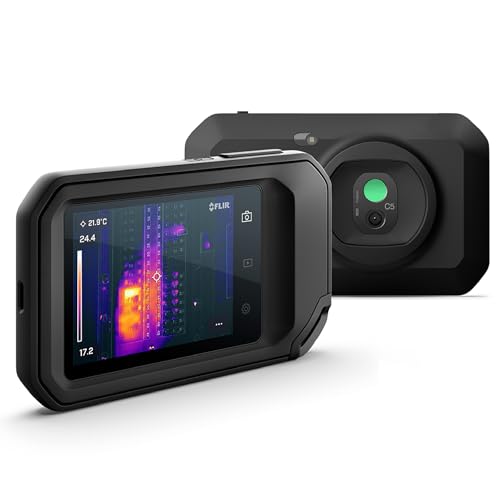
FLIR FLIR C5 Compact Thermal Imaging Camera with Wifi: High Resolution Infrared Imager for Inspection, Electrical/Mechanical, Building, and HVAC Applications
C5: Handheld IR camera measures temperatures from -20 to 400°C (-4 to 752°F) IDENTIFY AND TROUBLESHOOT: Quickly find hidden faults and reduce diagnostic time with MSX and 160 x120 true thermal imaging (19,200 pixels) PATENTED TECHNOLOGY: Patented MSX software embosses visual details on the thermal image to create a sharper, easier to understand picture DOCUMENT AND SHARE: Directly upload images using FLIR Ignite cloud connectivity, then create professional reports and email them to customers WARRANTY: 2-10 Thermal Camera Warranty from FLIR, 2 Years parts and labor coverage on the camera, 10 Years coverage on the detector - the most vital part of the whole camera
Detailed review of the FLIR C5 compact thermal imaging camera. Covers specs, real-world performance, MSX technology, pros and cons, and who should buy this pocket thermal camera.
FLIR C5 Review: The Pocket Thermal Camera That Punches Above Its Size
FLIR's pocket-sized thermal imager packs professional features into a compact form factor. Here's whether it's worth the investment for electrical and HVAC contractors.
Quick Verdict
The FLIR C5 is the best pocket thermal camera you can buy. At around $600, it delivers 160x120 resolution with MSX image enhancement, cloud connectivity, and genuinely rugged construction—all in a package that fits in your pants pocket. For contractors who want thermal capability without carrying a dedicated camera bag, the C5 hits a sweet spot between smartphone thermal adapters and full-sized professional imagers.
Best for: Electricians, HVAC technicians, and low voltage contractors who want quick thermal verification on job sites without the bulk or cost of full-sized cameras.
Check Current Price on Amazon →
Who This Is For (And Who Should Skip It)
Perfect for:
- Electricians – Quick panel scans, hot connection identification, circuit breaker diagnostics
- HVAC/R technicians – Ductwork inspection, compressor checks, insulation verification
- Low voltage contractors – Verifying no heat issues at electrical connections during installations
- Home inspectors – Moisture detection, insulation gaps, electrical hot spots
- Facility maintenance – Routine preventive checks on electrical and mechanical equipment
Skip it if:
- You need detailed diagnostic capability – The 160x120 resolution is good, not great. For precise temperature measurement on small components, you'll want a higher-resolution camera.
- You hate cloud dependencies – FLIR Ignite integration is convenient but effectively required for easy file management.
- You're on a tight budget – Smartphone thermal adapters offer basic capability for less, though with significant trade-offs.
Key Features That Actually Matter
160x120 True Thermal Resolution
At 19,200 pixels, the C5 captures significantly more detail than the now-discontinued C3 (80x60) and C3-X (128x96). This resolution lets you identify hot spots on individual breakers, trace warm cable runs, and spot insulation gaps from reasonable distances. It's not enough resolution for small component analysis, but for field inspection work, it gets the job done.
MSX Image Enhancement
FLIR's MSX (Multi-Spectral Dynamic Imaging) embosses visible light details onto thermal images. In practice, this means you see the outlines of equipment, labels, and structures overlaid on the thermal data. When scanning a crowded electrical panel, MSX helps you immediately identify which breaker is running hot without playing the guessing game of matching thermal blobs to physical components.
-4°F to 752°F Temperature Range
The expanded upper range handles most electrical and HVAC scenarios. You can measure hot connections that would peg cheaper cameras, inspect heating equipment, and work with industrial machinery. The ±3°C or ±3% accuracy is typical for this class—adequate for identifying problems, not laboratory measurement.
Genuinely Pocket-Sized
At 5.4 x 3.3 inches, the C5 fits in a cargo pocket. This matters more than you'd expect. When your thermal camera requires a belt holster or separate case, you leave it in the truck. When it fits in your pocket, you actually use it throughout the day. The included lanyard and wrist strap add security without bulk.
FLIR Ignite Cloud Connectivity
Wi-Fi uploads images directly to FLIR's cloud service. From there, you can organize images, generate reports, and share with clients or colleagues. The workflow is smoother than cable transfers—snap images, they sync automatically, then access them from your desktop. The trade-off is you need a FLIR account and internet connectivity.
2-Meter Drop Rating + IP54
The C5 survives real-world job site conditions. The IP54 rating handles dust and splashes, and the 2-meter drop rating means it survives the occasional fumble. The rubberized exterior absorbs impacts and provides grip, even in dirty or sweaty hands.
Real-World Performance
After pulling the C5 from my pocket dozens of times across various job sites, the compact form factor is the feature that matters most. Previous thermal cameras lived in padded cases that stayed in the truck unless I specifically planned to use them. The C5 comes with me everywhere because it fits in my pocket—and because it fits in my pocket, I actually use it.
The 3.5-inch touchscreen is adequate without being impressive. It's bright enough to see in most conditions, though direct sunlight requires shading with your hand. Touch responsiveness is acceptable—not smartphone smooth, but you're not jabbing at the screen repeatedly. The rotating display lets you shoot at awkward angles without standing on your head.
Image quality genuinely surprised me. The MSX enhancement makes thermal images immediately interpretable—you see the hot breaker in context, not just an orange blob on black background. The 160x120 resolution captures enough detail to identify which wire in a bundle is warm, which termination in a panel is failing. For a pocket camera, that's impressive.
The warm-up period caught me off guard initially. If the camera has been off for a few days, it takes 30-60 seconds to stabilize after power-on. The first time this happened, I assumed something was wrong. Now I know to power it on while walking to the panel, and it's ready by the time I arrive. Minor workflow adjustment, not a real limitation.
Battery life runs about 4 hours of actual use, which covers a typical workday of periodic inspections. The USB-C charging is convenient—the same cable that charges my phone charges the camera. I've never run out of battery on a job, though I do top it off overnight as habit.
What I Like (Pros)
- Truly pocket-portable – Actually fits in cargo pants, so you actually carry it
- MSX enhancement – Instantly interpretable images without guessing which component is hot
- Solid resolution for the size – 160x120 is enough for most field inspection work
- Rugged construction – IP54 and 2-meter drop rating survive real job site abuse
- Cloud workflow – Automatic uploads eliminate cable transfers and manual file management
- 10-year detector warranty – FLIR stands behind the most critical component
What Could Be Better (Cons)
- Cloud dependency – Getting images off the camera without FLIR Ignite is unnecessarily painful, especially on Mac
- Non-replaceable battery – When the battery eventually dies, the whole camera becomes e-waste
- Startup calibration delay – Takes 30-60 seconds to stabilize if powered off for extended periods
- Visual camera is mediocre – The 5MP visible light camera produces underwhelming images
- Price premium – At ~$600, you're paying significantly more than smartphone thermal adapters
- No manual focus – Fixed focus means everything is "acceptably" focused, nothing is perfectly focused
Specifications Table
| Specification | Value |
|---|---|
| IR Resolution | 160 x 120 (19,200 pixels) |
| Temperature Range | -4°F to 752°F (-20°C to 400°C) |
| Accuracy | ±3°C or ±3% (whichever is greater) |
| Thermal Sensitivity (NETD) | <70 mK |
| Field of View | 54° x 42° |
| Focus | Fixed |
| Refresh Rate | 9 Hz |
| Display | 3.5" rotating touchscreen |
| Visual Camera | 5 megapixel |
| Image Storage | >5,000 JPEG images |
| Battery Life | 4 hours |
| Charging | USB-C |
| Drop Rating | 2 meters |
| Ingress Protection | IP54 |
| Connectivity | Wi-Fi, USB-C |
| Dimensions | 5.4" x 3.3" x 0.9" |
| Warranty | 2 years camera, 10 years detector |
Is It Worth the Price?
At around $600, the FLIR C5 costs more than smartphone thermal attachments but less than professional standalone cameras. The question is whether that middle ground makes sense for you.
The C5 is worth it if:
- You want thermal capability you'll actually use (pocket portability matters)
- You need more resolution than smartphone adapters provide
- You value rugged construction that survives job sites
- You appreciate the cloud workflow for documentation and reporting
- You want the 10-year detector warranty that FLIR provides
Look elsewhere if:
- Budget is the primary constraint—smartphone adapters offer basic capability cheaper
- You need higher resolution for detailed diagnostic work—look at FLIR E-Series
- You strongly object to cloud dependencies for basic file management
- You need replaceable batteries for extended field work
For most contractors doing occasional thermal verification rather than dedicated thermography, the C5 hits the right balance. It's capable enough to catch real problems, portable enough to actually carry, and durable enough to survive the field.
The Bottom Line
The FLIR C5 is the pocket thermal camera to beat. The combination of 160x120 resolution, MSX enhancement, cloud connectivity, and genuinely portable size makes it the most practical thermal tool for contractors who need thermal capability without the commitment of full-sized equipment. You'll actually carry it, which means you'll actually use it, which means you'll actually catch problems before they become failures.
The cloud dependency and non-replaceable battery are real limitations that FLIR should address. But within the pocket thermal camera category, nothing else combines this level of capability with this level of portability. If you want a thermal camera that lives in your pocket instead of a case in your truck, the C5 is the one to buy.
Rating: 4.3/5 – The best pocket thermal camera available, limited only by the inherent constraints of the compact format.
Check Current Price on Amazon →
Disclosure: This post contains affiliate links. If you purchase through these links, Low Voltage Nation may earn a commission at no additional cost to you.
Find Projects That Need This Tool
Looking for commercial jobs where a thermal camera like this pays for itself in inspection work?
LVN Signal surfaces electrical and HVAC inspection projects from permit data before they hit bid boards.
Join 35,000+ Low Voltage Pros
Get weekly permit updates, tool deals, job opportunities, and industry news. No spam, unsubscribe anytime.