
Join Low Voltage Nation — Find project opportunities and showcase your company to thousands of industry professionals
Fleet and Tract have moved the South Valley / Reno AI data-center campus into active construction. LVN maps Clark, NV Energy, low-voltage scope, jobs, and skills to watch.
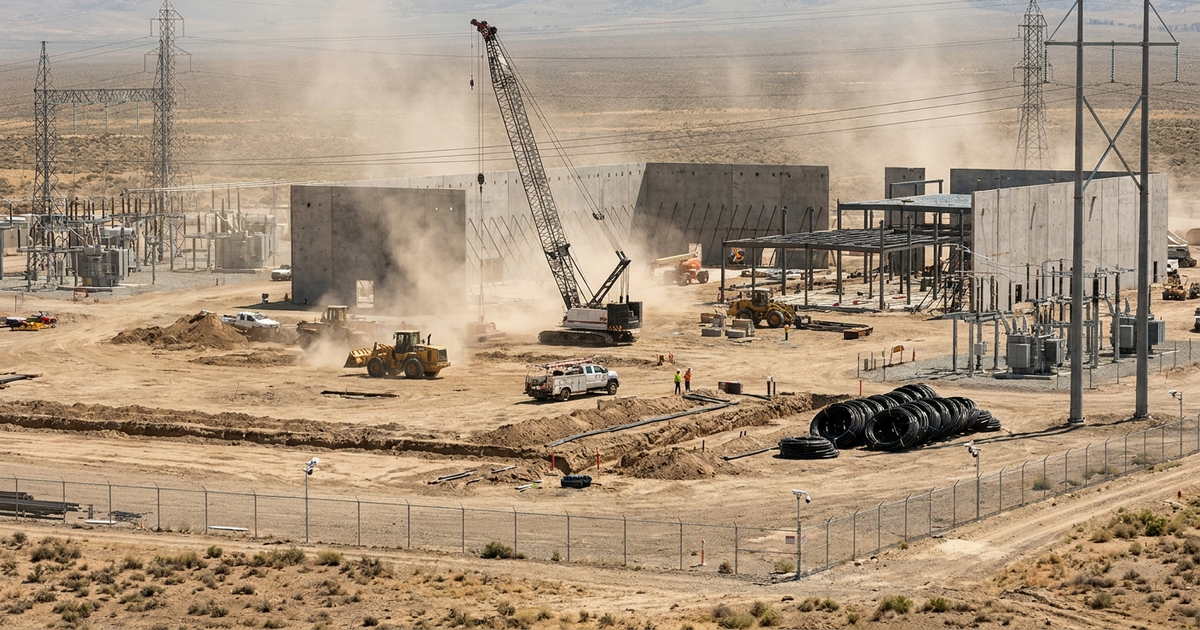
Fleet and Tract moved South Valley from finance story to construction story
Fleet Data Centers and Tract have made the Storey County, Nevada AI data-center build a live construction signal, not just a capital-markets headline. The project sits around South Valley / USA Parkway near the Reno-Tahoe Industrial Center, one of the Western U.S. locations where land, transmission, industrial zoning, and hyperscale demand are converging. For LVN, the important move is simple: a large AI campus is now far enough along that low-voltage contractors should be mapping the account before every specialty package is visible.
The owner-side source is Fleet Data Centers' financing release. Fleet described a 230 MW utility-capacity, 200 MW critical IT, turnkey data center and electrical substation on a Storey County property, fully leased to an unnamed AA- investment-grade tenant. Kirkland & Ellis also describes the Tract Capital transaction around a 230 MW utility / 200 MW critical IT project and the long-term lease structure.
The construction-start signal came through local coverage and Fleet's own public update. KOLO 8 News reported that Fleet and Tract broke ground on a roughly 2 million-square-foot South Valley data center with Governor Joe Lombardo, roughly 1,500 peak construction jobs, about 100 permanent jobs, and a closed-loop water narrative. Baxtel separately tracked the project as under construction outside Reno. Fleet's LinkedIn update adds the bigger account context: Fleet says the Reno campus represents more than $9 billion across two separate developments, 769 acres, and 400 MW of critical power, with operations expected to begin in Q4 2027.
| Item | Public detail | LVN read |
|---|---|---|
| Location | South Valley / USA Parkway, Storey County, Nevada | Reno-area industrial land, utility, and permit signals matter. |
| Focused project | 230 MW utility capacity / 200 MW critical IT | Large enough for major fiber, security, controls, and commissioning scope. |
| Broader site | Tract lists 1,534 acres and 1,215 MW capacity | South Valley is a powered-site platform, not a one-building story. |
| Construction jobs | About 1,500 peak construction jobs | Labor, safety, documentation, and site access will become real constraints. |
| Tenant | Unnamed AA- investment-grade tenant | Do not infer the customer until a primary source names it. |
Clark and NV Energy are the names that change the account map
The biggest new construction-side detail is Clark. Fleet's public update thanked "our general contractor Clark Construction Group" at the Reno campus groundbreaking. That matters because earlier public coverage named Fleet, Tract, the state, and the site, but did not give low-voltage vendors a clear construction lead to monitor. Clark's presence turns the project from a watch item into an account-mapping exercise: prequalification, package timing, vendor outreach, project management jobs, trade-partner signals, and document-control requirements.
A second useful source is S&P Global Ratings' presale analysis. S&P identifies Clark Construction Group as responsible for construction obligations and identifies Sierra Pacific Power Co., doing business as NV Energy, around the 345 kV extension line, Gosling substation, and grid connection. S&P also describes the data-center design as 20 data halls of 10 MW each. That is exactly the kind of detail that helps low-voltage teams think in phases instead of waiting for a vague campus announcement to turn into an RFP.
Tract's South Valley project page adds the powered-site layer: seven parcels, 1,534 total acres, 1,215 MW capacity, an on-site 525/345 kV substation, construction power available in 2025, and site energization targeted for September 2027. None of those details names a low-voltage subcontractor. They do show why the low-voltage timing will be tied to power, substation, sitework, pathway, and building turnover milestones.
| Company | Public role | Why to watch |
|---|---|---|
| Fleet Data Centers | Owner/operator/developer | Primary source for project, lease, campus, jobs, and hiring updates. |
| Tract / Tract Capital | Land and infrastructure platform | Controls the South Valley powered-site context and broader capacity story. |
| Clark Construction Group | General contractor | Best current construction-side path for packages, prequal, and trade partners. |
| Sierra Pacific Power / NV Energy | Utility and grid-connection party | Extension line, Gosling substation, power delivery, and energization timing. |
| Storey County / Nevada officials | Public-sector stakeholders | Permits, inspections, infrastructure, and economic-development signals. |
Where low voltage shows up
AI data centers create a large low-voltage surface area because the building is only one layer of the job. The exterior campus needs diverse fiber paths, duct banks, vaults, entrances, perimeter systems, cameras, access points, and coordination with utility work. Inside the facility, the work becomes pathways, data hall cabling, MMR and IDF coordination, security rooms, fire alarm interfaces, BAS/BMS controls, network integration, labeling, test records, closeout documentation, and commissioning discipline.
The current public sources do not name the electrical subcontractor, low-voltage contractor, fiber carrier, access-control integrator, CCTV integrator, fire alarm contractor, controls integrator, DAS vendor, or commissioning agent. That is normal at this stage. It also means the best move is to watch upstream signals: Clark project hiring, Fleet construction roles, NV Energy substation movement, Storey County permit activity, Tract site updates, and any supplier or trade-partner language around South Valley, Reno Campus, USA Parkway, SV RNO, PR RNO, or Fleet Data Centers.
| Scope | Why it matters | What to watch |
|---|---|---|
| Fiber / OSP | AI campuses need diverse, documented high-count fiber paths. | Carrier routes, duct banks, vaults, entrances, and test records. |
| Structured cabling | Data halls and support spaces require clean pathway and labeling discipline. | Tray, rack, row, IDF/MMR, QA, and turnover documentation. |
| Access control / CCTV | Single-tenant AI facilities are security-heavy from perimeter to data hall. | Security integrator, card access, VMS, cameras, and commissioning. |
| Fire alarm / life safety | Mission-critical fire systems interface with suppression and monitoring. | AHJ milestones, FA contractor, special inspections, and interfaces. |
| BAS/BMS controls | Cooling and electrical monitoring create controls and network dependencies. | Controls integrator, trend logs, alarms, and owner acceptance testing. |
| Grounding / commissioning | Hyperscale sites punish weak documentation and sloppy closeout. | Bonding checks, test sheets, punch lists, and Level 3-5 commissioning. |
The timing is phased, not one date
The useful contractor question is not "when is the campus done?" It is which enabling systems have to move first. Power and sitework usually lead. Fiber routes, diverse entrances, security perimeters, temporary construction networks, trailer connectivity, camera coverage, gate access, and documentation processes can show up well before data hall cabling is ready. Once the vertical build accelerates, the low-voltage workload shifts into room-by-room coordination, rough-in, pathways, device locations, backbone design, testing, owner standards, and punch-list control.
That phased view also helps reconcile the public dates. Tract lists construction power available in 2025 and site energization targeted for September 2027. Fleet's public update says broader Reno campus operations are expected to begin in Q4 2027. S&P describes contracted delivery and completion milestones tied to utility power, while also noting an acceleration path using behind-the-meter power. Those dates should not be treated as one clean finish line. They are separate clocks: site power, grid connection, building turnover, tenant fit-out, commissioning, and operations.
For low-voltage firms, this creates several entry points. The first is relationship and qualification: know the general contractor, watch the prequal path, and understand the owner's documentation expectations. The second is infrastructure intelligence: follow substation, line extension, civil, duct-bank, and carrier-route movement because they shape when OSP and entrance work becomes real. The third is package readiness: be ready with data-center references, safety records, manpower planning, testing capability, labeling standards, QA process, and closeout examples before a package hits the street.
The tenant still matters, but public sources have not named it. Fleet and S&P describe an investment-grade tenant with a market capitalization above $3 trillion. That is enough to understand the hyperscale seriousness of the project. It is not enough to claim a customer. LVN will keep the project tenant-agnostic until a primary source names the user, because guessing creates bad account intelligence.
Jobs, skills, and the contractor angle
KOLO's 1,500 peak construction-job figure is the workforce headline, but the practical LVN angle is skill density. A site like this rewards technicians who can work under a general contractor's documentation process, survive strict safety onboarding, test and label consistently, coordinate with electrical and mechanical trades, and close out work in a way the owner can operate years later.
For installers and supervisors, the relevant preparation is not abstract AI hype. It is fiber cleaning and testing, copper and fiber standards, lift and site safety, pathway coordination, grounding and bonding, device addressing, redlines, as-builts, QA photos, and commissioning support. Useful training paths include BICSI Installer 2, Optical Fiber, BICSI Installer 2, Copper, the FOA workforce resources, and OSHA outreach training. Those are not guarantees of work, but they line up with the discipline data-center contractors expect.
The near-term watchlist is practical. Monitor Clark for data-center project roles and trade-partner language. Monitor Fleet for construction management, MEP, operations, and commissioning hires. Monitor Tract and Storey County for site, permit, and infrastructure updates. Monitor NV Energy for substation and transmission milestones. Monitor public posts and supplier pages for the first named electrical, fiber, security, fire alarm, controls, DAS, network, grounding, and commissioning partners.
This is the reason LVN Signal is tracking AI data-center construction as a trade map. The opportunity is not only the headline investment number. It is the chain of companies, jobs, power milestones, low-voltage systems, and package timing that lets contractors see the project while the market is still forming.
Join 35,000+ Low Voltage Pros
Get weekly permit updates, tool deals, job opportunities, and industry news. No spam, unsubscribe anytime.