
Join Low Voltage Nation — Find project opportunities and showcase your company to thousands of industry professionals
Fit Energy plans a Pennsylvania campus with grid power and fuel cells. Review the zoning milestone, named organizations and prospective low-voltage work.
Fit Energy’s Newport Township proposal has reached a concrete early milestone: zoning permits covering 15 data-center structures and three gas generation facilities in Luzerne County, Pennsylvania. The developer now names FuelCell Energy as its planned fuel-cell supplier. For low-voltage firms, the opportunity is a large proposed campus whose utility arrangements, building designs and package buyers still need to become visible.
Fit Energy’s October 6 announcement says engineering and remaining permitting are underway ahead of construction. That establishes the appropriate reading of the project today: planned development with an identified developer and power partner. LVN has not verified a construction start, committed tenant, financing close, general contractor or awarded specialty trade package.
The project at a glance
| Item | Current evidence | What remains open |
|---|---|---|
| Location | Newport Township, Pennsylvania | Verified parcel entrance |
| Proposed campus | About 1,386 acres | Final development plan |
| Zoning permits | 15 data-center structures | Later construction approvals |
| Power facilities | Three in zoning record | Site capacity and design |
| Power approach | Grid plus natural gas fuel cells | Supply split and delivery |
| Budget | $35B reported application estimate | Original budget and funding |
| Construction timing | Planning and engineering | Start and completion dates |
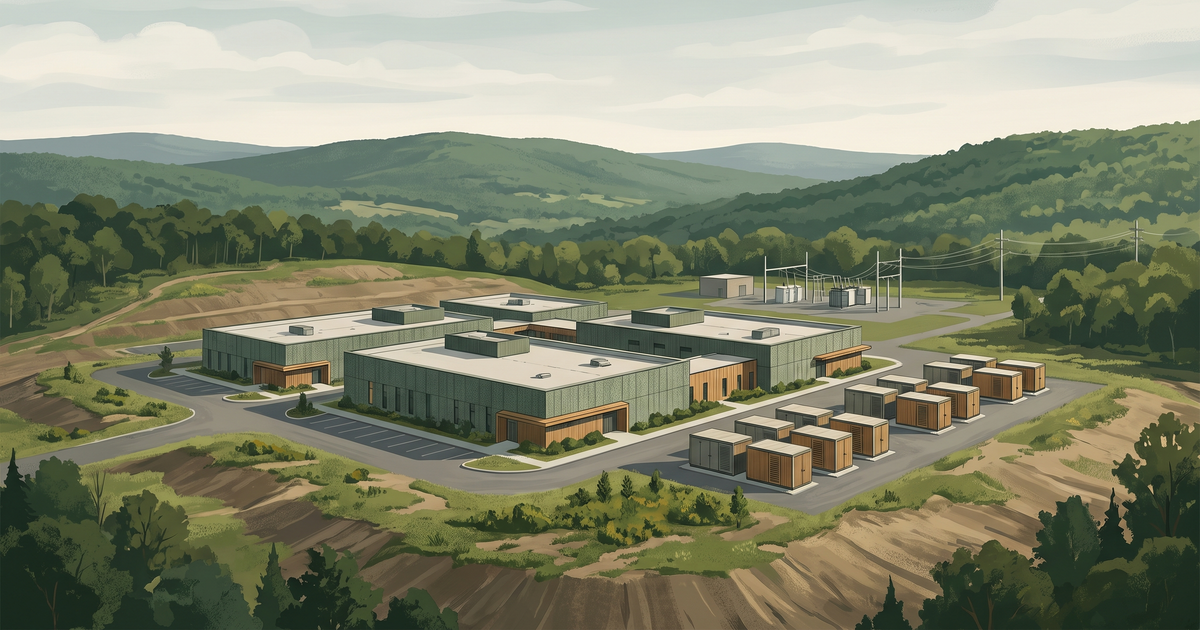
The acreage comes from the developer’s project website, which describes previously mined and quarried land. Its imagery is explicitly conceptual. Rendered buildings, landscaped grounds and workforce scenes should be read as illustrations of a proposal. They provide no evidence of installed equipment or present construction activity. The featured artwork accompanying this LVN report is also an AI-generated editorial concept, with no claim to reproduce the actual site plan.
What the township actually approved
The official September 8 meeting minutes, pages 5–6, record zoning permits issued August 10. The mixed-use zone accounts for seven data-center structures and two gas generation facilities; the industrial zone adds eight structures and one generation facility. Both entries include sign and exterior-fencing permits. The township’s public update independently confirms the August date.
The minutes also say the proposals remain subject to the township’s land-development process, with public review at each step. A zoning milestone therefore leaves substantial work before mobilization can be assumed. Contractors evaluating the lead should seek issued civil and building plans, utility delivery requirements, procurement contacts and a phase-specific schedule. Those documents turn broad development interest into a package that can be priced and staffed.
Community review is active. The October 5 draft minutes record residents raising concerns about the proposed data centers. The township’s meeting-record index distinguishes those draft minutes from September’s official record. Fit Energy says a Community Benefits Agreement is being developed and a public information session will be announced. An executed agreement and confirmed session date were not available in the reviewed material.
How to read the $35 billion figure
An October 8 Citizens’ Voice report, reproduced on the township website, attributes a $35 billion proposed construction estimate to zoning applications obtained through a public-records request. LVN has not independently inspected the original budget schedule. The number is an attributed proposal estimate; financing commitments, phase allocations and the division between campus and power work remain unverified.
The same reporting identifies Newport Aggregate Inc. as landowner and describes roughly 2,600 acres of broader holdings. That landholding figure has a different basis from the developer’s approximately 1,386-acre proposal. The report also uses ambiguous wording around 7.7 million square feet of land area. It is premature to present that as verified building floor area. Current parcel conveyance also remains unresolved.
These distinctions affect estimating. A campus-wide number cannot establish the value of cabling, security or controls work without knowing what it includes. Power plants, site reclamation, utility extensions, shells, cooling infrastructure and tenant equipment can sit under different buyers and budgets. Applying a fixed low-voltage percentage to the headline estimate would create unsupported precision. A useful commercial assessment begins with the issued scope, its exclusions and the organization buying that work.
Fuel-cell agreement capacity needs a site assignment
The proposed energy design combines utility-grid supply with on-site natural gas fuel cells. The project website says fuel cells would provide a portion of campus electricity. It does not establish the split, a delivered grid allocation or an overall Newport megawatt figure. No verified campus IT load or currently energized capacity is available.
FuelCell Energy’s June corporate announcement describes an agreement with Fit Energy for up to 380 MW, beginning with a 30 MW phase. Its delivery language is a forecast made at that time. Those figures describe the supplier relationship across potential deployments; the release does not assign that capacity to Newport.
The related SEC filing adds useful detail: after the initial phase, Fit can elect additional phases of 100, 125 and 125 MW. Site identification leads to separate commissioning and service agreements. Until a Newport allocation is documented, neither the 380 MW ceiling nor the initial 30 MW belongs in a Newport capacity claim.
For controls and networking firms, the practical question is responsibility at each interface. A prospective package may involve plant telemetry, facility monitoring, security networks and utility communication. The eventual design must identify who supplies equipment interfaces, who configures networks and who witnesses testing. Separate generation and data-building contractors can create coordination work even when the underlying communications hardware looks familiar. These are preparation questions, not evidence that any specific package has been released.
The organizations named so far
| Organization | Supported role | Boundary |
|---|---|---|
| Fit Energy | Developer | Construction buyer unconfirmed |
| FuelCell Energy | Planned fuel-cell supplier | Newport MW unconfirmed |
| Fit Ventures | Developer’s corporate backer | Project funding unverified |
| Newport Aggregate | Reported landowner | Current conveyance unverified |
| Newport Township | Zoning authority | Further review remains |
| BHW Construction Consultation Services | Municipal zoning services | No campus GC award established |
Fit Energy’s corporate page identifies Fit Ventures as its backer. That relationship supplies company context without establishing a Newport financing close. BHW appears through the township’s third-party zoning function. Its construction-related name should not be interpreted as a campus construction award. No GC, EPC, architect, engineer of record or low-voltage installer was confirmed by the reviewed sources.
Where low voltage could enter the project
The following opportunities are LVN’s assessment of a proposed multi-building data and power campus. They are prospective work categories. Final requirements depend on tenant needs, engineering, permitting and the contracting structure.
| Potential package | Likely coordination | Evidence to seek |
|---|---|---|
| Fiber and outside plant | Entrances, duct banks, diverse routes | Carrier and route drawings |
| Cabling and networks | Pathways, racks, labels, testing | Tenant layout and quantities |
| CCTV and access control | Gates, perimeter, equipment areas | Integrator and specifications |
| Fire and monitoring | Alarm interfaces and reporting | Approved design responsibilities |
| Controls and commissioning | Plant telemetry and integrated tests | Interface matrix and test plan |
Outside-plant planning deserves early attention because underground pathways interact with grading, roads, drainage and utilities. For a bidder, the useful questions concern route ownership, spare pathway requirements, separation between entrances and access for future maintenance. A large acreage claim gives no reliable cable quantity. Distances and crossing conditions must come from drawings and field information.
Inside buildings, estimators need to establish the boundary between base-building communications and tenant fit-out. A shell package may leave substantial network work for a later contract. Security and facility controls can require operational connectivity before tenant systems are commissioned. Clarifying that sequence helps crews plan temporary connections, testing access and turnover documentation without assuming a simultaneous campus-wide opening.
Quality documentation is another useful preparation area. Fiber crews can organize inspection, cleaning, labeling and test-record workflows. Controls and security firms can prepare device schedules, network addressing records and interface checklists. These are general capabilities a contractor can demonstrate now; Newport-specific acceptance criteria, equipment selections and certification requirements have not been published in the sources reviewed.
Jobs, trades and practical preparation
Fit Energy anticipates construction employment across a multiyear buildout and later skilled operating roles. Its announcement names operations, maintenance, security, facility management and technology. It supplies no verified job count or current hiring roster. Regional employment potential should therefore remain qualitative until employers, packages and actual openings are identified.
For technicians, the Fiber Optic Association’s workforce resources provide a starting point for fiber training. The OSHA Outreach program provides general safety-training information. Neither link establishes a Newport hiring partnership or a project-specific credential mandate. Relevant preparation also includes pathway coordination, grounding and bonding awareness, safe equipment access, clear test records and disciplined handoff between installation and commissioning teams.
The next documents that would change the opportunity
The most useful next evidence is an issued development package identifying parcels, buildings and phases; documented utility and gas arrangements; a Newport-specific generation allocation; and the named construction manager or general contractor. A confirmed tenant and financing close would clarify delivery priorities. Released bid packages would finally establish scope, purchasing authority, schedule and qualification requirements.
Until those appear, Newport is a development lead to research and qualify. Firms can prepare their relevant project experience, test capabilities and prequalification materials while following the public review. They should reserve staffing and revenue assumptions for a documented procurement opportunity.
Follow the project with LVN Signal. Use the linked source records to understand the milestone, identify the organizations involved and assess where your trade could fit as design and procurement become clearer.
Join 35,000+ Low Voltage Pros
Get weekly permit updates, tool deals, job opportunities, and industry news. No spam, unsubscribe anytime.