
Join Low Voltage Nation — Find project opportunities and showcase your company to thousands of industry professionals
Energy Vault and Crusoe have started Snyder AI with an 8MW first phase, a 25MW expansion path, and a broader 500MW modular campus plan.
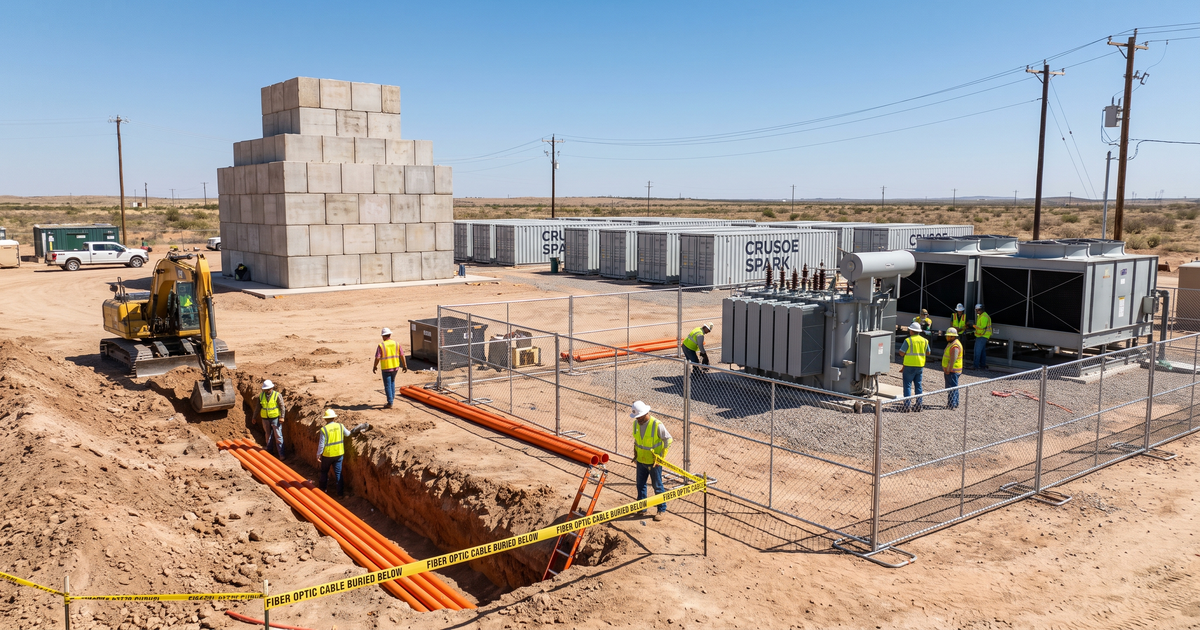
Energy Vault and Crusoe have started a compact but consequential AI infrastructure build in Snyder, Texas. The July 27 project announcement says construction is underway on fiber, site preparation, power infrastructure, and enabling works for the Snyder AI campus at 9301 Camp Springs Road.
The first phase is designed for 8MW of powered-shell capacity and targets commercial operation in the first quarter of 2027. A second phase can expand the deployment to 25MW. Energy Vault also describes a broader modular campus plan that can scale to 500MW. Those are three different capacity markers and should not be collapsed into one number.
The project is built around ten Crusoe Spark modular data centers. Under the announced structure, Energy Vault will buy the modules and lease them back to Crusoe as powered-shell infrastructure. Crusoe describes Spark as an integrated modular AI data center with power, cooling, remote monitoring, fire suppression, and GPU-ready racks.
| Project fact | Source-backed detail | LVN read |
|---|---|---|
| Current stage | Construction underway | Fiber, site preparation, power, and enabling work have started. |
| Phase 1 | 8MW powered shell | Initial commercial operation targeted for Q1 2027. |
| Phase 2 | Up to 25MW | Expansion path after the initial deployment. |
| Campus plan | Up to 500MW | Broader planned capacity, not current delivered IT load. |
| Delivery model | Ten Crusoe Spark modules | Energy Vault buys and leases powered-shell modules to Crusoe. |
| Construction team | Not separately disclosed | GC, engineer, electrical, and specialty packages remain open watch items. |
The Energy Vault-Crusoe framework agreement provides the commercial foundation. It ties Energy Vault's infrastructure ownership and financing model to Crusoe's modular AI factory platform. The Snyder deployment is the first visible project under that relationship, giving contractors a real site and schedule rather than a generic corporate partnership.
Energy Vault's public-company filing adds another layer of accountability around the relationship and execution path. Public filings do not replace construction permits, but they help confirm that the arrangement is material enough to appear in corporate reporting. They also provide a useful lane for future phase, financing, and delivery updates.
Crusoe's Spark Factory expansion announcement explains how the modular strategy can compress schedules. Factory assembly moves repeatable data-center systems into a controlled manufacturing environment. Field work then concentrates on site utilities, foundations and placement, electrical distribution, fiber, network handoff, security, fire interfaces, grounding, testing, and integrated commissioning.
That factory-built approach does not eliminate low-voltage work. It changes the boundary. Some racks, monitoring, fire suppression, cooling controls, and internal systems arrive as part of the module. The site still needs carrier connectivity, outside plant, campus pathways, module-to-module links, operational networks, perimeter systems, owner integrations, alarms, documentation, and turnover.
| Company / agency | Source-backed role | Evidence |
|---|---|---|
| Energy Vault | Developer and powered-shell owner | Groundbreaking release |
| Crusoe | AI data-center operator and modular vendor | Spark platform |
| Crusoe Cloud | Compute operator / offtaker context | Project announcement |
| City of Snyder | Local jurisdiction | Location confirmation |
| SEC | Public-company filing authority | Energy Vault filing |
Secondary project profiles help orient the site but should remain subordinate to owner sources. Data Center Map lists Crusoe Snyder, while POWER Magazine reports the groundbreaking and phased capacity. LVN uses those sources for context, not to add contractors, capacity, or timelines that the owner record does not support.
The contractor stance remains conservative. Reviewed sources do not name a separate general contractor, EPC, EPCM, architect, engineer of record, electrical contractor, low-voltage integrator, fiber or outside-plant contractor, structured-cabling firm, security integrator, fire alarm contractor, controls integrator, DAS contractor, grounding contractor, or commissioning authority.
That absence is commercially important. Construction is active and the Q1 2027 target creates a short delivery window. If specialty firms are already assigned, the awards have not yet surfaced publicly. If they are not, the current phase is exactly when contractor portfolios, job postings, permit records, supplier pages, and local construction activity can reveal the team.
| Low-voltage lane | Why it matters | Watch signal |
|---|---|---|
| Fiber / OSP | Carrier entrances, campus backbone, module links, and diverse paths | Duct banks, handholes, splice packages, carrier notices, and OTDR requirements. |
| Structured cabling | Operations, controls, support spaces, and module handoff | Copper/fiber standards, pathways, labeling, testing, and closeout packages. |
| Security | Perimeter, gates, module access, visitors, and critical infrastructure | Access control, CCTV, intercom, badging, and SOC integration awards. |
| Fire alarm | Factory systems still require site and AHJ coordination | Alarm interfaces, monitoring, acceptance testing, and suppression coordination. |
| BMS / EPMS | Power, cooling, telemetry, alarms, and remote operations | Point lists, controls networks, API boundaries, and sequence testing. |
| Commissioning | Fast modular deployment depends on verified integrated turnover | CxA award, scripts, witness tests, punch closure, and as-built requirements. |
Fiber is the most immediate source-backed low-voltage signal because Energy Vault says installation is already underway. Public sources do not identify the carrier, fiber owner, route, OSP contractor, splice contractor, or testing firm. Contractors should watch local permits, utility crossings, carrier maps, construction notices, and company hiring for those names.
The modular layout raises a practical network question: where does factory scope stop and site scope begin? Each Spark module may arrive with internal network and monitoring components, but the campus still needs resilient external connectivity, secure management access, time synchronization, telemetry transport, operational segmentation, and clean handoff to Crusoe Cloud.
Controls integration is another high-value boundary. Power, cooling, remote monitoring, fire suppression, rack systems, site electrical equipment, alarms, security, and owner dashboards must operate as one environment. The public sources describe the integrated product but do not name the BMS, EPMS, DCIM, SCADA, controls platform, network integrator, or cybersecurity responsibility matrix.
Fire and life-safety coordination will have both factory and field components. Modular equipment can arrive with internal suppression and detection, but site alarm reporting, monitoring, emergency power interfaces, jurisdictional review, acceptance testing, and documentation still need a complete project-level solution. The local authority having jurisdiction and package holder remain unconfirmed.
Security is similarly split. The campus needs perimeter fencing, gates, vehicle controls, video surveillance, visitor processing, credentialing, and protected operations access. The modules need their own access and monitoring. A clean design must reconcile factory-installed devices with the campus security platform and Crusoe's operational standards.
Grounding and bonding deserve early attention because modular delivery creates repeatable interfaces between factory-built equipment and field-installed power, pathways, racks, communications, and lightning protection. Inspection and turnover should verify continuity, bonding, labeling, test results, and the responsibility boundary for each module.
Commissioning may be the schedule's hardest integration point. The initial commercial-operation target is only months away. Factory acceptance, shipping, site acceptance, utility readiness, power quality, network validation, controls point-to-point testing, alarm verification, failover, thermal performance, fire interfaces, security, documentation, and operator training must converge.
For technicians and subcontractors, useful preparation includes OSHA and mission-critical safety readiness, fiber cleaning and inspection, fusion splicing, OTDR and optical-loss testing, copper certification, pathway coordination, grounding and bonding, controls testing, access-control and VMS commissioning, fire alarm acceptance support, redlines, asset labeling, and disciplined digital closeout.
Prequalification materials should be ready now: insurance, bonding, EMR and safety metrics, workforce counts, service territory, data-center or industrial references, QA/QC plans, testing equipment, manufacturer certifications, field supervision, scheduling capability, submittal workflow, commissioning experience, and example turnover packages.
The capacity language must remain precise. Eight megawatts is the initial powered-shell phase. Twenty-five megawatts is the stated second-phase expansion path. Five hundred megawatts is the broader planned Snyder campus capacity. None of those figures should be presented as a currently delivered building-level critical IT load.
The project cost is also unknown. Reviewed owner, filing, product, and trade sources do not disclose Snyder-specific construction capex. A leaseback structure and modular equipment count are not enough to calculate a defensible project value or low-voltage contract value. LVN will leave those fields open until a primary record provides them.
Job counts remain undisclosed as well. Construction activity and factory manufacturing clearly create labor demand, but reviewed sources do not provide Snyder-specific construction employment or permanent operating headcount. Hiring pages and local workforce notices may become useful evidence as installation accelerates.
The practical watch list is focused: Energy Vault and Crusoe releases, SEC filings, City of Snyder and Scurry County records, ERCOT and utility activity, local permits, fiber construction, equipment delivery, crane and site activity, contractor portfolios, plan rooms, supplier registration, job postings, and commissioning milestones.
Alias control will keep Signal clean. Track Snyder AI, Energy Vault Snyder AI, Crusoe Snyder, Crusoe Spark Snyder, Energy Vault technology center, 9301 Camp Springs Road, and Snyder modular AI campus. Keep this project distinct from Crusoe and Lancium developments in Abilene and Childress and from other West Texas AI infrastructure projects.
The business-development angle is legitimate without overstating procurement. LVN now has a source-backed construction record for the owner, operator, modular platform, location, active work, capacity phases, and commercial-operation target. Energy Vault, Crusoe, contractors, suppliers, and local partners can correct the record, claim profiles, share verified package or hiring information, or sponsor continued coverage.
Bottom line: Snyder AI is a high-confidence construction watch because work has started and the first operating deadline is close. The modular platform compresses deployment, but it still creates real site demand for fiber, OSP, controls, security, fire interfaces, grounding, testing, documentation, and commissioning. The missing contractor roster is the next source-backed layer LVN will track.
Join 35,000+ Low Voltage Pros
Get weekly permit updates, tool deals, job opportunities, and industry news. No spam, unsubscribe anytime.