
Join Low Voltage Nation — Find project opportunities and showcase your company to thousands of industry professionals
Edged Energy-Austin has a $2.8B TDLR filing, a $7.3B Caldwell County improvement signal, MG2 as design firm, and early low-voltage watch items.
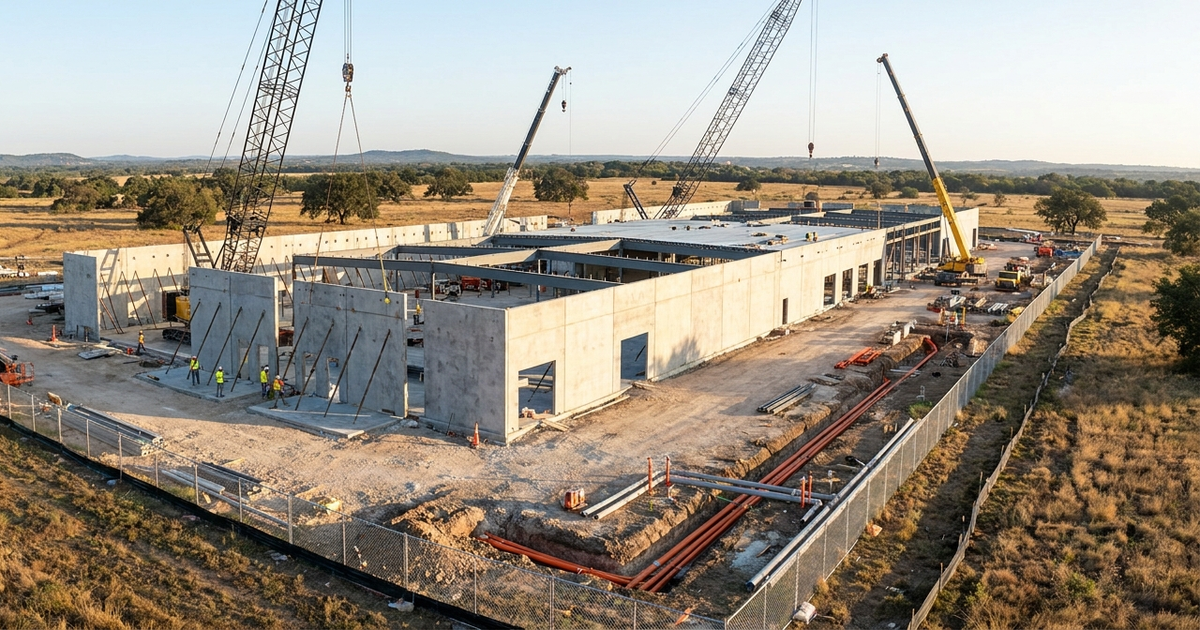
Edged Energy-Austin is the newest Caldwell County AI data-center construction signal worth tracking because the project is now visible in both state and county records. The Texas Department of Licensing and Regulation project record TABS2026019322 lists Edged Energy-Austin at 11255 Hwy 142 in Maxwell, Texas, with a privately funded $2.8 billion new-construction data-center building. The filing shows a June 1, 2026 start date, a June 30, 2028 completion date, 869,684 square feet, Capital Land Investments I LP as the owner in the TDLR record, and MG2 Architecture Corporation as the design firm.
The county side of the record makes the opportunity larger than a single permit line. In its March 26, 2026 Commissioners Court recap, Caldwell County says commissioners approved a Chapter 312 tax abatement agreement with EDC Austin LLC for a turnkey data center that would be owned and operated by Edged Energy. The same county recap places the site on about 330 acres off SH 142 near the LCRA Timmerman Powerplant in the Maxwell area and says total improvements are projected at $7.3 billion. For LVN readers, that combination matters: the state record gives a building, address, schedule, square footage, and design firm, while the county record points to the broader campus economics and owner/operator context.
| Project Fact | Source-Backed Detail | LVN Read |
|---|---|---|
| Location | 11255 Hwy 142, Maxwell, Caldwell County, Texas. | Central Texas data-center corridor, distinct from Lockhart, Bastrop, and San Marcos projects. |
| First building | TDLR lists 869,684 sq ft of ground-up data-center construction. | Large enough for major pathways, security, life-safety, controls, and commissioning scope. |
| Schedule | TDLR lists June 2026 start and June 2028 completion. | Early enough for prequal, bid-list, permit, utility, and package tracking. |
| Investment | $2.8B in the TDLR filing; county recap says $7.3B projected total improvements. | Owner/county evidence supports a serious campus watch item, not a vague rumor. |
| Status | Planned / review complete in public records. | GC and specialty trade names remain the next public-evidence gap. |
The Caldwell County tax abatement agreement adds another useful detail: the project is described as a turn-key data center campus inside Caldwell 142 Reinvestment Zone #1. The agreement ties the abatement economics to operation of the facilities as a data-center campus, substantial completion, water-use limits, PILOT payments, and job and salary targets. The jobs table in the agreement starts with 30 target full-time equivalent jobs in the first abatement year and 50 target full-time equivalent jobs in years two through ten, with a $67,500 target average annual salary. That is an operating-jobs covenant, not a construction labor count. Construction job counts and named specialty subcontractors were not disclosed in the sources reviewed for this publish run.
That jobs language is still useful for contractors because it helps frame the handoff from construction to operations. A campus with operating job targets needs turnover packages that can survive owner review, tenant review, commissioning, maintenance, and later troubleshooting. Low-voltage crews should expect documentation to matter: as-builts, test results, labeling schedules, device maps, fiber records, OSP route details, rack and room naming, change logs, and commissioning punch lists. The project is early, so none of those scopes should be treated as awarded. But the size of the first building and the county agreement both point toward mission-critical standards rather than generic warehouse work.
Data Center Dynamics' May 2026 coverage connects the TDLR filing and county abatement trail to Edged Austin and reports that the full buildout could exceed 2 million square feet across two buildings. That is useful secondary context, but the public record still needs to drive the contractor stance. TDLR names MG2 Architecture Corporation as design firm. The county recap names EDC Austin LLC and Edged Energy. Reviewed owner/public records do not yet name a general contractor, EPCM, electrical contractor, low-voltage contractor, fiber vendor, security integrator, fire alarm contractor, BAS/BMS controls contractor, DAS provider, network integrator, grounding contractor, or commissioning firm.
| Entity | Source-Backed Role | Evidence |
|---|---|---|
| Edged Energy / Edged U.S. | Owner/operator context in county record. | Caldwell County recap and Edged company site. |
| EDC Austin LLC | Tax-abatement agreement party and owner entity in the county agreement. | Caldwell County agreement PDF. |
| Capital Land Investments I LP | Owner listed in the TDLR project record. | TDLR TABS2026019322. |
| MG2 Architecture Corporation | Design firm listed in the TDLR record. | TDLR record and MG2 data-center portfolio context. |
| Caldwell County / TDLR | County tax-abatement and state accessibility record sources. | County recap, agreement PDF, and TDLR filing. |
| Endeavour | Parent-company context for Edged in secondary coverage. | DCD coverage; monitor only. |
The owner names should not be flattened into one simple label. TDLR lists Capital Land Investments I LP as owner. Caldwell County's recap ties the planned turnkey data center to EDC Austin LLC and says it would be owned and operated by Edged Energy. The tax agreement is between Caldwell County and EDC Austin LLC. DCD gives additional Edged/Endeavour context. That mix is common in data-center development, where land, tax, development, operating, tenant, and parent-company names can differ. For outreach and tracking, use the public entity names carefully and keep each one tied to the source that actually names it.
The power context deserves the same restraint. The county recap says the site is near the LCRA Timmerman Powerplant, and DCD describes that plant as a natural-gas peaker. That proximity is a watch item, not proof of a final interconnection, power-purchase structure, substation package, or generator plan for the data center. The useful public trail is still ahead: TCEQ air records, utility filings, interconnection records, county meetings, site plans, and contractor postings. Power and cooling choices will affect low-voltage timing because pathways, controls, monitoring, security, and commissioning all depend on the final facility layout.
The low-voltage opportunity is still early, which is exactly when Signal-style tracking is most useful. A nearly 870,000-square-foot first building with data halls and an administrative area usually means layered work around campus entrances, carrier routes, structured cabling, fiber testing, access control, video surveillance, fire alarm interfaces, BAS/BMS controls, network coordination, DAS or public-safety coverage, grounding and bonding, labeling, turnover documentation, and commissioning support. The caveat is important: those scopes are practical data-center watch zones, not confirmed subcontract awards. Until public sources name package holders, the right move is to monitor permits, plan rooms, job postings, utility records, and owner/architect/contractor pages.
| LV System | Why It Matters | Public Signal To Watch |
|---|---|---|
| Fiber / OSP | Large campuses need diverse entrances, carrier paths, vaults, and tested backbone routes. | Carrier, conduit, utility, civil, and fiber-contractor filings. |
| Structured cabling | Data halls and admin areas need disciplined pathways, labeling, and test documentation. | Tenant fit-out records, rack/row scope, tray packages, and QA roles. |
| Access control / CCTV | Data centers require perimeter, building, loading, admin, and secure-area coverage. | Security integrator awards, device schedules, and commissioning jobs. |
| Fire alarm | Life-safety systems have to coordinate with suppression, monitoring, and AHJ inspections. | Fire alarm permits, inspection milestones, and specialty contractor names. |
| BAS/BMS controls | Cooling, alarms, monitoring, and facility systems depend on controls integration. | Controls integrator roles, commissioning specs, and turnover requirements. |
| DAS / networking | Large hardened buildings often need wireless coverage and IT/OT network coordination. | DAS design, carrier coordination, network integrator, and public-safety requirements. |
| Grounding / bonding | Pathways, telecom rooms, racks, equipment, and electrical coordination need clean bonding. | Electrical coordination notes, QA checklists, and commissioning documentation. |
For technicians and small contractors, the skill signal is straightforward. Data-center work rewards crews that can operate under access control, follow safety onboarding, keep test equipment calibrated, document every run, label consistently, work cleanly around electrical and mechanical systems, and close punch-list items without drama. Fiber cleaning and inspection, OT network awareness, grounding discipline, cable tray and pathway coordination, fire alarm interface coordination, BAS/BMS point coordination, and commissioning support all become more valuable as the site moves from shell to fit-out and turnover. The crews that can prove that discipline before bid day are better positioned than crews that wait for a public grand opening.
There is also a timing lesson in the TDLR date range. A June 2026 start and June 2028 completion window does not mean every low-voltage package is ready today. It means the project is entering the public construction record while many downstream scopes may still be forming. Early months can be dominated by site, civil, shell, utilities, power, and long-lead coordination. Low-voltage firms should use this period to map owner names, design names, county aliases, permit IDs, and likely future bid channels. When the first visible specialty package or job posting appears, the project will already have a source trail.
For contractors, the practical next step is not to spam the owner. It is to build a source-backed watch list. Monitor TDLR/TABS updates, Caldwell County agendas and minutes, Maxwell and Lockhart-area permit activity, Edged U.S., MG2, EDC Austin LLC, TCEQ air or generator records, LCRA/Timmerman-area utility context, and public job postings. The aliases matter too: Edged Energy-Austin, Edged Austin, Edged Energy Maxwell, EDC Austin LLC, 11255 Hwy 142, SH 142 Maxwell, Caldwell 142 Reinvestment Zone #1, TABS2026019322, Capital Land Investments I LP, and Maxwell/Caldwell County data center.
Keep this project separate from other Central Texas data-center builds. Prime AUS01/AUS02 in Lockhart, PowerHouse Uhland, Tract Caldwell Valley, CloudBurst San Marcos, EdgeConneX Bastrop, and Edged Dallas/Fort Worth are different project families. Edged Austin is its own Maxwell/Caldwell County signal. LVN Signal will be most useful here when it catches the next public layer: the general contractor, utility/substation milestone, electrical package, fiber or OSP path, security/fire alarm/BAS awards, commissioning movement, or first credible job-posting trail tied to the site.
Join 35,000+ Low Voltage Pros
Get weekly permit updates, tool deals, job opportunities, and industry news. No spam, unsubscribe anytime.