Join Low Voltage Nation — Find project opportunities and showcase your company to thousands of industry professionals
Edged ATL01-3 has topped out in Atlanta, opening a source-backed watch window for fiber, security, fire alarm, controls, networking, and commissioning.
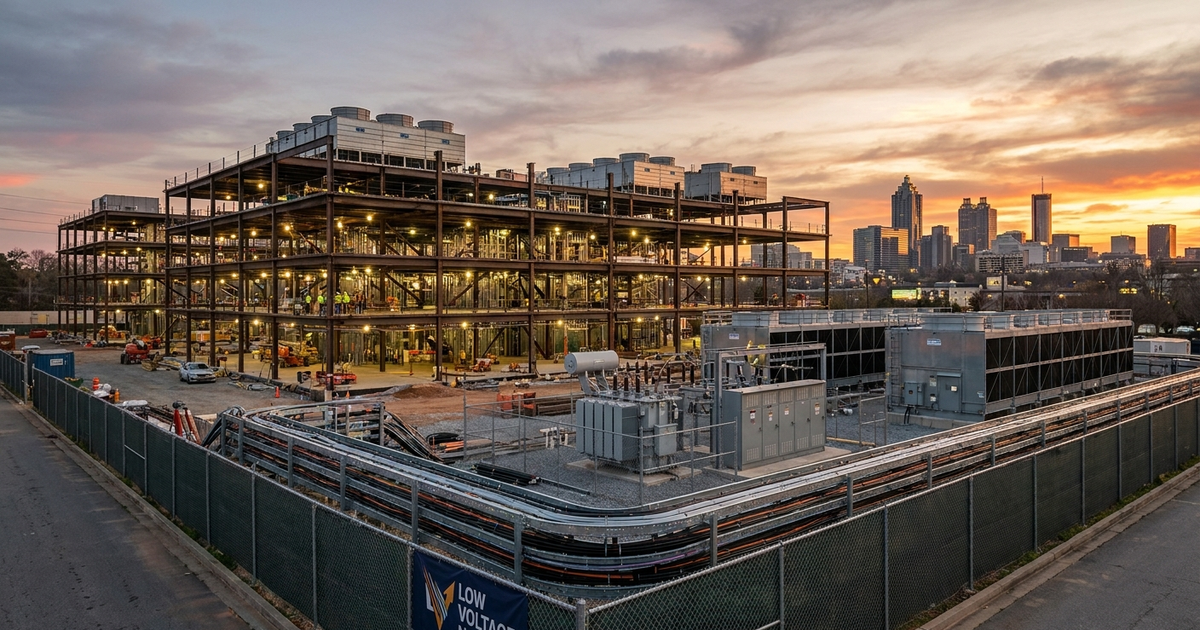
Edged Atlanta ATL01-3 is the kind of AI data-center signal that matters after the headline phase. Edged US says the third facility at its Atlanta campus has topped out, after completion of the building's structural framework. The same announcement describes a 42 MW facility optimized for AI training and inference, able to support ultra-high-density workloads, and expected to be operational in early 2027. For LVN readers, that moves the account from broad development news into the period where MEP, low-voltage, controls, security, fire alarm, network, fiber, and commissioning signals become more useful.
The project sits at Edged's Atlanta campus at 1740 Thomas Street NW. Edged lists the broader campus at 169 MW of critical capacity across more than 80 acres, with ATL01-03 identified as a 42 MW building. The campus page also points directly to low-voltage and facility-systems work: multiple fiber providers, four diverse points of entry, two meet-me rooms, N+1 UPS and generation, redundant A/B power distribution, biometric access, badging, CCTV, fencing, access gates, pre-action fire protection, smoke detection, DCIM, waterless cooling, and revenue-grade metering. Those details are not a named subcontract award, but they define the systems that will need design coordination, installation discipline, testing, labeling, and closeout.
The current topping-out announcement is valuable because Edged names more of the team than many AI infrastructure announcements do. Edged names Brasfield & Gorrie as builder, MG2 and Bala Consulting Engineers as design partners, ThermalWorks as cooling supplier, and PowerSecure as power supplier. Older Edged construction-start context also ties the Atlanta campus to Endeavour, TPA Group, and Georgia Power collaboration. That gives contractors a source-backed account map without overstating what has been awarded.
Project Snapshot
| Item | Public Evidence | LVN Takeaway |
|---|---|---|
| Project | Edged ATL01-3 at 1740 Thomas Street NW in Atlanta. | Third facility on Edged's AI-ready Atlanta campus. |
| Capacity | 42 MW for ATL01-3; 169 MW across the broader campus. | Large enough to support meaningful fiber, security, controls, network, and commissioning scope. |
| Stage | Structural framework topped out in April 2026. | The next public clues should come from MEP, system integration, inspection, energization, and turnover activity. |
| Operations target | Edged expects ATL01-3 to be operational in early 2027. | That creates a defined window for systems completion and commissioning signals. |
| AI workload fit | Edged says the building supports 400+ kW per rack with liquid cooling and 120+ kW per rack with air cooling. | High-density environments raise the bar for controls, power coordination, monitoring, documentation, and commissioning. |
Project-specific ATL01-3 construction value and square footage were not found in the reviewed sources. ThermalWorks and Edged's broader campus launch context described a $1.69 billion regional economic investment and hundreds of jobs for the Atlanta campus, but that should not be treated as the cost or job count for ATL01-3 alone. The clean source-backed facts are the topping-out milestone, the 42 MW facility capacity, the campus systems context, the early 2027 operating target, and the named builder, design, cooling, and power partners.
Named Companies And Roles
| Company | Source-Backed Role | Evidence |
|---|---|---|
| Edged US | Owner/operator/developer for the Atlanta campus. | Campus page and topping-out release. |
| Endeavour | Parent infrastructure platform context. | Edged construction-start and topping-out context. |
| Brasfield & Gorrie | Builder for ATL01-3. | Edged topping-out release. |
| MG2 | Architecture/design partner. | MG2 data centers page. |
| Bala Consulting Engineers | Design partner and engineering/commissioning context. | Bala mission critical page. |
| ThermalWorks | Cooling supplier. | ThermalWorks Atlanta page. |
| PowerSecure | Power supplier. | PowerSecure Atlanta page. |
| Georgia Power / TPA Group | Utility and real-estate development context for the broader campus. | Edged construction-start context. |
The contractor stance should stay conservative. Reviewed sources do not name the electrical contractor, low-voltage contractor, fiber/OSP contractor, structured cabling contractor, access-control or CCTV integrator, fire alarm contractor, BMS/BAS controls integrator, DAS/networking contractor, grounding and bonding team, or commissioning agent. Brasfield & Gorrie is source-backed as builder. MG2 and Bala are source-backed as design partners. ThermalWorks and PowerSecure are source-backed suppliers. Specialty scopes remain open until a public record, company page, permit, job posting, or announcement names the firm and role.
That open specialty layer is exactly why ATL01-3 is useful to track now. Topping out usually means a project is moving closer to the systems-heavy phase, but it does not prove that every low-voltage package is public. The useful evidence often appears in small fragments: subcontractor prequalification, hiring posts, permit descriptions, inspection records, utility or energization notes, vendor case studies, owner operations updates, and commissioning language. Each clue should be matched against the project aliases before treating it as a confirmed package.
Where Low Voltage Shows Up
| Scope | Source Context | Evidence To Watch |
|---|---|---|
| Fiber / OSP | Campus page lists multiple fiber providers, four diverse entries, and two meet-me rooms. | Carrier clues, conduit/vault permits, MMR work, OSP routes, fiber testing, and closeout records. |
| Structured cabling | High-density AI halls need clean pathways, labeling, test results, and documentation. | Cable tray, rack/row buildout, copper/fiber test reports, labels, and QA signoff. |
| Security systems | Edged lists biometrics, badges, CCTV, fencing, gates, and layered security. | Access-control, VMS, camera, perimeter, gate, badging, and security-integrator signals. |
| Fire alarm / life safety | Campus page names pre-action fire protection and smoke detection. | Fire alarm permits, monitoring, suppression interfaces, special inspections, and AHJ signoff. |
| BMS / BAS controls | Waterless cooling, high-density racks, DCIM, power monitoring, and metering require controls discipline. | Controls integrator roles, alarm routing, trend logs, sequence docs, and commissioning scripts. |
| DAS / networking | Large secure buildings require facility networks and may require public-safety radio coverage. | DAS design, public-safety coverage checks, facility VLANs, IT/OT boundaries, and acceptance testing. |
| Grounding / bonding | Telecom rooms, racks, pathways, and equipment spaces need clean bonding coordination. | Grounding tests, telecom bonding records, pathway inspections, and electrical coordination. |
The skills angle is practical. A project like ATL01-3 rewards crews that can work inside mission-critical site rules: badging, orientation, lift discipline, housekeeping, documentation, and clean handoff. Fiber crews need OTDR and power-meter discipline, clean end faces, labeling, pathway coordination, and as-built documentation. Structured cabling teams need pathway awareness and test records that survive QA. Security integrators need device schedules, door hardware coordination, camera placement, VMS planning, and commissioning evidence. Fire alarm teams need clean interfaces with suppression and monitoring. BAS/BMS teams need equipment network awareness, alarm routing, trend logs, and turnover documentation. Grounding and bonding work has to line up with electrical coordination and telecom-space standards.
Training paths that fit this type of work include BICSI Installer 2, Optical Fiber, BICSI Installer 2, Copper, BICSI face-to-face training, FOA fiber workforce training, and OSHA outreach training. Certifications are not a substitute for project access or prequalification, but they help techs and contractors speak the language of testing, safety, documentation, and mission-critical quality control.
The power and cooling context also matters for low-voltage firms because it shapes how the facility will be monitored and turned over. Edged's campus page points to redundant A/B distribution, N+1 UPS and generation, revenue-grade metering, DCIM, and waterless cooling. PowerSecure describes its Atlanta collaboration around critical electrical and mechanical systems, PowerBlocks, backup generation, medium-voltage distribution, and microgrid connectivity. ThermalWorks describes the Atlanta campus as using ultra-efficient waterless cooling. None of that names a low-voltage subcontractor, but it does show the environment where controls networks, alarm routing, metering data, monitoring points, cable pathways, grounding, and commissioning evidence have to be clean.
There is a labor-market angle here even without an ATL01-3-specific headcount. The broader Edged Atlanta campus has been described as a major regional investment, and the current facility is a high-density AI building with a defined early 2027 operations target. That means contractors should expect pressure around schedule, documentation, safety, QA, and closeout. The winning firms on these projects are rarely just the cheapest installers. They are the teams that can coordinate with electrical, mechanical, security, fire protection, controls, IT, commissioning, and owner operations without creating field chaos.
For vendors, this is a good account to qualify by role. A fiber contractor should look for OSP route work, carrier entrance language, meet-me-room scopes, and test documentation. A security integrator should look for door hardware, badging, biometrics, VMS, camera counts, perimeter systems, and command-center language. A fire alarm contractor should look for pre-action interfaces, smoke detection, monitoring, inspection, and AHJ activity. A BAS/BMS controls firm should look for cooling and power equipment integration, alarm routing, sequence documents, and commissioning checklists. A DAS or networking firm should look for public-safety radio requirements, facility network segmentation, and IT/OT coordination.
The public evidence is strong enough to justify tracking, but not strong enough to fill in every trade name. That distinction is important. When a project names the builder and technology suppliers but not the low-voltage layer, the right move is not to invent the missing firms. The right move is to watch the named team, the address, the permit trail, the utility and power suppliers, the campus aliases, and the workforce language until the specialty scopes surface.
The naming discipline matters. Track Edged Atlanta, ATL01-3, ATL01-03, Edged ATL3, 1740 Thomas Street NW, Tilford Yard, Marietta Road, Edged Energy, Endeavour, ThermalWorks, and PowerSecure. Keep ATL01-3 distinct from Edged ATL01-1, ATL01-2, older campus-opening coverage, Edged Chicago ORD01-2, and unrelated Georgia data-center proposals. The project is active, but source-backed specialty package names are still the prize.
For contractors and vendors, the next move is account mapping. Watch Edged, Brasfield & Gorrie, MG2, Bala, ThermalWorks, PowerSecure, Georgia Power, the City of Atlanta, Fulton County or Develop Fulton records, and local permit or inspection systems. Look for MEP package references, low-voltage language, electrical room and pathway milestones, fiber routes, security and fire alarm permits, BMS/BAS controls work, DAS/networking requirements, grounding documentation, energization, and commissioning. LVN Signal is tracking this category so the trade can see the owner, builder, design partners, suppliers, systems, skills, and missing package names before the opportunity is obvious to everyone else.
Join 35,000+ Low Voltage Pros
Get weekly permit updates, tool deals, job opportunities, and industry news. No spam, unsubscribe anytime.