
Join Low Voltage Nation — Find project opportunities and showcase your company to thousands of industry professionals
Two Cedar Creek filings list $1.4B and Gensler as designer. Explore the named firms, planned schedule and potential fiber, security and controls work.
Two planned data-center buildings in Cedar Creek, Texas, carry $1.4 billion in combined filed construction estimates. EDCAUS31 and EDCAUS32 share an address at 6543 FM 535 in Bastrop County. Each registration lists a $700 million estimate and an October 5, 2026 construction-start target. As of this October 6 review, actual mobilization remains unverified.
The pair presents a substantial project-development lead for communications, security and controls firms. The available evidence identifies the filed owner and design firm, while leaving the general contractor, end customer, building power and specialty trade awards unresolved. Contractors can use those distinctions to prepare a focused qualification effort and identify the next useful evidence.
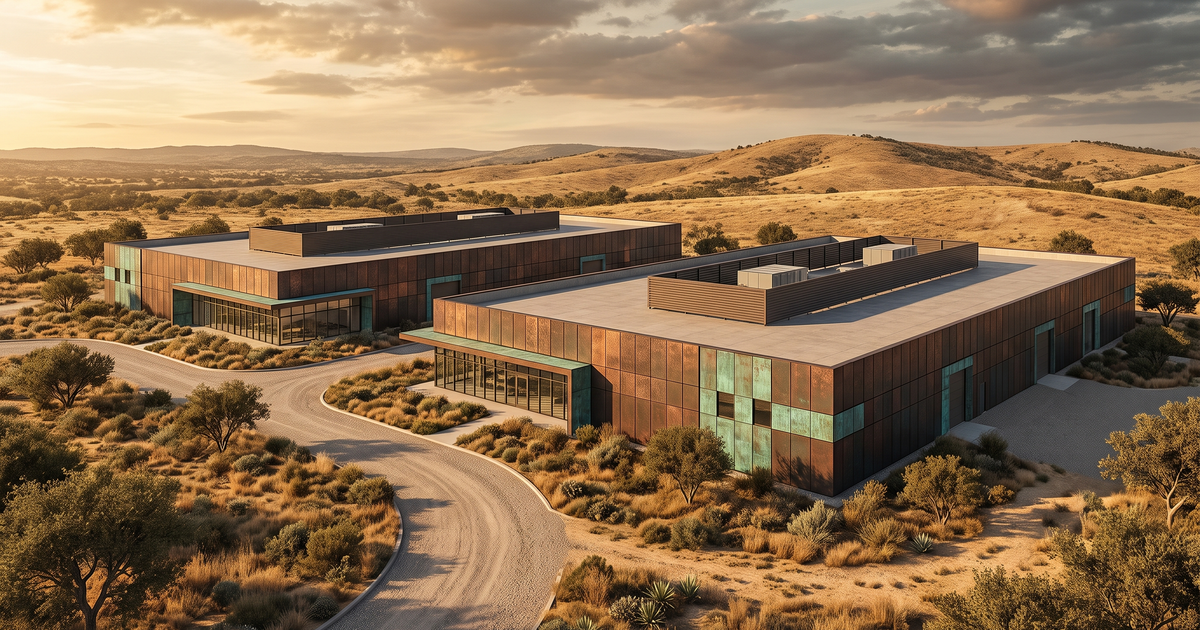
Artwork accompanying this report is an AI-generated architectural concept. It does not document the actual design, site arrangement or construction progress.
What the two construction registrations establish
The primary records are Texas Department of Licensing and Regulation registrations TABS2026028550 for EDCAUS31 and TABS2026028609 for EDCAUS32. They describe new single-story data centers with supporting office space, associated site improvements and automatic sprinkler protection. Both name Uppingham Adams Holdings, LLC as owner and Gensler Architecture, Design & Planning, P.C. as design firm.
| Item | Filed information | Reporting limit |
|---|---|---|
| Location | 6543 FM 535, Cedar Creek, TX 78612 | Shared filed address |
| EDCAUS31 | $700M; 576,777 sf in narrative | 577,000 sf rounded field |
| EDCAUS32 | $700M; 576,777 sf in narrative | 577,000 sf rounded field |
| Start target | October 5, 2026 for both | Actual start unverified |
| Completion targets | 31: December 29, 2028 32: December 25, 2028 | Filed schedules |
| Power and tenant | Undisclosed / unassigned | No building-specific MW |
The scope narratives add to 1,153,554 square feet. The rounded area fields add to 1,154,000 square feet. Both support describing approximately 1.15 million square feet across the pair. The difference comes from the filing's two area representations; it provides no evidence of a subsequent physical expansion.
The cost total likewise needs its basis attached. Adding two $700 million estimates produces $1.4 billion. The records do not reconcile possible overlap in shared site improvements or establish a final campus budget. They also do not document financing close, executed construction contracts or expenditure to date. No defensible low-voltage contract value can be calculated from these filings alone.
A filed start date is a useful reporting checkpoint
October 5 construction coverage drew attention to the pair reaching its scheduled start. The original state records still show a registered project. An accessibility-program registration and its supplied dates do not independently establish issued building permits, field mobilization or a groundbreaking.
LVN therefore treats the pair as planned. The next stage change needs corroboration: an owner or contractor statement tied to these building numbers, a relevant permit or inspection record, or dated site evidence whose location can be verified. The same discipline applies to the December 2028 completion targets. Those dates describe the submitted program; they do not guarantee commissioning, tenant occupancy or commercial availability.
For an estimator, this is a point to investigate procurement ownership. A published start target can guide a research call, but it cannot supply a current bid deadline. Before allocating a takeoff team, confirm which organization is buying the package, whether drawings are issued and whether the solicitation covers one building, both buildings or common infrastructure.
Gensler is named; the ownership records need careful reading
Data Center Dynamics' August reporting connects the buildings to EdgeConneX through naming conventions and earlier local land reporting, while acknowledging the developer is not explicitly named in those construction applications. The Texas Comptroller's data-center register supplies separate primary evidence for the broader numbered group.
| Organization | Supported role | Evidence |
|---|---|---|
| Uppingham Adams Holdings, LLC | Filed owner | Both TDLR registrations |
| Gensler | Design firm | Both TDLR registrations |
| EdgeConneX | Reported family developer | Qualified DCD attribution |
| EdgeConnex MCN Austin Property 7, LLC | ECX AUS31–36 group owner | Comptroller register |
| EdgeConnex MCN Austin Operations 7, LLC | Group occupant/operator | Comptroller register |
| GC and specialty contractors | Unverified | No confirmed awards found |
The ECX AUS31–36 registry entry is effective July 8, 2026. It names Property 7 as owner and Operations 7 as occupant and operator. These are roles in a tax registry. The entry does not resolve the property or lease chain connecting those entities to Uppingham, demonstrate that six buildings are being constructed or identify a third-party customer.
Gensler's critical-facilities practice provides useful company context. Its Cedar Creek design attribution comes from the state filings. The practice page's featured Phoenix project should stay identified as a separate example when company imagery is used. No reviewed source establishes an EDCAUS31/32 GC, construction manager, MEP engineer, electrical contractor or communications integrator.
One road contains several different data-center scopes
Building numbers and addresses are essential here. The separate EDCAUS11 filing concerns 6682 FM 535. The EDCAUS11/12 pair already has its own project history. Its similar naming and combined dollar headline provide no basis for merging it with EDCAUS31/32 at 6543 FM 535. Contractor information associated with another building likewise needs direct corroboration before being applied to this pair.
The EdgeConneX Austin brochure for AUS01–04 describes another group, including AUS01 at 6752 FM 535. Its 96 MW first-phase plan, 336 MW initial potential and 130-acre description belong to that earlier offering. None establishes power or acreage for the two buildings covered here. The brochure describes AI-capable infrastructure, but the reviewed EDCAUS31/32 records leave their eventual workloads unspecified.
Tenant attribution requires the same care. The Comptroller lists CoreWeave at a separate EdgeConneX AU02 entry. That is insufficient evidence of a CoreWeave commitment to EDCAUS31/32. Their tenant fields remain unassigned, and LVN has not verified an end-customer lease.
Water agreements also follow their actual addresses. Aqua WSC's June 25 statement describes service for DFW33220N, LLC at 6752 FM 535, with a maximum flow of 210 gallons per minute and a conditional 2027 service expectation. Those terms cannot establish water availability, consumption or cooling design at 6543 FM 535.
For this pair, IT load, facility demand, utility allocation and energized capacity remain unknown. So do the confirmed electric-service provider, interconnection milestone and water arrangement. These gaps matter to procurement because power and cooling decisions can shape the sequence and interfaces of controls, communications and commissioning work.
Where low-voltage firms can prepare
The following opportunities are LVN's analysis of potential work in a large data-center development. Automatic sprinklers appear in the filed scope. Detailed communications, electronic security, fire-alarm and controls packages remain unverified. Treat the table as a guide to qualification questions and capability preparation.
| Potential scope | Preparation | Evidence to obtain |
|---|---|---|
| Fiber and outside plant | Pathways, splicing, test records | Routes, carriers, package buyer |
| Structured cabling | Labeling, testing, turnover | Tenant design and bid scope |
| Access control and CCTV | Device integration, acceptance tests | Security designer and integrator |
| Fire interfaces | Sprinkler monitoring coordination | Alarm drawings and trade split |
| BMS and networking | Controls interfaces, IT/OT coordination | System architecture and buyer |
| Commissioning support | Test plans, records, closeout | Acceptance criteria and schedule |
Fiber firms can prepare examples of route coordination, clean termination practices, splice documentation and completed test packages. The commercial questions begin with where the work starts and ends: carrier entrance, campus backbone, building distribution or tenant fit-out. Those boundaries determine which buyer and design team can actually answer a bid question.
Security and controls teams can demonstrate how they document interfaces between devices, networks and building operations. Useful questions cover network ownership, system acceptance, alarm routing and the party responsible for integrated testing. Public-safety radio or DAS requirements, manufacturer selections and specific network architectures have not been established for these buildings.
Across disciplines, pathway coordination and turnover quality offer practical preparation. A capability package can show completed coordination drawings, labeling conventions, grounding and bonding experience, test reports and issue-resolution records. Verify confidentiality before sharing another customer's examples. The objective is to make relevant experience easy for a prospective procurement team to assess.
Jobs, trades and training resources
No project-specific construction workforce total, permanent-job forecast or current EDCAUS31/32 vacancy was verified. A billion-dollar estimate does not produce a reliable headcount. The potential trades include fiber installation and testing, structured cabling, security integration, fire interfaces, controls, electrical coordination and commissioning support, subject to the eventual package structure.
The Fiber Optic Association's workforce resources offer general training information. BICSI's training catalog is another communications-skills reference. These resources support preparation; no particular credential has been verified as a requirement for this project.
Gensler careers is a corporate hiring resource, with no EDCAUS31/32 opening established by this review. Applicants and subcontractors should confirm the actual employer, work location and assignment. Site onboarding, lift access, safety training, supervision and prequalification requirements also need to come from the eventual contracting team.
The evidence that would make this lead actionable
The strongest next development would connect the filed building numbers to an identifiable construction or procurement event. Watch for a project-specific GC appointment, issued permit, public bid package, verified site start, utility-service milestone or owner schedule update. Each would answer a different commercial question; none should be inferred solely from a calendar date.
For an initial inquiry, identify the building pair and address, describe the relevant completed work and ask who controls the intended package. Confirm whether shared infrastructure and tenant fit-out are procured separately. Keep the request narrow enough for a company representative to route it without needing to validate every regional campus claim.
EDCAUS31/32 offers a clear starting point: two large new-build registrations, a named design firm and a prospective delivery schedule. Its value to a contractor grows as verified buyer, scope and timing information becomes available. Explore LVN Signal to find construction projects, review source-backed company information and follow opportunities relevant to your trade.
Join 35,000+ Low Voltage Pros
Get weekly permit updates, tool deals, job opportunities, and industry news. No spam, unsubscribe anytime.