
Join Low Voltage Nation — Find project opportunities and showcase your company to thousands of industry professionals
Digi Power X is building a Tier III Columbiana campus for Cerebras with 40MW of contracted IT load and phased delivery through Q1 2027.
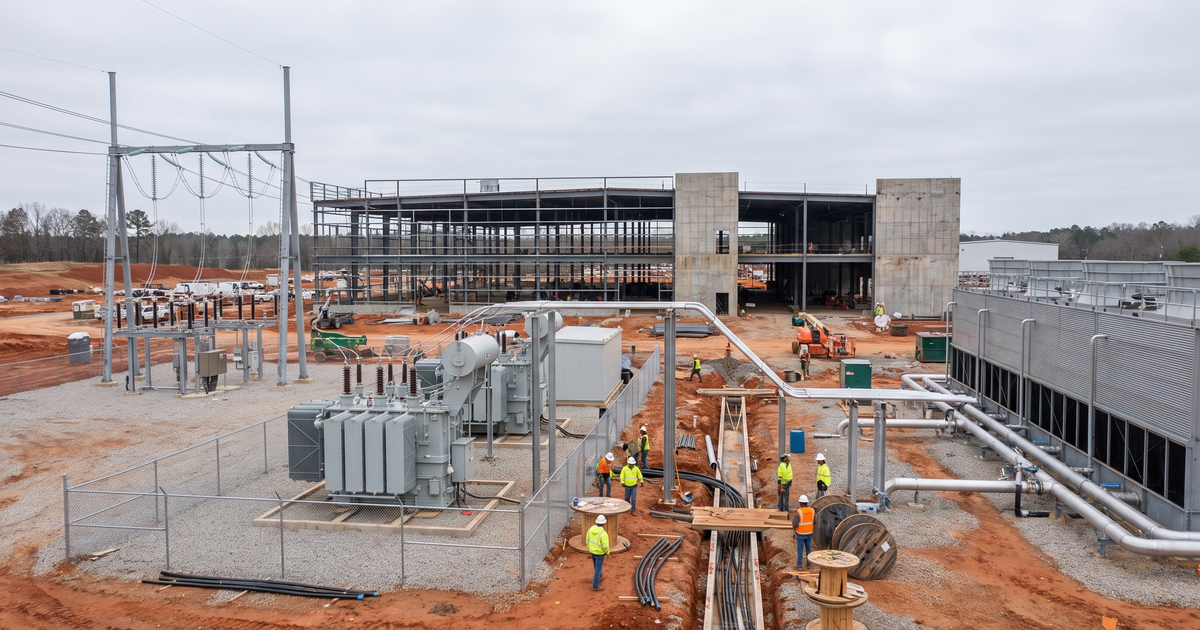
A purpose-built Tier III AI data center is moving vertically in Columbiana, Alabama. Digi Power X's July operations update says crews are erecting the building shell and that major long-lead electrical and switchgear equipment has been secured. The campus at 130 Industrial Parkway is being delivered for Cerebras Systems under a two-phase contract covering 40 megawatts of IT load.
The capacity is unusually clear because the commercial terms are filed. The master services agreement assigns 15 MW to Phase 1 and another 25 MW to Phase 2. Phase 1 is targeted for December 15, 2026, with the full 40 MW targeted by the end of Q1 2027. That is contracted IT load, not a vague campus-power headline.
The dollar figures need equal discipline. Digi Power X describes about $1.1 billion of value across the initial ten-year Cerebras contract and up to $2.5 billion if extension options are exercised. Those figures are customer-contract value, not construction cost. Reviewed sources do not disclose total project capex, individual trade-package values, or a final permanent-job count.
| Project fact | Source-backed detail | LVN read |
|---|---|---|
| Stage | Building shell underway | Vertical construction is active. |
| Phase 1 | 15 MW IT load | Target: Dec. 15, 2026. |
| Phase 2 | 25 MW incremental | Target: end of Q1 2027. |
| Total | 40 MW contracted IT load | Older 55 MW is site power availability. |
| Commercial value | $1.1B initial; up to $2.5B | Contract value, not capex. |
| Address | 130 Industrial Parkway | Columbiana, Shelby County. |
The Form 8-K and filed agreement make Cerebras the named customer rather than a rumored tenant. Cerebras describes itself as an AI infrastructure company built around wafer-scale systems and high-performance AI compute. That customer profile raises the importance of resilient power, high-density cooling interfaces, clean optical connectivity, disciplined labeling, monitoring, and integrated turnover.
Digi Power X is the source-backed owner and operator. Its project announcement says the Phase 1 onsite substation is complete, grid interconnection is finalized, and a power-delivery agreement is in place with Alabama Power. Those milestones materially de-risk the schedule compared with projects that have land but no firm power path.
They also move several low-voltage interfaces closer to field execution. Substation telecom, utility fiber, relay and controls networking, SCADA or EPMS telemetry, metering, physical security, grounding, remote alarms, and commissioning all have to coordinate with the data-center electrical and operations systems. Public sources do not yet identify the companies holding those packages.
| Company / agency | Source-backed role | Current limit |
|---|---|---|
| Digi Power X | Owner and operator | Project release |
| Cerebras Systems | Contracted customer | Filed agreement |
| Alabama Power | Utility counterparty | Utility context |
| GC / EPCM | Not publicly named | Do not infer an award. |
| Design team | Not publicly named | Architect and engineer unknown. |
| Specialty trades | Not publicly named | Packages remain open signals. |
Local Shelby County reporting corroborates the completed substation, Alabama Power agreement, and active campus work. It also reports that the site drove most of Digi Power X's roughly $45 million in first-quarter 2026 capital expenditures. That is useful evidence of current deployment, but it still should not be converted into a total project-cost claim.
Construction trade coverage likewise describes the 40 MW two-phase build and current construction movement. Neither source names a separate general contractor, EPCM, architect, engineer, electrical contractor, fiber contractor, security integrator, fire-alarm contractor, controls vendor, network integrator, grounding contractor, or commissioning authority.
That contractor gap is the opportunity window. Shell erection and secured switchgear indicate that civil, structural, electrical-room, equipment-yard, and utility coordination are already moving. The next public evidence should come from permits, inspections, job postings, subcontractor prequalification, supplier announcements, plan-room notices, and contractor portfolios tied to the Columbiana address or project aliases.
| Low-voltage lane | Likely requirement | Watch signal |
|---|---|---|
| Fiber / OSP | Carrier, utility, campus, and hall links | Duct banks, entrances, splice and test work. |
| Structured cabling | Operations, support, controls, and compute | Pathways, labeling, certification, closeout. |
| Security | Perimeter, entrances, rooms, and assets | Access control, CCTV, intercom, SOC links. |
| Fire alarm | Data halls and electrical spaces | Detection, interfaces, sequence testing. |
| BMS / EPMS | Power, cooling, alarms, and trends | Point lists, networks, dashboards, integration. |
| Commissioning | Tier III phased turnover | Cx scripts, witnesses, IST, training. |
Fiber and outside plant should be treated as schedule-critical enabling work. A two-phase AI campus needs diverse service entrances, carrier handoffs, utility and substation communications, campus backbone routes, protected duct banks, handholes, maintenance holes, splice planning, entrance-facility grounding, optical-loss testing, OTDR traces, clean connector inspection, route documentation, and restoration procedures.
Inside the buildings, structured cabling will support operations, monitoring, security, controls, wireless, offices, support rooms, and tenant infrastructure. Cerebras may furnish parts of the AI compute environment, but the facility still needs coordinated pathways, racks and cabinets, patching, labeling, certification, as-builts, port records, and a turnover package that operations can actually use.
Physical security must protect the site perimeter, construction entrances, loading areas, utility yard, substation, equipment rooms, meet-me rooms, operations center, data halls, and customer assets. Watch for vehicle gates, badging, visitor management, access control, CCTV, video analytics, intercom, duress, key management, alarm monitoring, and integration between owner and customer security systems.
Fire and life safety will cross data halls, electrical rooms, generator and battery areas, cooling infrastructure, offices, and exterior support equipment. The work may include early-warning detection, fire alarm, suppression interfaces, supervisory points, emergency-power sequences, releasing panels, monitoring, cause-and-effect matrices, acceptance testing, and integrated testing with security, controls, and power systems.
BMS, EPMS, DCIM, and controls networking will be central to a high-density AI facility. Operators need visibility into switchgear, UPS systems, generators, cooling equipment, pumps, leak detection, environmental sensors, meters, alarms, trends, and failure sequences. The package boundary between electrical controls, mechanical controls, utility telemetry, customer monitoring, and facility DCIM remains unknown.
The project should also be monitored for DAS, public-safety radio, cellular, Wi-Fi, and private-wireless requirements. These systems are not named in current sources, but the combination of insulated mission-critical construction, electrical rooms, equipment yards, and a secured industrial site can create coverage challenges that only become visible through surveys and jurisdictional testing.
Grounding and bonding will touch the substation, service entrance, switchgear, UPS systems, generators, cooling equipment, structural steel, lightning protection, telecom rooms, OSP entrances, cable tray, racks, controls panels, and security devices. Contractors should watch for who owns testing, documentation, coordination, and corrective work across electrical and communications scopes.
Commissioning is the final bridge between the accelerated schedule and usable capacity. Phase 1 and Phase 2 will need factory tests, site acceptance, point-to-point verification, fiber readiness, network validation, cooling sequences, alarm testing, security and fire interfaces, failure-mode testing, integrated systems tests, customer witness points, operator training, and clean digital closeout.
Useful contractor readiness includes Alabama licensing, mission-critical references, safety and EMR records, bonding and insurance capacity, regional labor plans, fiber cleaning and inspection, fusion splicing, OTDR and optical-loss testing, copper certification, pathway coordination, grounding, access-control and VMS commissioning, fire-alarm acceptance support, controls point-to-point testing, redlines, labeling, and electronic as-builts.
Prequalification packages should show QA/QC procedures, testing equipment, manufacturer certifications, field supervision, schedule controls, equipment tracking, change management, commissioning experience, and examples of complete turnover records. The short delivery window makes procurement visibility and proven field documentation as important as raw installation capacity.
The Phase 1 deadline also creates a sequencing risk. Low-voltage teams cannot wait for every room to be cosmetically complete before coordinating pathways, sleeves, supports, cable tray, grounding points, device backboxes, network cabinets, controls panels, and test access. Early model review, coordinated shop drawings, material-release schedules, prefabrication, daily constraint tracking, and room-by-room turnover planning will determine whether systems arrive in an orderly sequence or collide during final commissioning.
Workforce planning should account for simultaneous electrical, mechanical, controls, security, fire, network, and customer activity. Useful field skills include lift and site access, mission-critical safety, cable pulling and dressing, fusion splicing, fiber inspection, OTDR and optical-loss testing, copper certification, access-control hardware, camera commissioning, fire-alarm testing, controls point checks, grounding measurements, labeling, redline discipline, and digital closeout. Supervisors who can coordinate live equipment rooms and phased energization will be especially valuable.
The two delivery dates suggest that turnover will be phased rather than a single end-of-project event. Contractors should expect rolling area releases, temporary network and monitoring needs, partial alarm coverage, progressive security zones, equipment startup, customer witness points, punch-list control, and strict configuration management. Any package award should be read together with its testing, documentation, training, warranty, and post-occupancy support requirements, not just installation quantities.
Alabama Power's data-center community page explains its large-load cost protections and notes Columbiana's 2026 data-center noise ordinance. That local context matters for generator and cooling design, acoustic requirements, commissioning hours, and community-facing compliance. It does not identify the data-center's electrical or low-voltage contractors.
Track Digi Power X Alabama AI Campus, DigiPowerX Columbiana, US Data Centers Columbiana, USDC Alabama, 130 Industrial Parkway, Cerebras Columbiana, and Shelby County AI data center. Keep this project distinct from older Digi Power X cryptocurrency or modular-compute sites and from unrelated Alabama data-center proposals.
The business-development angle is direct. LVN now has a source-backed project, customer, utility, address, contracted IT load, phased schedule, construction status, and known substation milestone. Digi Power X, Cerebras, Alabama Power, and future trade partners can correct the record, claim company profiles, provide verified package or hiring updates, or sponsor continued coverage.
Bottom line: Columbiana has advanced beyond announcement-stage speculation. The building shell is underway, major electrical equipment is secured, power infrastructure is materially advanced, and a named AI customer has contracted 40 MW of IT load on an aggressive schedule. The next decisive signals are the GC and design team, building permits and inspections, electrical and controls packages, fiber routes, security and fire-alarm awards, and the commissioning plan needed to hit December 2026 and Q1 2027 delivery dates.
Join 35,000+ Low Voltage Pros
Get weekly permit updates, tool deals, job opportunities, and industry news. No spam, unsubscribe anytime.