
Join Low Voltage Nation — Find project opportunities and showcase your company to thousands of industry professionals
Decimal Digital's Project Eagle Ridge is a planned Monroeville AI data-center watch with a 30 MW starting load, 100 MW target, 69 kV line, substation, and open trade packages.
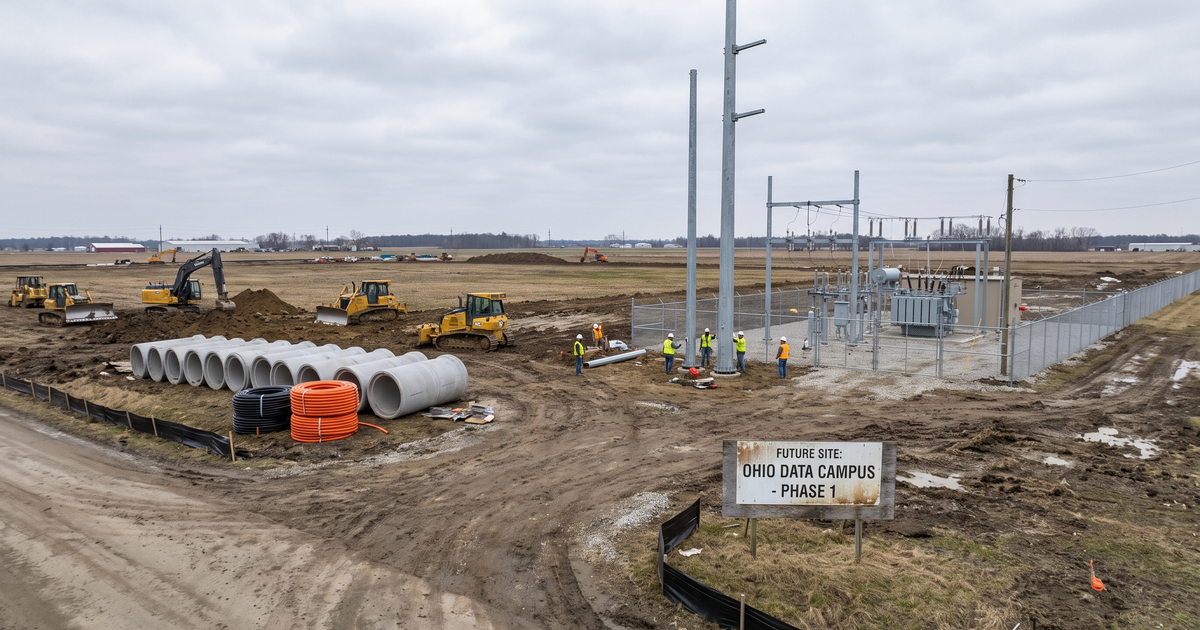
Project Eagle Ridge in Monroeville, Ohio is an early AI data-center watch item because the public record already connects a named developer, a municipal electric-service discussion, a 30 MW starting load, and a planned path toward 100 MW. Decimal Digital's public Project Eagle Ridge site frames the proposal as an AI infrastructure campus. The Village of Monroeville's special council meeting minutes add the most useful construction intelligence: Digital Decimal Currency LLC, the Monroeville Industrial Park, a proposed electric-service agreement, an initial 30 MW load, expansion toward 100 MW, high-speed fiber needs, a Decimal-funded 69 kV line from Herbert substation, a Decimal substation, AMPT and FirstEnergy context, onsite generation, and collateral protections for the village.
That combination is the LVN angle. This is not a finished contractor map. It is a source-backed early signal that power, fiber, controls, security, life safety, data hall networking, and commissioning scopes could form if the project moves from planning and electric-service work into vertical construction. Current public evidence does not name a general contractor, EPCM, engineer of record, electrical contractor, low-voltage contractor, structured cabling firm, security integrator, fire alarm contractor, BAS/BMS controls firm, DAS/networking provider, grounding contractor, or commissioning provider. The right way to cover it is to separate the confirmed power and site-development trail from the still-open package names.
| Item | Source-backed detail | LVN read |
|---|---|---|
| Project | Project Eagle Ridge | Planned AI data-center campus in Monroeville, Ohio. |
| Developer | Decimal Digital / Digital Decimal Currency LLC | Named in project and village evidence. |
| Power start | 30 MW initial electric-service load | Early utility work can expose fiber, controls, and commissioning signals. |
| Planned scale | Ramp toward 100 MW | Large enough to justify serious low-voltage watch coverage. |
| Utility work | 69 kV line, Decimal substation, AMPT/FirstEnergy context | Substation and transmission work can move before building packages. |
Trade coverage strengthens the watch case but should remain secondary to the public-record facts. Data Center Knowledge describes Decimal's transparency approach, the 100 MW AI data-center proposal, the developer-funded 69 kV transmission work, PJM package context, closed-loop liquid cooling, and AI training/inference design intent. ETDatacenters echoes the community-engagement and 100 MW framing. Those reports are useful because they connect the Monroeville record to a broader AI infrastructure trend, but the highest-confidence construction facts still come from the village minutes and the project site.
The capacity wording needs discipline. The 30 MW figure is the starting electric-service load discussed in the public record. The 100 MW figure is the planned first-phase or ramp target described in current project and trade coverage. Neither number should be treated as disclosed building-level IT critical load unless Decimal, the village, a utility filing, a permit, or another primary record publishes that distinction. For now, LVN should call 30 MW the initial electric-service load, 100 MW the planned AI-campus target, and building-level IT load unknown.
| Company or agency | Role | Evidence |
|---|---|---|
| Decimal Digital | Developer | Project site |
| Digital Decimal Currency LLC | Electric-service customer | Village minutes |
| Village of Monroeville | Municipal utility / local jurisdiction | Council record |
| American Municipal Power Transmission | Transmission context | Council record |
| FirstEnergy | Transmission utility context | Council record |
| PJM | Interconnection context | Trade coverage |
| Verizon / Frontier | Fiber-connectivity context | Council record |
For low-voltage contractors, the key signal is not a public award. It is the project sequence. Before a data hall is cabled, a project like this has to solve power delivery, site access, utility protection, service redundancy, carrier connectivity, internal distribution, security posture, and documentation. The village minutes explicitly mention high-speed fiber and additional Verizon/Frontier node capacity as load grows. That gives OSP and fiber contractors a concrete watch path even though no fiber package holder is named.
The 69 kV line and substation references matter because power infrastructure creates communications and controls scope. Substation security, relay/control communications, utility network monitoring, grounding, fiber routes, temporary construction connectivity, camera coverage, access control, and turnover documentation can all appear around the utility package. Those scopes may not sit under the same contractor as later structured cabling or data-hall fit-out work, so LVN should watch the utility trail separately from building permits.
| System | Why it matters | Watch signal |
|---|---|---|
| Fiber / OSP | Carrier routes, nodes, entrances, and diverse paths | Verizon/Frontier, conduit, splicing, testing, and route records |
| Structured cabling | Data hall and support-space cabling | Fit-out packages, pathway language, and certification requirements |
| Access control / CCTV | Perimeter, substation, and facility security | Security integrator awards, door/camera schedules, VMS language |
| Fire alarm | Life-safety interface with data-center systems | AHJ review, fire alarm permits, acceptance testing |
| BAS / BMS | Cooling, power, alarms, and operational monitoring | Controls integrator hiring, point lists, commissioning scopes |
| Grounding / commissioning | Mission-critical QA and turnover discipline | Test records, bonding specs, commissioning-agent signals |
The jobs language also needs to stay narrow. The village minutes reference 45 initial construction workers, 26 first-phase jobs at the 30 MW stage, and additional technical and support jobs as megawatts increase. That is enough to show workforce relevance, but it is not enough to claim a full construction labor peak or permanent headcount. LVN should frame this as early workforce signal plus practical preparation: safety, lift/site access, fiber testing, labeling, grounding, controls documentation, security credentialing, fire alarm familiarity, and commissioning paperwork.
The local utility structure is also part of the opportunity. Monroeville is not just a passive host community in the public record. The council minutes show village officials evaluating electric-service exposure, collateral, project risk, load growth, and the infrastructure needed to serve the site. That creates a public trail that can be monitored over time. If the project advances, contractors should expect the next useful evidence to appear in local public meetings, electric-service updates, utility engineering references, zoning or site-plan movement, and eventually building or trade permits.
For LVN readers outside Ohio, the pattern is portable. AI data-center projects are increasingly showing up first through power and community documents, not through polished contractor announcements. The low-voltage contractor who waits for a public cabling award may be late. The contractor who watches interconnection language, carrier-capacity notes, substation references, water and cooling statements, local tax discussions, and workforce comments can build a better target list before procurement is obvious.
For estimators and business-development teams, Project Eagle Ridge is a reminder that the earliest opportunity may not look like a bid invite. It may look like a council PDF, a utility-service agreement, a substation reference, an interconnection package, a carrier-capacity note, a local zoning agenda, or a developer transparency page. The firms that catch those records early can prepare prequalification, update data-center resumes, verify insurance and safety requirements, and monitor job postings before the visible package race begins.
The technical preparation should be concrete. Fiber crews should be ready to document route, splice, OTDR, power meter, labeling, and handoff details. Security and access-control teams should be ready for perimeter, substation, gate, visitor, and operations-area coordination. Fire alarm and life-safety teams should expect AHJ review and integration with suppression or monitoring systems if the building scope matures. BAS/BMS and network teams should expect point lists, alarming, trend logs, and owner turnover requirements. Grounding and bonding should be treated as a QA discipline, not a closeout afterthought.
This project should stay distinct from other Ohio data-center activity. It is not the SB Energy / SoftBank PORTS Technology Campus in Pike County. It is not a Columbus, New Albany, Lancaster, or Google Ohio row. The aliases to track are Decimal Digital Project Eagle Ridge, Project Eagle Ridge, Digital Decimal Currency LLC, Decimal Monroeville, Monroeville Industrial Park data center, Herbert Substation AI data center, and Monroeville AI data center. Alias control matters because Ohio has multiple data-center and power-infrastructure stories moving at once.
The next public evidence worth watching is straightforward: village planning commission and council agendas, electric-service agreement updates, zoning and building-permit records, AMPT or FirstEnergy activity around the Herbert substation, PJM interconnection references, onsite-generation filings, fiber route or node work, and job postings tied to Decimal Digital or Digital Decimal Currency LLC. A named GC, EPCM, engineer, electrical contractor, low-voltage contractor, fiber contractor, security integrator, controls firm, fire alarm firm, or commissioning provider should not be published until a source connects the company directly to Project Eagle Ridge.
The business-development angle is warm but cautious. Decimal Digital, the village, utility stakeholders, and any future named contractors may have a reason to correct, expand, or sponsor source-backed coverage once the project advances. But the current article should not imply LVN has found the trade-partner list. The value today is that LVN has organized the public construction record, identified the low-voltage systems likely to matter, and marked the unresolved scopes before the market gets noisy.
Bottom line: Project Eagle Ridge is a high-confidence planned AI data-center signal because the project name, location, developer context, municipal electric-service record, 30 MW starting load, planned 100 MW path, 69 kV line, substation, fiber needs, and utility context are all visible now. It belongs in LVN Signal as an early watch, not as a completed contractor map. The low-voltage opportunity is real enough to track and still early enough that the most important names are likely ahead.
Join 35,000+ Low Voltage Pros
Get weekly permit updates, tool deals, job opportunities, and industry news. No spam, unsubscribe anytime.