
Join Low Voltage Nation — Find project opportunities and showcase your company to thousands of industry professionals
DC BLOX's Thunderbird Indianapolis campus is now a source-backed data-center watch item: two planned buildings, $1.8B-$2.0B total investment context, July 15 MDC approval, and open low-voltage package names.
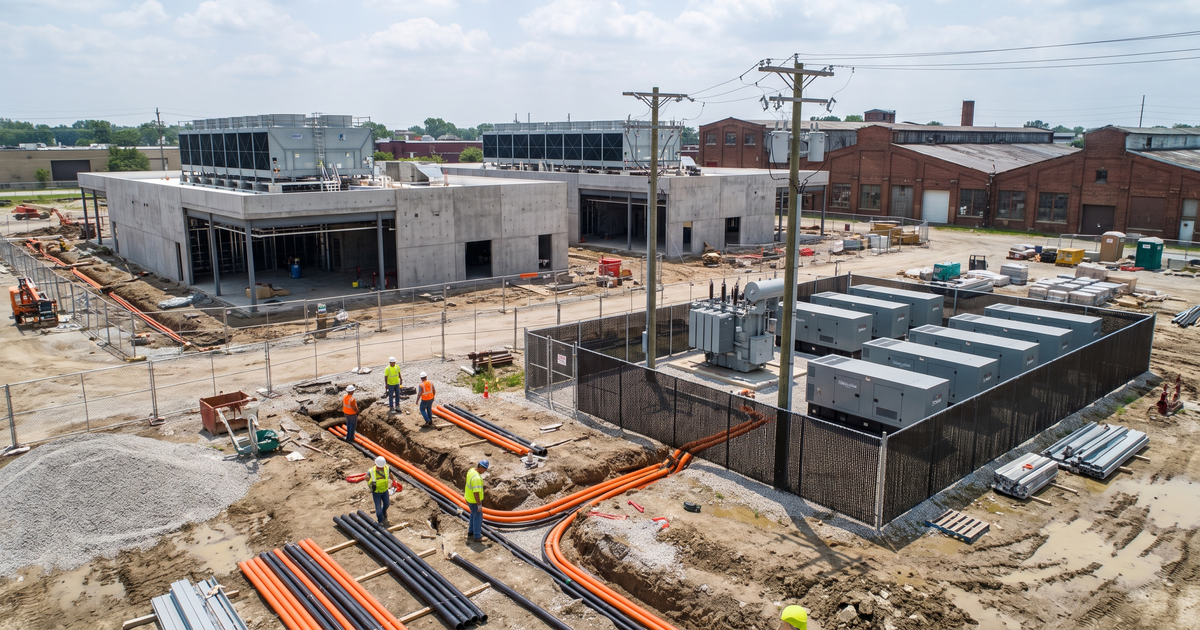
DC BLOX's Thunderbird Indianapolis project now has enough source-backed detail for LVN to treat it as an active AI/data-center watch item. The project sits at 305 Fintail Drive in the Thunderbird Commerce Center area on the east side of Indianapolis. DC BLOX's project page describes a scaled two-building campus with about $1.8 billion to $2.0 billion of total investment, up to 600 peak construction workers, about 21 permanent operations staff, and a plan that reduced the original power request by removing one building.
The current public approval context matters. Mirror Indy reported that the Indianapolis Metropolitan Development Commission approved the scaled project 6-1 on July 15, 2026. That does not mean every trade package is visible. It does mean the project has moved from neighborhood and policy debate into a practical permit, replat, utility, site, building, and subcontractor-watch window. The same outlet's moratorium coverage says the future-focused data-center moratorium would not apply to DC BLOX because this project had already entered the review path.
| Item | Source-backed detail | LVN read |
|---|---|---|
| Project | DC BLOX Thunderbird Indianapolis data-center campus | Approved scaled campus with two planned data-center buildings. |
| Location | 305 Fintail Drive, Indianapolis / Marion County, IN | Specific address for permit, replat, plan-room, and job-post monitoring. |
| Current scope | About 70,000 sq ft for Building 1 and about 250,000 sq ft for Building 2 | Roughly 320,000 sq ft of current building-area context in owner materials. |
| Investment | About $1.8B-$2.0B total, including $600M-$700M DC BLOX site/building investment and $1.2B-$1.3B tenant hardware | Separate building/site capex from tenant server, network, and high-performance hardware spend. |
| Capacity | Remaining critical IT load not disclosed in reviewed public sources | DC BLOX says the redesign reduced critical IT load by 28 MW, but the remaining MW should not be inferred. |
The strongest technical source is the July 14 plan of operation. It names DCB Indianapolis LLC, confirms the two-building layout, describes an existing substation on the site, says the first phase can begin after variance and replat approval, and frames the first building as a roughly 24-month build after approvals. It also says full buildout is expected over about five years. For contractors, that sequencing points to a staged opportunity rather than one monolithic release.
The statement of commitments gives LVN the low-voltage and facility-systems watch lanes. It requires closed-loop cooling, municipal water, site-plan conformance, screening, sound study work, SPCC planning, generator-testing limits, developer-funded substation and additional generation/transmission/distribution infrastructure, and renewable-power-program enrollment. Those commitments do not name contractors, but they tell us where controls, monitoring, security, communications, environmental documentation, and commissioning evidence may surface.
| Company / agency | Role | Evidence |
|---|---|---|
| DC BLOX | Owner/operator/developer | Project page |
| DCB Indianapolis LLC | Project entity | Plan of operation |
| Faegre Drinker Biddle & Reath LLP | Land-use counsel / filing context | Plan of operation |
| Indianapolis MDC | Approval authority | July 15 approval coverage |
| IDEM / EPA | Environmental and SPCC context | Commitments filing |
| Baxtel / WFYI | Secondary project and public-process context | Baxtel / WFYI |
The conservative contractor stance is important. Reviewed sources do not yet name a general contractor, EPCM, engineer of record, electrical contractor, low-voltage contractor, fiber/OSP contractor, structured cabling firm, security integrator, fire alarm contractor, BAS/BMS or EPMS controls firm, DAS/networking contractor, grounding contractor, utility provider, or commissioning provider. DC BLOX, DCB Indianapolis LLC, Faegre Drinker, the MDC, IDEM, EPA, Baxtel, and WFYI are source-backed. Package holders remain open.
That open-package condition is exactly why this is useful for LVN. The project is specific enough to track, but not so mature that every specialty name has already been publicized. The plan describes data-center buildings, tenant networking equipment and high-performance hardware, generators, substation and power-infrastructure commitments, closed-loop cooling, screening, environmental controls, and a staged buildout. Each of those facts creates a watch lane for low-voltage and adjacent mission-critical trades.
| System | Why it matters | Watch signal |
|---|---|---|
| Fiber / OSP | Data-center tenants need diverse connectivity, entrance facilities, and tested backbone paths. | Carrier, conduit, duct-bank, handhole, MMR, splicing, and OTDR language. |
| Structured cabling | Tenant networking and high-performance hardware spend points to later fit-out and pathway discipline. | Rack/row scope, cable tray, labeling, copper/fiber testing, and closeout specs. |
| Access control / CCTV | Campus screening and mission-critical security need layered perimeter and building controls. | Gate, badging, visitor, camera, VMS, and perimeter-security packages. |
| Fire alarm | Buildings, generator areas, and staged approvals require AHJ coordination and acceptance testing. | Fire alarm permits, inspection records, submittals, and acceptance-test notes. |
| BAS/BMS / EPMS | Cooling, generator, substation, power, and environmental commitments need monitoring and controls integration. | Controls integrator, EPMS/BMS, alarms, trend logs, and commissioning records. |
| Grounding / commissioning | Power-dense facilities need bonding discipline, QA/QC, and turnover documentation. | Grounding specs, commissioning agent notices, prefunctional checklists, and test reports. |
The jobs and skills read should stay grounded. DC BLOX estimates up to 600 workers at peak construction and about 21 permanent operations staff at full buildout. That does not translate directly into low-voltage headcount, but it does point to contractor readiness needs: OSHA and site onboarding, lift and access training, electrical-safety coordination, fiber cleaning and inspection, OTDR and power-meter documentation, copper certification, cable tray and pathway discipline, labeling standards, grounding and bonding, access-control commissioning, CCTV/VMS setup, fire alarm acceptance testing, BAS/BMS point verification, redlines, turnover packages, and clean change-order process.
The source stack is strong because it combines owner material, filing documents, and local public-process coverage. DC BLOX provides the project page. The plan of operation gives building, investment, substation, staffing, generator, and schedule context. The commitments exhibit gives environmental, cooling, power-infrastructure, and operating constraints. Mirror Indy gives the July 15 approval outcome. WFYI and Baxtel provide secondary public-process and project-profile context.
The capacity language needs discipline. DC BLOX says the scaled plan reduced critical IT load by 28 MW, but the reviewed public sources do not disclose the remaining building-level MW or critical IT load. LVN should publish the reduction as a design-change fact, not reverse-engineer a remaining load number. The reliable public facts are the address, approval posture, two-building layout, approximate building areas, staged timeline, total investment range, and open contractor fields.
Alias tracking should include DC BLOX Thunderbird, DC Blox Indianapolis, DCB Indianapolis LLC, Thunderbird Commerce Center data center, 305 Fintail Drive, Warren Township data center, Irvington data center, and Kitley Avenue / Pennsy Trail data center. Keep it distinct from Metrobloks Martindale Brightwood, Sabey Decatur Technology Park, Microsoft La Porte, Meta Lebanon, and Google's withdrawn Franklin Township proposal. Indianapolis has multiple data-center narratives; this Signal row is specifically the DC BLOX Thunderbird campus.
The next evidence to watch is straightforward: Indianapolis / Marion County MDC records, replat status, building permits, drainage permits, IDEM air permits, generator filings, utility and substation records, any judicial-review appeal within 30 days of the July 15 approval, DC BLOX updates, DCB Indianapolis LLC filings, Thunderbird Commerce Center activity, local plan-room notices, union notices, and job postings. The first public specialty package names may appear in those places before they show up in a polished press release.
Bottom line: DC BLOX Thunderbird belongs in LVN's AI/data-center intelligence layer because the project now has a source-backed approval event, a specific address, a scaled two-building plan, a disclosed investment range, existing substation context, and a clear low-voltage watch window. The named parties are source-backed. The specialty packages are not. That is the opportunity: track the project while GC/EPCM, electrical, fiber, security, fire alarm, controls, networking, grounding, and commissioning names are still unresolved.
Join 35,000+ Low Voltage Pros
Get weekly permit updates, tool deals, job opportunities, and industry news. No spam, unsubscribe anytime.