
Join Low Voltage Nation — Find project opportunities and showcase your company to thousands of industry professionals
DataOne's Vineland AI Factory has two data-center phases under construction, more than 500 workers onsite, and named power and gas partners while specialty low-voltage packages remain unresolved.
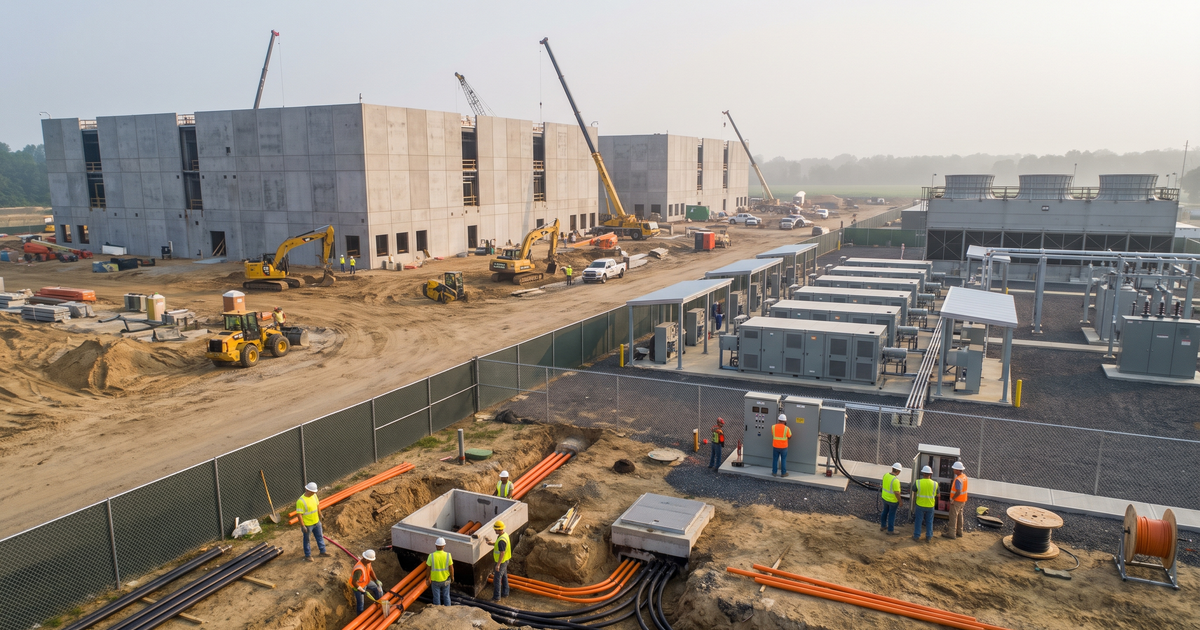
DataOne's Vineland AI Factory is no longer just a proposal on a rendering. The City of Vineland's August 7 continuation notice says both the 129,622-square-foot Phase 1 data-center building and a 587,980-square-foot two-story Phase 2 expansion are under construction at 3963 South Lincoln Avenue.
That notice matters because it also exposes the support infrastructure surrounding the data halls: multiple Bloom power areas, a chiller building, liquefied-natural-gas infrastructure, a water-treatment plant, megabay structures, parking, landscaping, and other site improvements. The amended preliminary and final site-plan hearing continues August 17 under application PBA-26-00001 for Block 7503, Lot 35.01.
The project has several legitimate scale figures, but they describe different things. Nebius calls its New Jersey AI region expandable to 300 megawatts. DataOne describes the Vineland campus as having 350 megawatts of maximum capacity. Kiely's contractor case study describes a 400-megawatt, 2.5-million-square-foot long-term campus. None of those figures is verified commissioned IT critical load, and they should not be collapsed into one headline number.
| Project fact | Source-backed detail | Current limit |
|---|---|---|
| Location | 3963 S Lincoln Ave, Vineland | Block 7503, Lot 35.01. |
| Stage | Both data-center phases under construction | Amended hearing continues Aug. 17. |
| Data-center area | 717,602 sq. ft. across Phases 1 and 2 | Not the full support-campus total. |
| Plan structures | 1,904,152 sq. ft. enumerated | Includes power and support buildings. |
| Capacity | 300 MW Nebius / 350 MW DataOne | Not commissioned IT load. |
| Workforce | More than 500 workers onsite | Owner-reported current count. |
DataOne's Vineland construction update says more than 500 union and non-union Cumberland County workers are active onsite. It says the company is continuing to onboard workers and targets delivery of all 14 data halls by the end of December 2026. That December date is an owner target, not verified substantial completion or an authority-issued occupancy milestone.
DataOne is both the owner/operator and a vertically integrated builder through DataOne Construction. That is an important contracting distinction: current sources do not name a separate conventional general contractor. They also do not yet identify every electrical, mechanical, low-voltage, controls, security, fire-alarm, fiber, or commissioning package holder.
The AI workload is source-backed. Nebius identifies DataOne as its construction partner, says the facility uses Nebius design, and describes the New Jersey region as expandable to 300 megawatts. A separate Nebius agreement with Microsoft says dedicated AI infrastructure capacity will be delivered to Microsoft from Vineland. Microsoft is therefore a capacity customer through Nebius, not the campus owner or builder.
Power is central to the construction story. Bloom Energy confirms its fuel cells will power the DataOne Vineland facility, while DataOne says data halls and mechanical loads will use onsite Bloom systems. DataOne also describes roughly 49 megawatts of permanent Atlantic City Electric grid supply, plus current construction power. The amended city notice adds multiple ground-mounted and multi-story Bloom areas and LNG infrastructure.
That combination expands the integration boundary. Fuel-cell controls, electrical protection, equipment monitoring, gas detection, fire and life safety, EPMS, BMS, alarms, security, networking, grounding, time synchronization, data logging, and commissioning all have to cross between the onsite generation plant and mission-critical buildings. Public sources have not yet identified the integrators responsible for those interfaces.
A major infrastructure package is already named. Kiely says it was selected to design and construct temporary and permanent natural-gas supply systems, including about 4,500 linear feet of 12-inch steel pipeline, regulation equipment, generator distribution, and pressure testing. That is a source-backed design-build role for gas infrastructure, not evidence that Kiely holds the full campus GC, electrical, controls, or low-voltage scope.
| Organization | Source-backed role | Scope boundary |
|---|---|---|
| DataOne | Owner / operator / builder | Specialty awards incomplete. |
| Nebius | AI infrastructure customer/operator | Not campus owner. |
| Microsoft | Capacity customer via Nebius | Not builder or GC. |
| Bloom Energy | Onsite fuel-cell provider | Installer details incomplete. |
| Kiely | Gas infrastructure design-builder | Not full-campus GC. |
| Project partner group | Named by DataOne | Exact packages unresolved. |
DataOne's own project-partner roster names Northeast Precast, E-Finity Distributed Generation, Bala Consulting Engineers, Building Theory, Riggs Distler, Byers Industrial Services, and MMPF Architects. E-Finity separately confirms the same Vineland team around resilient distributed-energy infrastructure. These are real project relationships, but the reviewed posts do not define each firm's exact package.
Northeast Precast has a deeper corporate connection. Local reporting says the company took a minority position in DataOne USA and brings precast-concrete expertise to the venture. The evidence supports a project-partner and investor relationship. It does not establish Northeast Precast as the owner, GC, or low-voltage awarder.
For LVN contractors, the open package map is the opportunity. An active 14-hall program with onsite power, water treatment, chilled systems, gas infrastructure, secure buildings, and a compressed owner schedule creates work well beyond racks and white space. The key is to follow documented interfaces instead of guessing which named partner owns them.
| Low-voltage lane | Why it matters | Watch signal |
|---|---|---|
| Fiber / OSP | Carrier and campus backbone | Routes, vaults, entrances, splicing. |
| Structured cabling | Halls and support buildings | Pathways, labeling, certification. |
| Access / CCTV | Large active secure campus | Gates, VMS, badging, analytics. |
| Fire alarm | Data, fuel, power and cooling zones | Interfaces, permits, acceptance. |
| BMS / EPMS / SCADA | Fuel cells, cooling and utilities | Point lists, networks, integrators. |
| DAS / wireless | Hardened multi-building coverage | Public safety and carrier design. |
| Grounding | Power, racks, pathways and OSP | Specs, tests, responsibility. |
| Commissioning | Integrated mission-critical plant | CxA, scripts, witnessed testing. |
Fiber and outside plant should be treated as campus infrastructure, not a late data-hall accessory. The program will need carrier entrances, diverse routes, duct banks, vaults and handholes, building-entry protection, fiber backbone, splicing, optical-loss testing, OTDR records, labeling, and as-built route documentation. Permanent carrier, OSP, and structured-cabling firms have not surfaced in current public records.
Structured cabling will extend into meet-me rooms, operations areas, offices, security points, controls panels, mechanical and power buildings, wireless systems, and the pathways connecting those spaces. Tenant-furnished compute fabric does not eliminate the substantial facility-network and support-space cabling around a hyperscale campus.
Physical security has temporary and permanent phases. Construction access, worker credentialing, deliveries, perimeter protection, guard operations, cameras, intrusion detection, and temporary network connectivity must transition into hardened visitor processing, badging, access control, video management, intercom, equipment-yard coverage, analytics, and auditable system turnover.
Fire and life safety will require careful occupancy and hazard coordination. Data halls, Bloom power structures, LNG areas, gas distribution, electrical rooms, chiller equipment, water treatment, megabay structures, and offices can carry different detection, monitoring, suppression-interface, emergency-power, and authority-having-jurisdiction requirements. Cause-and-effect documentation and integrated acceptance testing will matter as much as device counts.
Controls may be the highest-complexity specialty lane. Fuel-cell generation, utility service, electrical distribution, chillers, pumps, water treatment, gas systems, environmental monitoring, leak detection, alarms, security, and data-hall operations must exchange reliable data across defined IT/OT boundaries. Watch for BMS, EPMS, SCADA, PLC, instrumentation, protection-and-control, network-security, and commissioning awards.
DAS, public-safety radio, cellular, Wi-Fi, and private wireless requirements remain unresolved. The size and density of the buildings, equipment yards, construction zones, and emergency-response plans will drive coverage design. Contractors should wait for owner and jurisdiction requirements before assigning a specific DAS or wireless package.
Grounding and bonding should be tracked across structural steel, equipment skids, generators and fuel cells, gas systems, lightning protection, cable tray, racks, telecom rooms, security devices, OSP entrances, and controls cabinets. The work will depend on clear responsibility matrices, calibrated testing, recorded results, and disciplined closeout.
Commissioning will tie the system together. Expect point-to-point checks, device and cable certification, sequence verification, alarm routing, network failover, power transitions, cooling response, security and life-safety interfaces, integrated systems tests, operator training, redlines, asset records, and structured electronic turnover. The current sources do not name a commissioning authority.
The workforce signal is immediate rather than purely modeled. DataOne reports more than 500 workers onsite now and continuing onboarding. Techs preparing for this market should strengthen OSHA and mission-critical safety, fiber cleaning and inspection, fusion splicing, optical-loss and OTDR testing, copper certification, pathway coordination, grounding and bonding, security/VMS commissioning, fire-alarm acceptance support, controls verification, calibrated test-equipment discipline, and clean digital closeout.
Subcontractors should be ready with regional labor capacity, site supervision, safety and EMR history, insurance and bonding, data-center or industrial references, QA/QC plans, manufacturer credentials, material tracking, prefab coordination, schedule controls, commissioning experience, and examples of accurate labels, test records, redlines, and as-builts. The best outreach is a specific interface capability, not a generic claim to do everything.
The next public milestone is the August 17 Planning Board continuation. Useful evidence could include revised plans, approval conditions, testimony, equipment schedules, firm names, traffic or utility conditions, phasing changes, and permit dependencies. After that, watch building permits, Bloom installation and commissioning, Atlantic City Electric's permanent feed, LNG and water-treatment work, carrier construction, trade-partner portfolios, hiring, and occupancy milestones.
Track the aliases DataOne Vineland, Nebius New Jersey region, Vineland AI Factory, PBA-26-00001, Block 7503 Lot 35.01, and 3963 South Lincoln Avenue. Keep Nebius's 300-megawatt region, DataOne's 350-megawatt maximum, and Kiely's 400-megawatt long-term campus description separate until later records reconcile them.
Bottom line: Vineland is a high-confidence, under-construction AI data-center and onsite-power opportunity with two active data-center phases, 14 targeted halls, more than 500 workers onsite, named AI and power partners, and a documented gas-infrastructure contractor. The permanent fiber, structured-cabling, security, fire-alarm, controls, DAS, grounding, and commissioning package holders are still not public. Follow the project in LVN Signal while that map is forming.
Join 35,000+ Low Voltage Pros
Get weekly permit updates, tool deals, job opportunities, and industry news. No spam, unsubscribe anytime.