Join Low Voltage Nation — Find project opportunities and showcase your company to thousands of industry professionals
DataBank's Red Oak campus shows how AI demand is turning South Dallas into a live data-center construction market for fiber, security, controls, and commissioning.
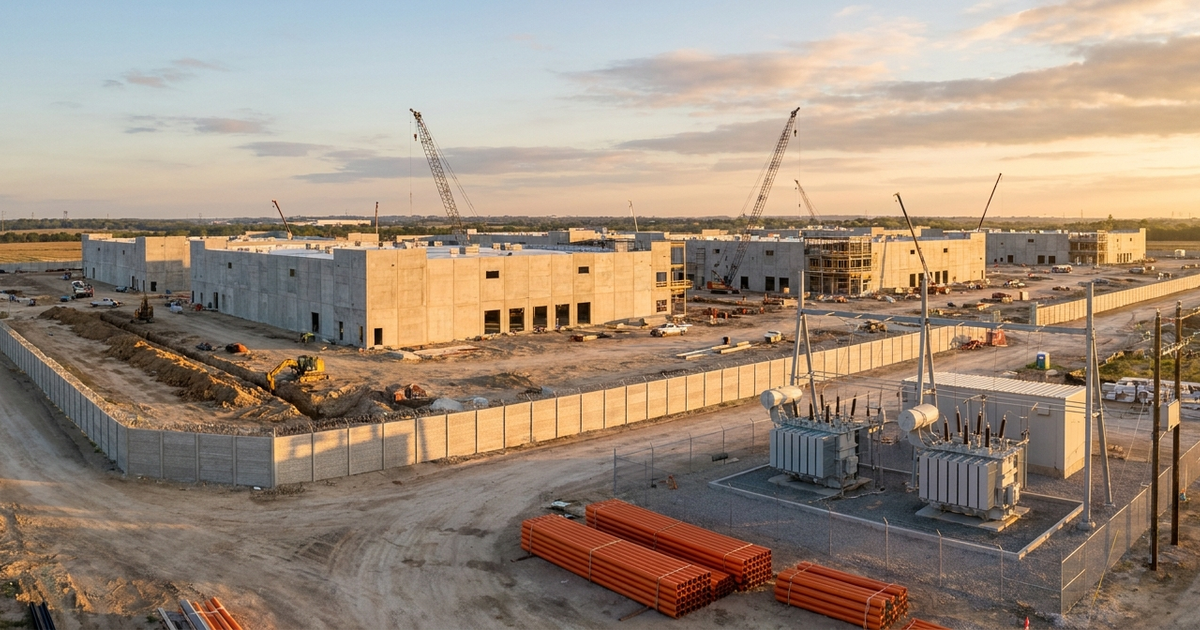
DataBank's Red Oak campus is one of the clearer public AI data-center construction signals in the Dallas market because the owner, the state filings, and contractor project pages all point to active multi-building work. DataBank says it secured $2.0 billion of construction financing for the first three South Dallas campus data centers, DFW9 through DFW11. That same announcement ties the financing to 600,000 square feet, 180 MW of capacity, existing power commitments, and accelerated delivery. For low-voltage contractors, this is the useful part: the project is not a vague future campus. It is a current construction platform with shell work, tenant fit-outs, substation context, and named general-contractor signals already visible in public sources.
The broader owner story is also substantial. DataBank's Red Oak campus page lists a 292-acre campus with four visible buildings in the current phase, 800,000 IT square feet, and 240 MW of critical IT load. Its 480 MW campus announcement describes a full buildout of as many as eight two-story buildings, up to 3.4 million gross square feet, and a 400 MW Oncor substation expandable to 800 MW. DataBank's AI-ready campus video/resource page adds the practical data-hall context: Universal Data Hall Design, air and liquid-cooling support, and high-density AI/HPC rack density. Those details matter because low-voltage opportunity follows the physical design. High-density AI halls increase the premium on clean pathways, fiber discipline, labeling, test records, secure access, monitoring, controls integration, and commissioning documentation.
| Project | Public Facts | LVN Read |
|---|---|---|
| Campus scale | 292 acres; current page lists DFW9-DFW12 at 800,000 IT sq ft and 240 MW. | Large enough for repeated pathway, security, controls, fiber, and commissioning packages. |
| Full buildout | DataBank announced up to eight buildings, 3.4M gross sq ft, and 480 MW. | The campus can keep trade partners engaged beyond one building cycle. |
| Power path | 400 MW onsite Oncor substation, expandable to 800 MW. | Utility and substation work will shape OSP, entrances, grounding, access, and turnover timing. |
| Financing | $2.0B construction loan for DFW9-DFW11. | Financing gives the first three buildings a stronger execution signal. |
| Stage | TDLR records show shell and tenant fit-out schedules active from 2024 through 2028. | Watch permits, inspections, fit-outs, and commissioning rather than only announcements. |
The Texas Department of Licensing and Regulation records give the project a useful building-level trail. DFW9 lists a Stainback Road Red Oak project with an estimated cost of $256 million, 425,170 square feet, and JHET Architects as design firm. DFW10 carries the same estimated cost and building area pattern. DFW11 lists a $325 million shell project. Separate tenant fit-out records for DFW11 TFO and DFW12 TFO add active 2026 fit-out evidence tied to DB Data Center Red Oak LLC and DB Data Center Red Oak 12 LLC. That matters because fit-out records are where data hall, office, storage, pathway, controls, security, life-safety, and commissioning work starts to become operationally relevant.
The named contractor evidence should stay conservative. Rogers-O'Brien's project page names DataBank DFW9 and DFW11 in Red Oak and ties the work to DataBank, JHET Architects, and more than 400,000 square feet. Yates Construction's DFW10 page says Yates is partnering with DataBank to deliver a two-story, 425,000-square-foot, 60 MW critical IT load facility with liquid-to-chip cooling support and a 2027 completion track. Those are source-backed general-contractor signals for specific buildings. They do not, by themselves, name the electrical contractor, low-voltage contractor, security integrator, fire alarm contractor, BAS/BMS controls integrator, DAS provider, or commissioning firm. Until those firms are named publicly, the right read is to track the opportunity without inventing package awards.
| Company | Source-Backed Role | Evidence |
|---|---|---|
| DataBank | Owner/operator/developer | Financing, campus, video, and 480 MW owner sources. |
| DB Data Center Red Oak LLC | Project owner entity | TDLR tenant fit-out records. |
| Rogers-O'Brien Construction | GC signal for DFW9/DFW11 | Contractor project page. |
| Yates Construction | GC signal for DFW10 | Yates DFW10 case study. |
| JHET Architects | Design firm | TDLR building and fit-out records. |
| Oncor | Utility/substation context | DataBank campus announcement. |
For LVN readers, the opportunity is not just the scale of the campus. It is the sequence. Shell projects create pathways, equipment rooms, utility interfaces, grounding discipline, site security, and early coordination. Tenant fit-outs create the dense work: data hall pathways, cage and room security, access control, CCTV, life-safety interfaces, BAS/BMS points, monitoring, labeling, documentation, test reports, punch lists, and commissioning. When the same campus has multiple buildings, contractors also have to standardize their install quality. The winning teams will not just pull cable. They will document, test, label, coordinate with electrical and mechanical teams, and make turnover clean enough for mission-critical operations.
| System | Where It Shows Up | What To Watch |
|---|---|---|
| Fiber/OSP | Carrier entrances, campus backbone, MMR/IDF spaces, and diverse routes. | OSP permits, carrier work, fiber testing, and pathway coordination. |
| Structured cabling | Data hall pathways, support spaces, labeling, and test documentation. | Fit-out scopes, rack/row schedules, and QA requirements. |
| Security | Perimeter, building, mantrap, data hall, and loading access. | Access-control and CCTV integrator awards. |
| Fire alarm | Life-safety interfaces, monitoring, AHJ inspections, and suppression coordination. | FA contractor, inspection, and acceptance-test movement. |
| BMS/BAS | Cooling, alarms, monitoring, and facility system integration. | Controls integrator, trend logs, commissioning, and turnover packages. |
| Grounding/bonding | Telecom spaces, racks, pathways, equipment rooms, and data halls. | QA records, bonding checks, and electrical coordination. |
The jobs and skills angle is practical even without a public project-specific headcount. This campus points toward data-center techs who can work safely on large active sites, read drawings, coordinate around electrical and mechanical trades, follow labeling standards, certify fiber and copper, keep closeout documentation organized, and survive commissioning scrutiny. Good preparation paths include BICSI Installer 2, Optical Fiber, BICSI Installer 2, Copper, BICSI face-to-face training, FOA fiber workforce resources, and OSHA outreach training. Those resources are not a substitute for site-specific prequalification, but they match the skill direction visible in AI data-center construction.
The clean contractor watch list is straightforward. Monitor DataBank, Rogers-O'Brien, Yates, JHET, Oncor, TDLR/TABS, Red Oak and Ellis County permits, plan-room notices, prequalification channels, and job postings. Watch aliases such as DataBank Red Oak, South Dallas campus, DFW9, DFW10, DFW11, DFW12, DFW13, Stainback Road, Batchler Road, Red Oak Campus, and Ellis County data center. Keep it distinct from Compass Red Oak, Digital Realty Garland, Prime/Edged Fort Worth, and other DFW-region data-center rows. Also avoid naming the tenant unless a primary or source-backed public record confirms it. DataBank says the first three facilities are leased, but the reviewed owner and public-record sources do not publicly name the customer.
Red Oak also has a useful timing profile for contractors because the evidence is staggered. The first owner announcement established the campus and substation direction. The newer financing announcement sharpened the DFW9 through DFW11 construction signal. The TDLR records add building-level and tenant-fit-out timing. The contractor pages add specific GC signals by building. That combination helps vendors avoid treating the campus as one generic data-center headline. DFW9, DFW10, DFW11, and DFW12 can each move through different shell, fit-out, inspection, and commissioning windows. For low-voltage firms, that means relationship-building, prequalification, manpower planning, and manufacturer coordination should start before the public record shows every specialty package by name.
The project also shows why AI-ready data centers change the quality bar for low-voltage work. High-density data halls do not tolerate sloppy labeling, weak test records, vague closeout packages, or casual coordination with mechanical and electrical systems. Liquid-cooling support, dense compute layouts, and large substation-backed campuses increase the number of interfaces that have to work cleanly at turnover. Security systems have to align with operations and compliance. Fire alarm interfaces have to clear inspection. BAS/BMS points have to trend and alarm correctly. Fiber and structured cabling teams have to leave documentation that operations teams can actually use. Commissioning support is not just a final checkbox; it is where poor installation discipline becomes visible.
There is also a market-development angle for local and regional firms. A multi-building campus can reward contractors who learn the owner's standards early and keep consistent crews, foremen, project managers, and documentation habits across phases. That does not mean every package will go to the same firms, and the reviewed sources do not name the specialty subcontractors yet. It does mean the campus is worth monitoring through contractor websites, job postings, plan rooms, permit updates, inspection records, and supplier activity. The best public signal will likely come in fragments: a hiring post from an integrator, a controls subcontractor resume, a manufacturer case study, a permit note, a commissioning role, or a contractor page that appears after the work is already underway.
The bottom line: DataBank Red Oak is a live AI infrastructure construction signal with enough source-backed detail to be useful now. The public record names the owner, owner entities, design firm, utility context, and building-specific general-contractor signals. The specialty low-voltage package names are still the missing layer. That is exactly where LVN Signal is useful: tracking the project, the companies, the public records, and the trade opportunities while the market is still forming instead of after every package has already been awarded.
Join 35,000+ Low Voltage Pros
Get weekly permit updates, tool deals, job opportunities, and industry news. No spam, unsubscribe anytime.