
Join Low Voltage Nation — Find project opportunities and showcase your company to thousands of industry professionals
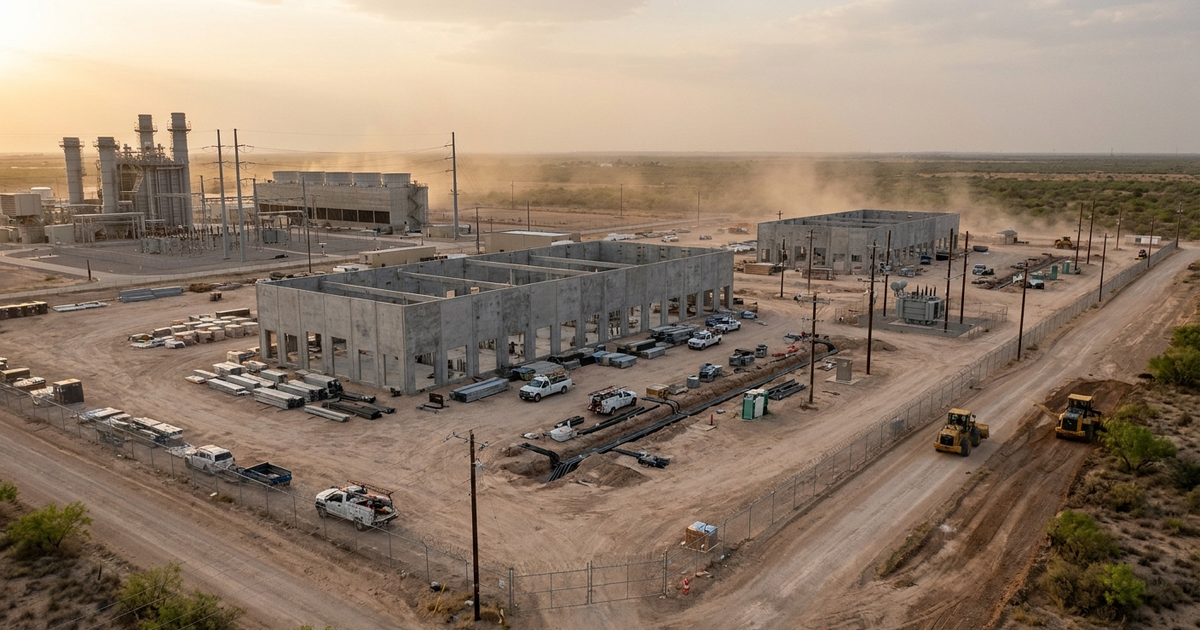
CyrusOne has broken ground on a Freestone County, Texas AI data-center campus tied to a 380 MW plus 380 MW Constellation/Calpine power path.
CyrusOne has moved Freestone County, Texas into the active AI data-center construction watchlist. The public trail is unusually useful for low-voltage contractors because it connects the data-center campus to a specific power site, specific power partners, a construction-start signal, and one named construction partner before the specialty package map is public.
The core fact pattern starts with the February 9, 2026 announcement from CyrusOne, Constellation, and Calpine. Calpine, now a Constellation business unit, signed a 380 MW agreement to connect and serve a new CyrusOne data center adjacent to the Freestone Energy Center in Freestone County. The same announcement describes an exclusive Phase 2 agreement for another 380 MW of power, grid connectivity, and site infrastructure. That puts the full public power framing at 760 MW if both phases move forward.
Then the construction signal tightened. CyrusOne's groundbreaking post says the company broke ground on its newest data-center campus in Freestone County alongside local officials, educators, community leaders, project partners, and residents. The post also thanks Calpine and Rogers-O'Brien Construction as project partners. Baxtel's June 2026 construction-start coverage aligns with that milestone and places the site about 90 miles south of Dallas. For LVN, the most important point is not that every scope is known. It is that the project has crossed from agreement into construction while the electrical, low-voltage, fiber, security, controls, life-safety, and commissioning names are still mostly unnamed in public sources.
| Fact | Source-backed detail | LVN read |
|---|---|---|
| Location | Freestone County / Fairfield area, next to the Freestone Energy Center in Texas. | Track county, city, utility, ERCOT, TDLR/TABS, and permit aliases. |
| Power phase | 380 MW Phase 1 agreement for power, grid connectivity, and site infrastructure. | The power path is central to the construction schedule and commissioning story. |
| Expansion path | Exclusive Phase 2 agreement for another 380 MW at the same site. | The campus could create repeat work across phases, not one isolated building. |
| Construction signal | CyrusOne says it broke ground in Freestone County in early June 2026. | Package awards, inspections, field hiring, and trade partner signals can start surfacing now. |
| Building data | Reviewed public sources do not disclose exact building count, square footage, or completion date. | Use confirmed facts and keep open items open until records name them. |
Why This Project Matters To Low Voltage
This is a power-first hyperscale project. That matters because the low-voltage story on a data-center campus is never just cable pulling inside a finished building. It starts with site access, duct banks, entrances, pathway decisions, telecom rooms, owner standards, grounding, utility coordination, commissioning documentation, and the schedule pressure created by power availability. When a 380 MW first phase is tied to existing generation and grid infrastructure, the low-voltage teams should expect a jobsite where electrical, civil, mechanical, controls, security, IT, and commissioning teams all collide early.
The Baxtel project profile frames CyrusOne Freestone as a two-phase hyperscale campus near Fairfield and repeats the 380 MW plus 380 MW power structure. The profile also ties the campus to the Freestone Energy Center setting. That does not replace owner or permit evidence, but it is useful project context while public building records are still thin. DataCenterMap also lists a CyrusOne Fairfield profile, but the local link check returned a 429 response during this run, so the public article is built around the working primary and accessible project links.
| Company | Source-backed role | What is still unknown |
|---|---|---|
| CyrusOne | Owner, operator, and developer of the Freestone County data-center campus. | Public sources do not yet disclose the full building schedule or tenant details. |
| Constellation Energy | Parent power-company context for the Calpine agreement and Powered Land approach. | Future utility filings and ERCOT signals should clarify interconnection milestones. |
| Calpine LLC | Power, grid-connectivity, and site-infrastructure partner at Freestone Energy Center. | Substation, service, backup, and commissioning partners remain unnamed publicly. |
| Rogers-O'Brien Construction | Named by CyrusOne as a Freestone project partner; company site shows mission-critical experience. | Reviewed sources do not yet define the exact Freestone contract scope or trade packages. |
| Freestone County / Fairfield | Local public-record and community context for the campus. | Permit, inspection, incentive, workforce, and local vendor details need monitoring. |
The Rogers-O'Brien signal deserves careful wording. CyrusOne's public post names Rogers-O'Brien Construction as a project partner, and Rogers-O'Brien's mission-critical portfolio shows relevant data-center experience, including CyrusOne work. That is enough to make Rogers-O'Brien a named construction partner signal for this project. It is not enough to invent the electrical contractor, low-voltage contractor, security integrator, fire alarm vendor, controls integrator, fiber contractor, DAS provider, or commissioning agent. Those roles remain open until a primary source, permit, bid package, subcontractor page, or job posting names them.
Where The Low-Voltage Scope Shows Up
The practical contractor opportunity is concentrated in systems that turn a powered shell into a usable mission-critical facility. On a campus like this, the field work is not just installation. It is sequencing, labeling, testing, documentation, QA, owner-standard compliance, and handoff. The teams that win data-center work tend to be the teams that can keep paperwork, test results, as-builts, pathway changes, and commissioning support clean under schedule pressure.
| Scope area | Practical work | Signals to watch |
|---|---|---|
| Fiber / OSP | Campus entrances, duct banks, diverse routes, MMR handoffs, testing, cleaning, labeling. | Carrier routes, fiber contractor pages, ROW work, vaults, and test documentation roles. |
| Structured cabling | Pathways, tray coordination, copper/fiber support cabling, racks, rooms, and labeling. | Low-voltage bid packages, material staging, QA roles, and standards-driven install notes. |
| Security | Access control, CCTV, perimeter devices, secure-area doors, VMS, and badging interfaces. | Integrator awards, camera/access hardware packages, and site-security job postings. |
| Life safety | Fire alarm interfaces, monitoring, AHJ inspections, suppression coordination, and closeout docs. | Fire alarm permits, inspection movement, and specialty contractor listings. |
| BMS / BAS | Cooling controls, alarms, monitoring, equipment integration, trend logs, and turnover support. | Controls integrator roles, commissioning schedules, and mechanical/electrical handoffs. |
| DAS / networking | Public-safety coverage, facility networks, IT/OT boundaries, and operational connectivity. | DAS design, carrier coordination, network integrator movement, and acceptance testing. |
| Grounding / bonding | Telecom grounding, rack/pathway bonding, equipment-room discipline, and test records. | QA notes, electrical coordination, grounding specs, and commissioning punch lists. |
Sequencing is the quiet reason this project belongs on a low-voltage watchlist now instead of later. In a conventional commercial build, many low-voltage teams can wait until interiors are better defined. In a hyperscale data-center environment, pathway, grounding, security, fire alarm, controls, carrier entrance, and commissioning assumptions can harden much earlier. A late contractor may still win work, but a prepared contractor is watching for civil packages, electrical-room layouts, generator and substation milestones, owner design standards, access-control standards, fiber entrance requirements, and site-specific safety or documentation rules before the bid package becomes obvious.
Prequalification is also part of the opportunity. Large data-center campuses usually filter vendors through insurance, safety history, bonding capacity, data-center references, manpower planning, tool control, change-management discipline, and turnover documentation. Small and mid-size LV contractors do not need to pretend they are the prime contractor. They need to know which scopes they can perform cleanly, which larger electrical or technology contractors they can support, and which proof points make them credible before the project team is already overloaded.
Jobs, Skills, And The Contractor Angle
CyrusOne and Constellation frame the Freestone development as a jobs and economic-growth project. CyrusOne's groundbreaking post also references education, workforce development, and community programs. The reviewed public sources do not provide a construction headcount or trade-by-trade hiring list, so the right public stance is specific but conservative: this is a major construction-stage data-center campus where the job demand will likely reward data-center-ready field discipline, but the exact employers and package owners still need to surface.
For technicians and small contractors, the useful preparation path is practical. Fiber techs should be ready for cleaning, inspection, OTDR/power testing, labeling, and documentation. Security and access-control teams should be ready for site access rules, secure areas, commissioning evidence, and owner-standard device naming. Fire alarm and BAS/BMS teams should expect AHJ, commissioning, electrical, mechanical, and controls coordination. Anyone trying to enter the project orbit should keep basics like BICSI Installer 2 Optical Fiber, BICSI copper training, FOA workforce resources, and OSHA outreach training in view. Certifications do not replace relationships, insurance, bonding, prequalification, or site experience, but they help make a crew legible to mission-critical buyers.
The near-term watchlist is straightforward: CyrusOne, Rogers-O'Brien Construction, Constellation, Calpine, Freestone County, Fairfield, ERCOT, Texas PUC, TDLR/TABS, and local permit records. Search aliases should include CyrusOne Freestone, CyrusOne Fairfield, Freestone Energy Center data center, Freestone County data center, DFW Fairfield, Powered Land Capabilities, Calpine Freestone, Constellation Freestone, and Rogers-O'Brien CyrusOne Freestone. Keep it distinct from CyrusOne Thad Hill in Bosque County, CyrusOne SAT San Antonio, Texas Research Park, Compass Red Oak, Rowan Temple, Hut 8 Beacon Point, Google Meitner, and other Texas power-adjacent data-center projects.
LVN Signal is tracking this project because the opportunity is still forming. The confirmed story is already strong: CyrusOne has a Freestone County campus under construction, the power structure is public, Calpine and Constellation are named, Rogers-O'Brien is a named project partner, and the low-voltage package layer is not yet public. That is exactly the window where contractors should be watching, preparing, and building the relationship map before the public record fills in.
Join 35,000+ Low Voltage Pros
Get weekly permit updates, tool deals, job opportunities, and industry news. No spam, unsubscribe anytime.