
Join Low Voltage Nation — Find project opportunities and showcase your company to thousands of industry professionals
A new Quinlan filing details a $1.3 billion building scope at Core Scientific’s Hunt campus. Primary records clarify AMD capacity, power plans and prospective low-voltage work.
Core Scientific's Hunt County campus has a new building-level filing that helps contractors understand the scale of the work taking shape near Quinlan, Texas. A November 13 registration describes a large data-center shell and site improvements. Separate owner disclosures establish the campus acquisition, reported construction activity, AMD lease allocation and expected delivery sequence. Together, these sources provide a useful starting point for firms investigating fiber, controls, security and commissioning opportunities.
The documents cover different boundaries. The registration describes a building; the power and commercial disclosures describe the wider campus. For a contractor, the practical task is to identify the buyer, the package and the acceptance requirements before turning these figures into a staffing plan or a bid. LVN reviewed the primary records on November 18, 2026.
What the new Hunt building filing establishes
The Texas Department of Licensing and Regulation record TABS2027005763 lists 4852 County Road 3507, Quinlan, with an estimated cost of $1.3 billion. Its scope covers a 341,326-square-foot core-and-shell building plus site and infrastructure improvements. Telios Quinlan One LLC is the registered owner, and Gensler is the design firm. The tenant field remains unassigned.
| Item | Filed detail | Qualification |
|---|---|---|
| Location | Quinlan, Hunt County | 4852 CR 3507 |
| Building | 341,326 square feet | Core, shell and site work |
| Estimate | $1.3 billion | Registered scope |
| Schedule | Nov. 2026–Sept. 2028 | Projected dates |
| Status | Project Registered | Accessibility filing |
The filed dates are November 24, 2026 through September 4, 2028. This architectural-barriers registration does not establish a building permit, a contract award, actual mobilization or a financing close. No building-specific megawatt allocation is established. Treating the estimate as the value of an available subcontract would go beyond the evidence.
Campus construction and the building schedule
Core Scientific's September 10 disclosure reported that construction had begun at Hunt and that long-lead equipment had been ordered. That supports an owner-reported campus construction stage. It does not identify the precise work completed at the newly registered shell. Actual start day, vertical progress and building-specific mobilization remain unverified.
For prospective bidders, this distinction changes the first conversation. A campus may have utility, civil and enabling work progressing while a particular building still has its own design, procurement and fit-out milestones. Ask which area the requested work serves and which drawings control it. A general statement that a campus is under construction leaves those commercial boundaries open.
Ownership and the organizations named so far
The May acquisition disclosure connects the registered owner to Core Scientific. It reports the May 5 purchase of Telios Quinlan One, which owned approximately 260 acres and a related electric-service agreement with Farmers Electric Cooperative. The approximately $232.5 million purchase price and $33 million utility collateral are separate financial facts. Adding them to the building estimate would not produce a verified campus budget.
| Organization | Supported role | Evidence |
|---|---|---|
| Core Scientific | Parent owner/operator | Issuer filings |
| Telios Quinlan One | Registered owner | TDLR and acquisition |
| Gensler | Building design firm | TDLR registration |
| AMD | Campus lease counterparty | November presentation |
| Farmers Electric Cooperative | Utility counterparty | Acquisition disclosure |
Gensler's critical-facilities practice provides background on the design organization. Its other project photographs should retain their original project identities. They provide no evidence of Hunt's appearance or progress. The same care applies to corporate images from Core Scientific.
No general contractor, electrical contractor, low-voltage integrator or commissioning firm was confidently identified in the inspected primary records. Those roles remain open research questions. A designer's name helps establish the project team, but it does not establish who controls subcontract procurement. Firms approaching the opportunity should seek a verified procurement contact and written package scope before investing in an estimate.
Power, leased capacity and reserved capacity
The September-quarter financial report describes approximately 430 MW of expected gross utility power capacity and an approved Hunt interconnection ramp schedule. The earlier September disclosure used 431 MW in discussing conditional Batch Zero grid classification. These are dated descriptions of the utility position; neither establishes that the campus is energized at that capacity.
Core Scientific's November 5 presentation, slides 4–6, assigns approximately 110 MW of leased power to Hunt under an AMD direct lease. A separate slide shows approximately 192 MW of Hunt leasable capacity under AMD reservation. The presentation places initial Hunt delivery in the first half of 2028. Its early-2027 headline concerns the first deliveries in a multisite program.
The quarterly report says the AMD leases had not commenced at September 30 and that the broader reservation arrangement is not a binding commitment to lease. The campus figures therefore need their original labels: gross utility capacity, leased capacity and reserved capacity. No source reviewed allocates the Hunt lease to the particular shell in the new registration.
For estimating, the missing bridge is the design package. A campus megawatt figure cannot tell an installer how many fiber strands, security devices, control points or rack connections are in scope. It also cannot identify which phase pays for shared infrastructure. Contractors need the drawings, responsibility matrix and acceptance criteria attached to the actual request.
Where low-voltage work may develop
The following is LVN's analysis of prospective interfaces in a new AI data-center development. It identifies questions worth taking into qualification and design discussions. Hunt-specific quantities, equipment selections, specialty awards and open bid packages remain unverified.
| Work area | Interface to investigate | Question for the buyer |
|---|---|---|
| Fiber and OSP | Entrances and campus routes | Who owns route acceptance? |
| Structured cabling | Pathways and tenant handoff | Where does shell scope end? |
| Security | Doors, cameras and networks | Who integrates the systems? |
| BMS and EPMS | Controls and monitoring | Who owns points and protocols? |
| Fire and wireless | Life-safety interfaces | What requirements are approved? |
| Commissioning | Tests and turnover records | Who witnesses acceptance? |
Fiber and outside-plant firms can begin by asking about campus entrances, duct-bank routes, handholes, building penetrations and route diversity. The commercial boundary matters as much as the route drawing. Establish who supplies conduit, installs cable, performs splicing, tests the completed link and owns restoration. A route crossing civil, electrical and telecom packages can create scope gaps if each estimate assumes another contractor will finish the handoff.
Structured-cabling teams should ask how the shell connects to later tenant work. Pathways, telecom spaces, bonding provisions and labeling conventions deserve review before installation. Procurement may separate base-building infrastructure from tenant equipment and cabling. The useful qualification question is whether the buyer wants a complete tested system, an installation labor package or a defined portion of a larger deployment.
Controls specialists can investigate the boundary between building-management systems, electrical-power monitoring and equipment controls. Ask for the point list, protocol requirements, network responsibilities and alarm ownership. A controls proposal becomes easier to evaluate when it identifies who maps points, provides gateways, documents trends and resolves failed functional tests. These are prospective coordination questions for Hunt, with the actual architecture still unverified.
Security work requires similarly clear handoffs among door hardware, access-control devices, camera coverage, network connectivity and the operating team. Integrators should establish the acceptance authority and the interface with construction access procedures. Fire-alarm interfaces and any distributed-antenna or emergency-responder coverage work need confirmed requirements before they enter an estimate. The public sources do not specify these packages or establish that each system will be separately procured.
Jobs, trades and preparation
No Hunt-specific construction headcount, permanent-job forecast or current vacancy count was verified. The work areas above describe potential trade relevance. They should not be read as a hiring announcement. A technician considering this sector can prepare a capability record while checking actual openings with the employer named in a verified posting.
The Fiber Optic Association's workforce resources offer background on fiber training and certification pathways. Useful areas of preparation include connector inspection and cleaning, test setup, trace interpretation, labeling and documentation. For an employer, a sample turnover package can demonstrate how a crew records work: link identifiers, test results, instrument details, deficiencies and the final acceptance record. Hunt-specific certification requirements have not been established.
OSHA Outreach provides general construction safety education through its 10-hour and 30-hour programs. OSHA describes these as course-completion programs, not certifications, and they do not replace required training under specific standards. Prospective workers still need to verify the employer's and site's onboarding requirements. Lift access, task training and other qualifications should be checked against the actual assignment.
For subcontractors, useful preparation includes a concise list of comparable work, crew capabilities, test equipment, supervision and documentation practices. Keep the proposal tied to the scope being requested. A strong qualification package explains how the firm handles interfaces and defects, who reviews results and how a completed system reaches acceptance. Those details are more actionable than a generic claim of data-center experience.
The next milestones to watch
The next useful evidence would connect named procurement roles to a defined building or campus package. Watch for an identified general contractor, confirmed specialty awards, issued procurement documents, building-specific construction updates and changes to the delivery forecast. For power, distinguish the ramp schedule from actual energization. For commercial demand, distinguish additional signed leases from capacity held under reservation.
A practical first inquiry can ask which entity buys the work, what phase it serves, which documents define the boundary and when qualification is required. That produces a clearer next step for a local fiber, controls or security firm. It also helps vendors avoid treating a public construction estimate as an open invitation to bid.
Follow the project through LVN Signal and use the linked primary records to evaluate the opportunity. The Hunt campus has documented ownership, a new building registration and owner-reported construction activity. The trade opportunity becomes actionable as the buyers, packages and acceptance requirements are established.
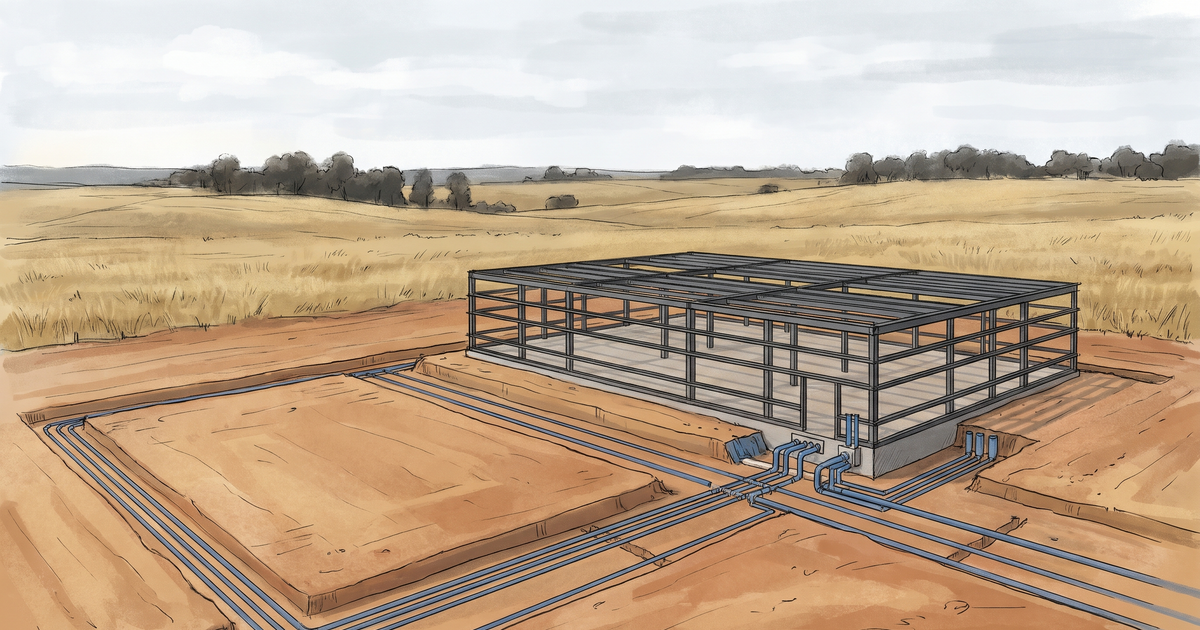
Artwork is an AI-generated editorial concept. It does not depict the verified Hunt design, installed equipment or current construction progress.
Join 35,000+ Low Voltage Pros
Get weekly permit updates, tool deals, job opportunities, and industry news. No spam, unsubscribe anytime.